• HOME
  • NEWS
  • EXPLORE
    • CAREER
      • Companies
      • Jobs
    • EVENTS
    • iGEM
      • News
      • Team
    • PHOTOS
    • VIDEO
    • WIKI
  • BLOG
  • COMMUNITY
    • FACEBOOK
    • INSTAGRAM
    • TWITTER
Sunday, August 16, 2026
BIOENGINEER.ORG
No Result
View All Result
  • Login
  • HOME
  • NEWS
  • EXPLORE
    • CAREER
      • Companies
      • Jobs
        • Lecturer
        • PhD Studentship
        • Postdoc
        • Research Assistant
    • EVENTS
    • iGEM
      • News
      • Team
    • PHOTOS
    • VIDEO
    • WIKI
  • BLOG
  • COMMUNITY
    • FACEBOOK
    • INSTAGRAM
    • TWITTER
  • HOME
  • NEWS
  • EXPLORE
    • CAREER
      • Companies
      • Jobs
        • Lecturer
        • PhD Studentship
        • Postdoc
        • Research Assistant
    • EVENTS
    • iGEM
      • News
      • Team
    • PHOTOS
    • VIDEO
    • WIKI
  • BLOG
  • COMMUNITY
    • FACEBOOK
    • INSTAGRAM
    • TWITTER
No Result
View All Result
Bioengineer.org
No Result
View All Result
Home NEWS Science News

Novel targeted modification strategy improves selectivity of polyamide nanofiltration membranes

Bioengineer by Bioengineer
March 11, 2021
in Science News
Reading Time: 2 mins read
0
IMAGE
Share on FacebookShare on TwitterShare on LinkedinShare on RedditShare on Telegram

IMAGE

Credit: WANG Jingyu

Recently, a research group led by Prof. WAN Yinhua from the Institute of Process Engineering (IPE) of the Chinese Academy of Sciences developed a novel targeted modification strategy to improve the separation selectivity of polyamide NF membranes.

The study was published in Journal of Membrane Science on March 10.

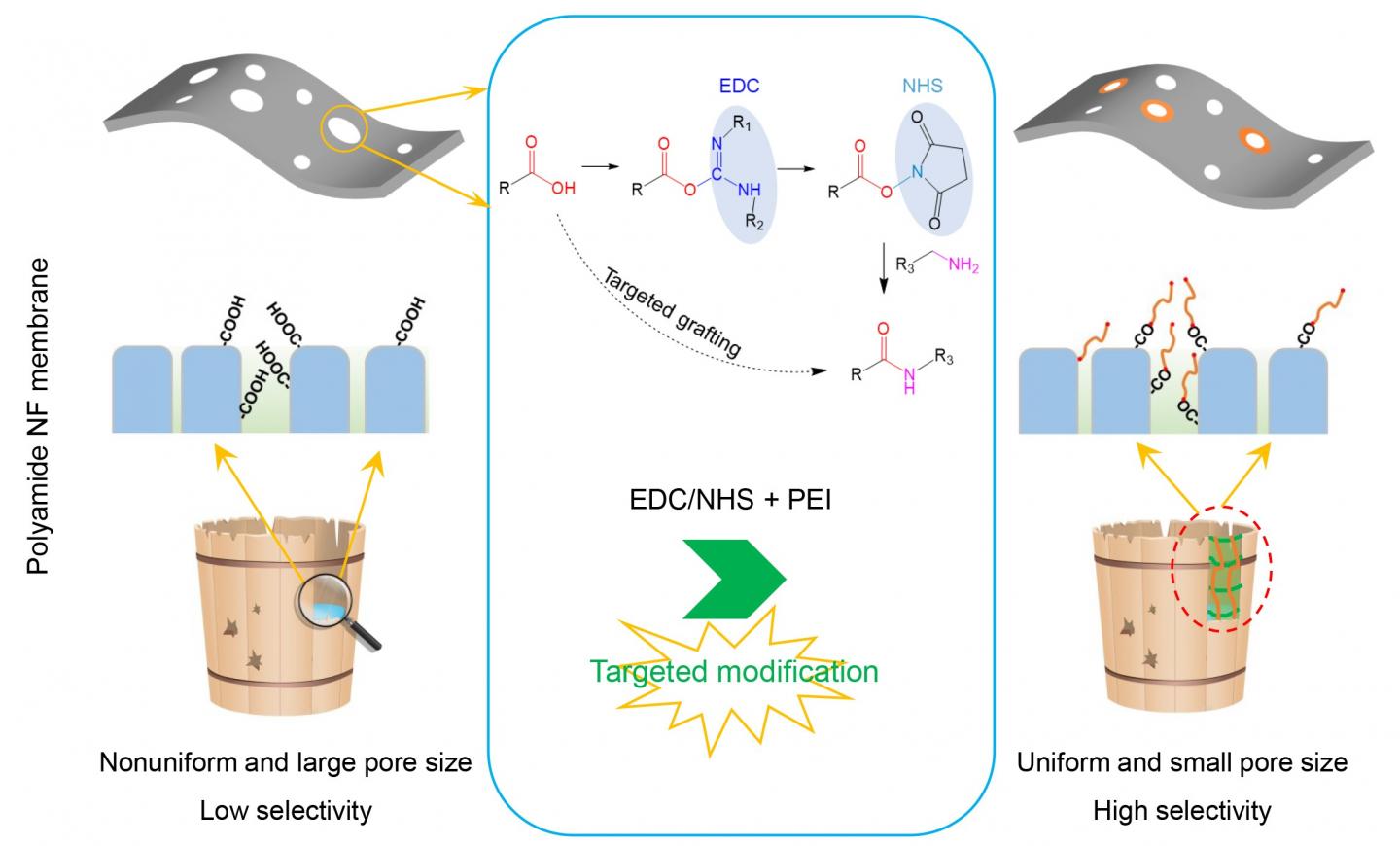
The low selectivity of commercial nanofiltration (NF) membranes to monosaccharides and monovalent salts is mainly due to the nonuniform pore size distribution and strong electronegativity.

Targeted modification can regulate the pore size distribution and electronegativity of polyamide NF membranes, and thus improve the separation selectivity.

In the strategy, carboxyl groups (-COOH) on the surface are activated by N-(3-Dimethylaminopropyl)-N’-ethyl carbodiimide (EDC) and N-Hydroxy succinimide (NHS), and subsequently grafted onto monomer or polymer containing amino groups (-NH2) for more precise separation.

The novel targeted modification strategy reduced the effective mean pore size while maintaining the porosity of the NF membrane, due to pore segmentation. This resulted in a remarkable improvement in glucose/fructose rejection (from 67.96% to 84.14%) and separation factor (from 2.20 to 6.78), with only a 4.70% permeability loss.

“The outcome of this work not only improves the separation efficiency of small organic and inorganic salts by NF, but also provides a new perspective in regulating pore size distribution and surface charge of NF membranes for precisely separating small molecules,” said Prof. LUO Jianquan from IPE, the corresponding author of the study.

The modified membrane also maintained separation performance in crossflow filtration and after alkaline cleaning, which outperformed the pristine NF membrane and those modified by uniform coating and simple physical adsorption.

###

Media Contact
LI Xiangyu
[email protected]

Related Journal Article

http://dx.doi.org/10.1016/j.memsci.2021.119250

Tags: Atomic/Molecular/Particle PhysicsChemistry/Physics/Materials SciencesIndustrial Engineering/ChemistryMaterials
Share12Tweet8Share2ShareShareShare2

Related Posts

KAIST develops semiconductor neuron that harnesses noise to selectively process signals

KAIST develops semiconductor neuron that harnesses noise to selectively process signals

August 16, 2026
Imagining natural and extra robotic thumbs together strengthens kinesthetic sensorimotor networks

Imagining natural and extra robotic thumbs together strengthens kinesthetic sensorimotor networks

August 16, 2026

PARP1 Drives Neuropathic Pain Through GPX4-Dependent Ferroptosis in Injured Mice’s Sensory Neurons

August 15, 2026

Strubbelig–NHL3 Receptor Complex Helps Arabidopsis Respond to Cellulose Deficiency

August 15, 2026
Please login to join discussion

POPULAR NEWS

  • KAIST develops semiconductor neuron that harnesses noise to selectively process signals

    29 shares
    Share 12 Tweet 7
  • Imagining natural and extra robotic thumbs together strengthens kinesthetic sensorimotor networks

    29 shares
    Share 12 Tweet 7
  • PARP1 Drives Neuropathic Pain Through GPX4-Dependent Ferroptosis in Injured Mice’s Sensory Neurons

    29 shares
    Share 12 Tweet 7
  • Strubbelig–NHL3 Receptor Complex Helps Arabidopsis Respond to Cellulose Deficiency

    29 shares
    Share 12 Tweet 7

About

We bring you the latest biotechnology news from best research centers and universities around the world. Check our website.

Follow us

Recent News

KAIST develops semiconductor neuron that harnesses noise to selectively process signals

Imagining natural and extra robotic thumbs together strengthens kinesthetic sensorimotor networks

PARP1 Drives Neuropathic Pain Through GPX4-Dependent Ferroptosis in Injured Mice’s Sensory Neurons

Subscribe to Blog via Email

Success! An email was just sent to confirm your subscription. Please find the email now and click 'Confirm' to start subscribing.

Join 85 other subscribers
  • Contact Us

Bioengineer.org © Copyright 2023 All Rights Reserved.

Welcome Back!

Login to your account below

Forgotten Password?

Retrieve your password

Please enter your username or email address to reset your password.

Log In
No Result
View All Result
  • Homepages
    • Home Page 1
    • Home Page 2
  • News
  • National
  • Business
  • Health
  • Lifestyle
  • Science

Bioengineer.org © Copyright 2023 All Rights Reserved.