• HOME
  • NEWS
  • EXPLORE
    • CAREER
      • Companies
      • Jobs
    • EVENTS
    • iGEM
      • News
      • Team
    • PHOTOS
    • VIDEO
    • WIKI
  • BLOG
  • COMMUNITY
    • FACEBOOK
    • INSTAGRAM
    • TWITTER
Tuesday, December 30, 2025
BIOENGINEER.ORG
No Result
View All Result
  • Login
  • HOME
  • NEWS
  • EXPLORE
    • CAREER
      • Companies
      • Jobs
        • Lecturer
        • PhD Studentship
        • Postdoc
        • Research Assistant
    • EVENTS
    • iGEM
      • News
      • Team
    • PHOTOS
    • VIDEO
    • WIKI
  • BLOG
  • COMMUNITY
    • FACEBOOK
    • INSTAGRAM
    • TWITTER
  • HOME
  • NEWS
  • EXPLORE
    • CAREER
      • Companies
      • Jobs
        • Lecturer
        • PhD Studentship
        • Postdoc
        • Research Assistant
    • EVENTS
    • iGEM
      • News
      • Team
    • PHOTOS
    • VIDEO
    • WIKI
  • BLOG
  • COMMUNITY
    • FACEBOOK
    • INSTAGRAM
    • TWITTER
No Result
View All Result
Bioengineer.org
No Result
View All Result
Home NEWS Science News Biology

Novel magnetic stirrer speaks to lab equipment

Bioengineer by Bioengineer
August 3, 2020
in Biology
Reading Time: 3 mins read
0
IMAGE
Share on FacebookShare on TwitterShare on LinkedinShare on RedditShare on Telegram

IMAGE

Credit: Credit: WMG, University of Warwick

A current problem for a wide range of chemists is when stirring a solution in the laboratory there is a need to check the properties of the solution and monitor how they change.

In the paper, ‘Monitoring chemistry in situ with the Smart Stirrer –a magnetic stirrer bar with an integrated process monitoring system’ published in the journal ACS Sensors, researchers from the School of Engineering, the Mathematics Institute and WMG at the University of Warwick present their innovative stirrer sensor.

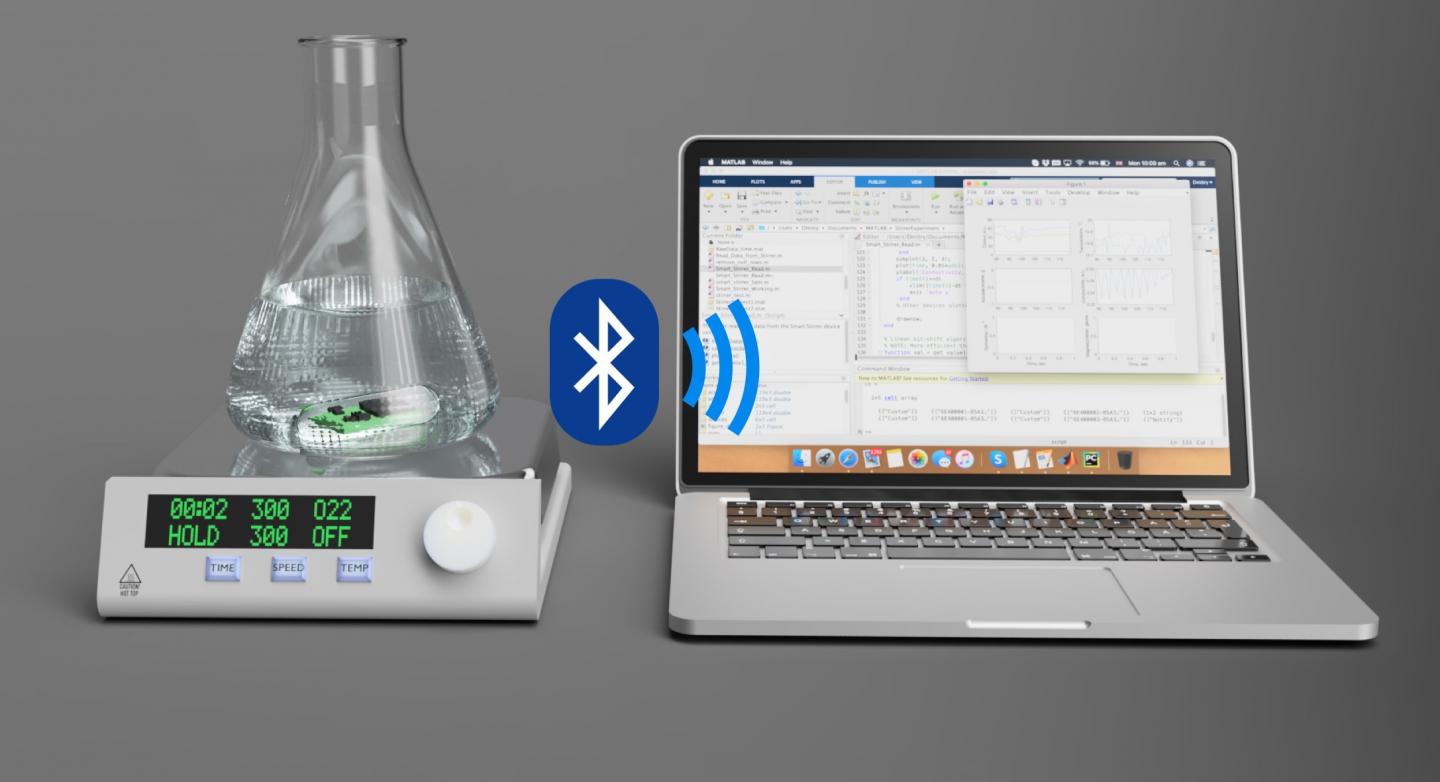
The small device, called “Smart Stirrer”, performed a function of a conventional laboratory stir bar, has an integrated microprocessor and various sensors capable of wireless and autonomous report the conversion of properties of a solution. The advanced sensor stir bar is a capsule shaped magnet encased in plastic.

A beaker filled with a solution is placed on a platform that generates a rotating magnetic field, when the magnetic stirrer is placed in the solution it continuously rotates stirring the liquid.

The Smart Stirrer then monitors:

    – Colour

    – Transparency

    – Conductivity

    – Viscosity

    – Temperature

Results are sent to a computer over Bluetooth, and any changes notify the user wirelessly. Although the idea of using magnetic stir bar with integrated sensors may not be entirely new, this new affordable, multi-sensor and easy programmable stirrer sensor device is first in its kind.

The concept is valuable to Research and Design laboratories and pharmaceutical and chemistry manufacturing industries because it allows wireless monitoring of several parameters of a chemical reaction simultaneously

Dr Dmitry Isakov, from WMG at the University who led the study comments:

“We are still continuing research into the stirrer, the next revision of the stirrer sensor that will be smaller size and with a bit more sophisticated sensors. We are collaborating with several chemists from Warwick University. This will help us to understand their needs and help to improve the device.

“The beauty of the Smart Stirrer is that it can be used everywhere, such as a sealed vessels thus minimising the contamination of the reactor. It may give a push to new discoveries as well. It is easy to integrate the stirrer into the labware family and make it “speak” to other lab equipment.”

Samuel Baldwin, from the Mathematics institute at the University of Warwick worked on the smart stirrer during his WMG summer internship, he comments:

“I have found every stage of development of the Smart Stirrer to be very fulfilling, from circuit design, to manufacturing to finally programming. We have leveraged state-of-the-art technology to build a device with very low power consumption, a broad range of sensor capabilities, and high data-throughput over the Bluetooth Low Energy platform.

“The laboratory of the future is that of automation, reproducibility and safety; our all-in-one Smart Stirrer device eliminates the need for a vast array of individual wired sensors whilst maintaining the control and customisability that one would expect from any piece of advanced laboratory equipment. I look forward to seeing the Smart Stirrer solve laboratory problems and help us understand complex reactions.”

###

NOTES TO EDITORS

High-res images available at:

https://warwick.ac.uk/services/communications/medialibrary/images/july_2020/smartstirrer.jpg

Caption: Demo of how the Smart Stirrer works.

Credit: WMG, University of Warwick

https://warwick.ac.uk/services/communications/medialibrary/images/july_2020/smartstirrercartoon.jpg

Caption: Demo of how the smart stirrer works – Cartoon version

Credit: WMG, University of Warwick

Paper available to view at: https://pubs.acs.org/doi/abs/10.1021/acssensors.0c00720

For further information contact:

Alice Scott

Media Relations Manager – Science

University of Warwick

Tel: +44 (0) 7920 531 221

E-mail: [email protected]

Media Contact
Alice Scott
[email protected]

Related Journal Article

http://dx.doi.org/10.1021/acssensors.0c00720

Tags: BiochemistryBiomedical/Environmental/Chemical EngineeringBiotechnologyChemistry/Physics/Materials SciencesComputer ScienceElectrical Engineering/ElectronicsElectromagneticsIndustrial Engineering/ChemistryPolymer ChemistryTechnology/Engineering/Computer Science
Share12Tweet8Share2ShareShareShare2

Related Posts

Dictyostelium discoideum Adapts Gene Expression to Hypoxia

Dictyostelium discoideum Adapts Gene Expression to Hypoxia

December 30, 2025
Impact of Sex and Gender on Clinical Outcomes: Review

Impact of Sex and Gender on Clinical Outcomes: Review

December 29, 2025

Thousands of Lytic Phages Found in Bacterial Genomes

December 29, 2025

Persistent Virulent Phages Found Across Bacterial Isolates

December 29, 2025
Please login to join discussion

POPULAR NEWS

  • Robotic Waist Tether for Research Into Metabolic Cost of Walking

    NSF funds machine-learning research at UNO and UNL to study energy requirements of walking in older adults

    71 shares
    Share 28 Tweet 18
  • Exploring Audiology Accessibility in Johannesburg, South Africa

    51 shares
    Share 20 Tweet 13
  • Nurses’ Views on Online Learning: Effects on Performance

    70 shares
    Share 28 Tweet 18
  • SARS-CoV-2 Subvariants Affect Outcomes in Elderly Hip Fractures

    44 shares
    Share 18 Tweet 11

About

We bring you the latest biotechnology news from best research centers and universities around the world. Check our website.

Follow us

Recent News

E2F8 Boosts DTL, Driving Endometrial Cancer via MAPK

Brain Imaging Insights in Early-Onset Precocious Puberty

Self-Efficacy and Identity Predict Spiritual Care Competence

Subscribe to Blog via Email

Enter your email address to subscribe to this blog and receive notifications of new posts by email.

Join 71 other subscribers
  • Contact Us

Bioengineer.org © Copyright 2023 All Rights Reserved.

Welcome Back!

Login to your account below

Forgotten Password?

Retrieve your password

Please enter your username or email address to reset your password.

Log In
No Result
View All Result
  • Homepages
    • Home Page 1
    • Home Page 2
  • News
  • National
  • Business
  • Health
  • Lifestyle
  • Science

Bioengineer.org © Copyright 2023 All Rights Reserved.