• HOME
  • NEWS
  • EXPLORE
    • CAREER
      • Companies
      • Jobs
    • EVENTS
    • iGEM
      • News
      • Team
    • PHOTOS
    • VIDEO
    • WIKI
  • BLOG
  • COMMUNITY
    • FACEBOOK
    • INSTAGRAM
    • TWITTER
Thursday, May 14, 2026
BIOENGINEER.ORG
No Result
View All Result
  • Login
  • HOME
  • NEWS
  • EXPLORE
    • CAREER
      • Companies
      • Jobs
        • Lecturer
        • PhD Studentship
        • Postdoc
        • Research Assistant
    • EVENTS
    • iGEM
      • News
      • Team
    • PHOTOS
    • VIDEO
    • WIKI
  • BLOG
  • COMMUNITY
    • FACEBOOK
    • INSTAGRAM
    • TWITTER
  • HOME
  • NEWS
  • EXPLORE
    • CAREER
      • Companies
      • Jobs
        • Lecturer
        • PhD Studentship
        • Postdoc
        • Research Assistant
    • EVENTS
    • iGEM
      • News
      • Team
    • PHOTOS
    • VIDEO
    • WIKI
  • BLOG
  • COMMUNITY
    • FACEBOOK
    • INSTAGRAM
    • TWITTER
No Result
View All Result
Bioengineer.org
No Result
View All Result
Home NEWS Science News Chemistry

Novel glass materials made from organic and inorganic components

Bioengineer by Bioengineer
November 16, 2020
in Chemistry
Reading Time: 3 mins read
0
IMAGE
Share on FacebookShare on TwitterShare on LinkedinShare on RedditShare on Telegram

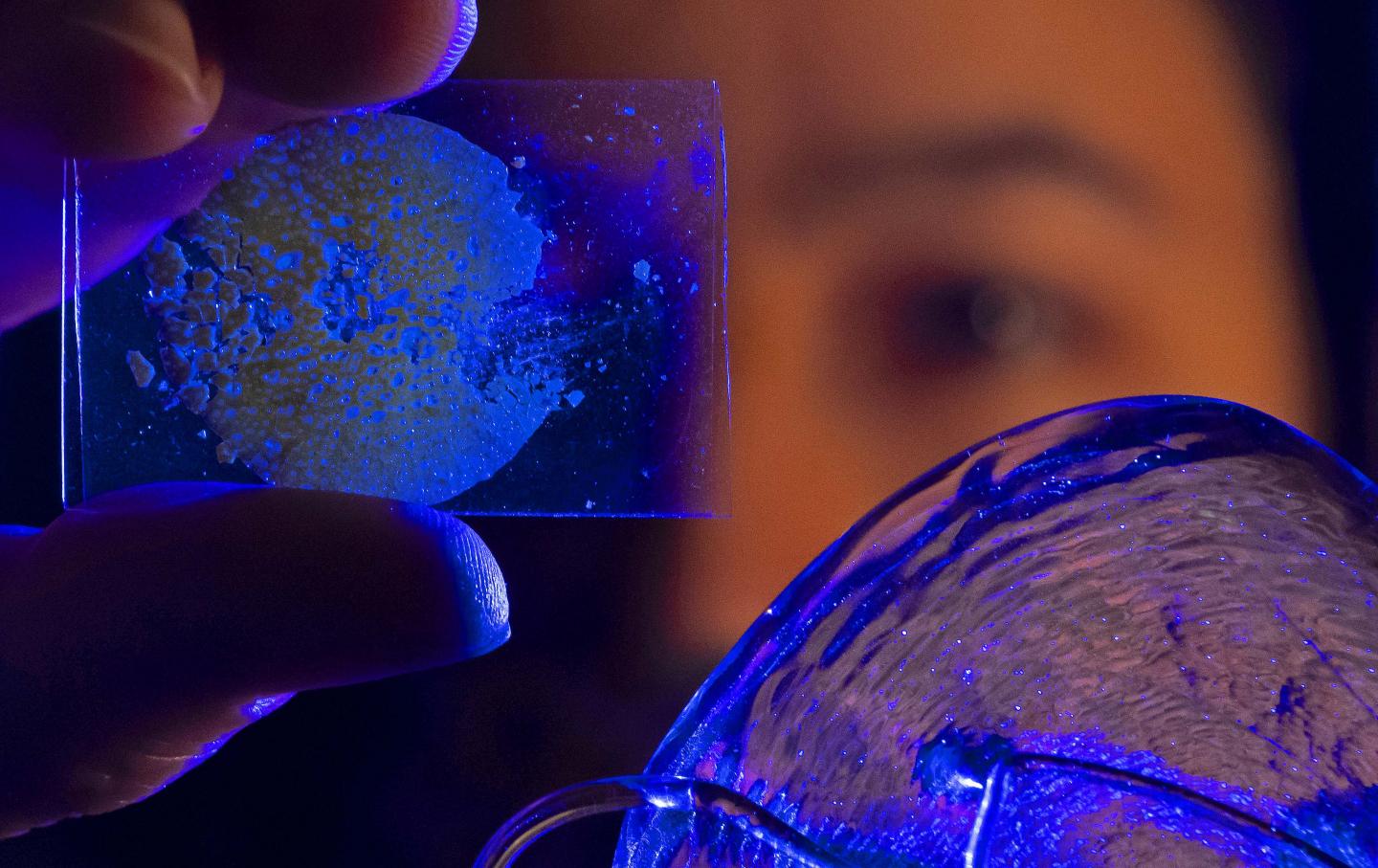
Researchers from Jena and Cambridge develop glass materials with novel combinations of properties
IMAGE

Credit: Image: Jens Meyer/University of Jena

Cambridge/Jena (16.11.2020) Linkages between organic and inorganic materials are a common phenomenon in nature, e.g., in the construction of bones and skeletal structures. They often enable combinations of properties that could not be achieved with just one type of material. In technological material development, however, these so-called hybrid materials still represent a major challenge today.

A new class of hybrid glass materials

Researchers from the Universities of Jena (Germany) and Cambridge (GB) have now succeeded in creating a new class of hybrid glass materials that combine organic and inorganic components. To do this, the scientists use special material combinations in which chemical bonds between organometallic and inorganic glasses can be generated. They included materials composed of organometallic networks – so-called metal-organic frameworks (MOFs) – which have recently been experiencing rapidly increasing research interest. This is primarily because their framework structures can be created in a targeted manner, from the length scale of individual molecules up to a few nanometers. This achieves a control of porosity which can be adapted to a large number of applications, both in terms of the size of the pores and their permeability, and in terms of the chemical properties prevailing on the pore surfaces. For example, separating membranes or storage devices for gases and liquids, supports for catalysts or new types of components for electrical energy storage devices can be designed.

“The chemical design of MOF materials follows a modular principle, according to which inorganic nodes are connected to one another via organic molecules to form a three-dimensional network. This results in an almost infinite variety of possible structures. A few of these structures can be converted into a glassy state by heat treatment. While crystalline MOF materials are typically synthesized in powder form, the liquid and glass states open up a wide range of processing options and potential shapes”, explains Louis Longley from the University of Cambridge, UK.

Best of both worlds combined

“The combination of such MOF-derived glasses with classic inorganic glass materials could make it possible to combine the best of both worlds,” says Courtney Calahoo, a senior scientist at the Chair of Glass Chemistry at Friedrich Schiller University Jena, Germany. For example, composite glasses of this kind could lead to significantly improved mechanical properties by combining the impact and fracture toughness of plastics with the high hardness and rigidity of inorganic glasses. The decisive factor in ensuring that the materials involved are not simply mixed with one another is the creation of a contact area within which chemical bonds can form between the organometallic network and conventional glass. “Only in this way can really new properties be obtained, for example in electrical conductivity or mechanical resistance,” explains Lothar Wondraczek, Professor of Glass Chemistry in Jena.

###

Media Contact
Prof. Dr-Ing. Lothar Wondraczek
[email protected]

Original Source

https://www.uni-jena.de/en/201116_Hybridglas

Related Journal Article

http://dx.doi.org/10.1038/s41467-020-19598-9

Tags: Chemistry/Physics/Materials SciencesMaterials
Share12Tweet8Share2ShareShareShare2

Related Posts

Researchers Develop High-Efficiency Hydrogen Separation Membranes Using Innovative ‘Mortar-and-Brick’ Design — Chemistry

Researchers Develop High-Efficiency Hydrogen Separation Membranes Using Innovative ‘Mortar-and-Brick’ Design

May 13, 2026
Green Electrosynthesis Paves the Way for Direct Amines Production from Atmospheric Nitrogen — Chemistry

Green Electrosynthesis Paves the Way for Direct Amines Production from Atmospheric Nitrogen

May 13, 2026

Decoding Life’s Chemistry: A Revolutionary Search Engine from Molecules to Meaning

May 13, 2026

How Olympic Weightlifting Harnesses the Barbell’s ‘Whip’ for Peak Performance #ASA190

May 13, 2026
Please login to join discussion

POPULAR NEWS

  • Research Indicates Potential Connection Between Prenatal Medication Exposure and Elevated Autism Risk

    842 shares
    Share 337 Tweet 211
  • New Study Reveals Plants Can Detect the Sound of Rain

    729 shares
    Share 291 Tweet 182
  • Salmonella Haem Blocks Macrophages, Boosts Infection

    62 shares
    Share 25 Tweet 16
  • Breastmilk Balances E. coli and Beneficial Bacteria in Infant Gut Microbiomes

    57 shares
    Share 23 Tweet 14

About

We bring you the latest biotechnology news from best research centers and universities around the world. Check our website.

Follow us

Recent News

ALS Progresses Through a Domino-Like Chain Reaction Initiated in Nerve Cells

Liquid Metal Nano-Gyroid Enables Ultra-Resilient Electronics

Intense Precipitation Reduces Terrestrial Water Storage

Subscribe to Blog via Email

Enter your email address to subscribe to this blog and receive notifications of new posts by email.

Join 82 other subscribers
  • Contact Us

Bioengineer.org © Copyright 2023 All Rights Reserved.

Welcome Back!

Login to your account below

Forgotten Password?

Retrieve your password

Please enter your username or email address to reset your password.

Log In
No Result
View All Result
  • Homepages
    • Home Page 1
    • Home Page 2
  • News
  • National
  • Business
  • Health
  • Lifestyle
  • Science

Bioengineer.org © Copyright 2023 All Rights Reserved.