• HOME
  • NEWS
  • EXPLORE
    • CAREER
      • Companies
      • Jobs
    • EVENTS
    • iGEM
      • News
      • Team
    • PHOTOS
    • VIDEO
    • WIKI
  • BLOG
  • COMMUNITY
    • FACEBOOK
    • INSTAGRAM
    • TWITTER
Wednesday, July 1, 2026
BIOENGINEER.ORG
No Result
View All Result
  • Login
  • HOME
  • NEWS
  • EXPLORE
    • CAREER
      • Companies
      • Jobs
        • Lecturer
        • PhD Studentship
        • Postdoc
        • Research Assistant
    • EVENTS
    • iGEM
      • News
      • Team
    • PHOTOS
    • VIDEO
    • WIKI
  • BLOG
  • COMMUNITY
    • FACEBOOK
    • INSTAGRAM
    • TWITTER
  • HOME
  • NEWS
  • EXPLORE
    • CAREER
      • Companies
      • Jobs
        • Lecturer
        • PhD Studentship
        • Postdoc
        • Research Assistant
    • EVENTS
    • iGEM
      • News
      • Team
    • PHOTOS
    • VIDEO
    • WIKI
  • BLOG
  • COMMUNITY
    • FACEBOOK
    • INSTAGRAM
    • TWITTER
No Result
View All Result
Bioengineer.org
No Result
View All Result
Home NEWS Science News Chemistry

Novel Chinese nanogenerator takes cue from electric eels

Bioengineer by Bioengineer
June 24, 2019
in Chemistry
Reading Time: 2 mins read
0
IMAGE
Share on FacebookShare on TwitterShare on LinkedinShare on RedditShare on Telegram

IMAGE

Credit: TAN Puchuan

Researchers from the Beijing Institute of Nanoenergy and Nanosystems and the University of Chinese Academy of Sciences have developed a bionic stretchable nanogenerator (BSNG) that takes inspiration from electric eels.

The scientists hope the new technology will meet the tough demands of wearable equipment applications for stretchability, deformability, biocompatibility, waterproofness and more.

BSNG, which uses technology that mimics the structure of ion channels on the cytomembrane of electric eels’ electrocytes, has two broad applications: Besides providing a potential power source for wearable electronic devices underwater and on land, it can also be used for human motion monitoring due to its excellent flexibility and mechanical responsiveness.

The study was published online in Nature Communications on June 19.

BSNG is based on a mechanically sensitive bionic channel that relies on the stress mismatch between polydimethylsiloxane and silicone. Like its eel counterpart, BSNG can generate an open circuit voltage up to 10 V underwater. It can also generate an open circuit voltage up to 170 V under dry conditions.

BSNG’s bionic structure and material ensure superior stretchability. For example, BSNG maintained stable output performance without attenuation after 50,000 uniaxial tensile tests (tensile rate of 50%).

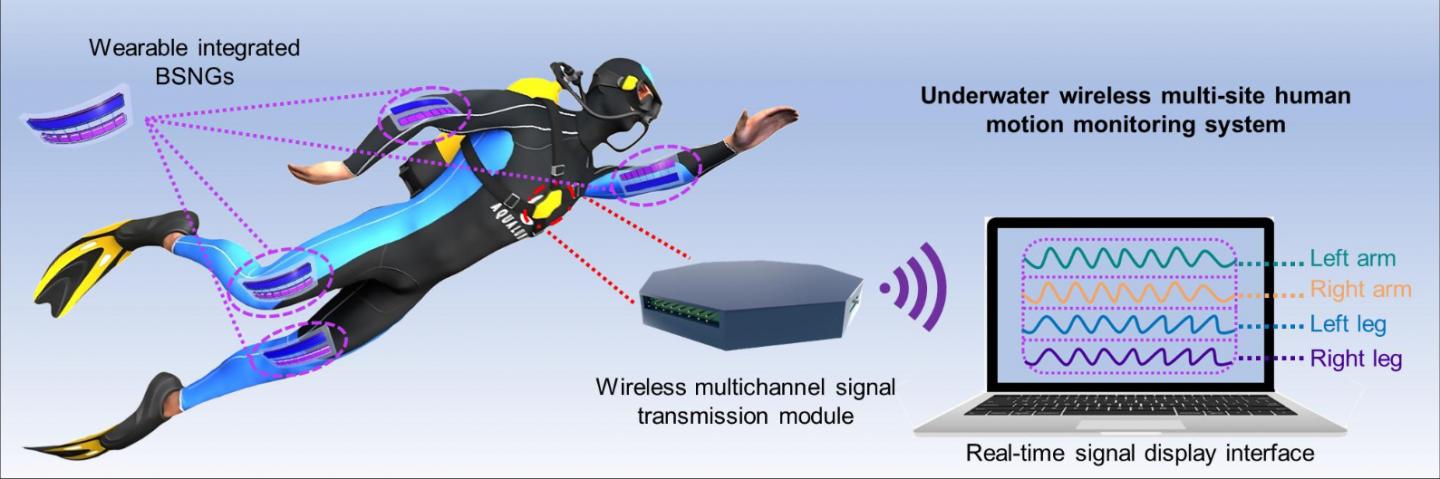
To prove the practicability of the technology, the researchers built an underwater wireless motion monitoring system based on BSNG.

Through this system, the motion signals under different swimming strokes can be synchronously transmitted, displayed and recorded. As for the energy harvester application, researchers achieved underwater rescue based on BSNG.

Wearable integrated BSNGS can collect mechanical energy from human motion and convert it into electrical energy to store in capacitors. In case of emergency, the rescue signal light can be lighted remotely by tapping the alarm trigger in front of the chest.

Due to its excellent properties, BSNG holds great promise for use in electronic skin, soft robots, wearable electronic products and implantable medical devices.

###

Media Contact
TAN Puchuan
[email protected]

Related Journal Article

http://dx.doi.org/10.1038/s41467-019-10433-4

Tags: Chemistry/Physics/Materials SciencesMaterials
Share12Tweet8Share2ShareShareShare2

Related Posts

Applying Physical Pressure Can Double EV Battery Lifespan and Slash Environmental Impact — Chemistry

Applying Physical Pressure Can Double EV Battery Lifespan and Slash Environmental Impact

July 1, 2026
Scientists Capture Ultrafast Chemical Reactions Unfolding in Real Time — Chemistry

Scientists Capture Ultrafast Chemical Reactions Unfolding in Real Time

July 1, 2026

Biochar-Based Materials Offer Promising Solution for Sustainable Uranium Recovery in Nuclear Energy

June 30, 2026

From Cells to Boundaries: Unveiling the Origins of Biological Order

June 30, 2026
Please login to join discussion

POPULAR NEWS

  • Detection of EDCs in Breast Milk and Infant Urine Up to Six Months Highlights Early Exposure Risks

    77 shares
    Share 31 Tweet 19
  • Saying Goodbye to PGY-6: Pediatric Fellowship Realities

    103 shares
    Share 41 Tweet 26
  • New Drug Candidate Developed at McMaster Shows Potential for Treating Brain Cancer

    58 shares
    Share 23 Tweet 15
  • KTU Researchers Explore Ultrasound’s Role in Enhancing Blood Flow Beyond Diagnostics

    53 shares
    Share 21 Tweet 13

About

We bring you the latest biotechnology news from best research centers and universities around the world. Check our website.

Follow us

Recent News

Dexpanthenol Shields Young Rats from Experimental Colitis

Social Marginalization Limits Access to Ontario Home Care

Revolutionary Soft Robotic Heart Paves the Way for Advanced Disease Research and Medical Device Testing

Subscribe to Blog via Email

Enter your email address to subscribe to this blog and receive notifications of new posts by email.

Join 82 other subscribers
  • Contact Us

Bioengineer.org © Copyright 2023 All Rights Reserved.

Welcome Back!

Login to your account below

Forgotten Password?

Retrieve your password

Please enter your username or email address to reset your password.

Log In
No Result
View All Result
  • Homepages
    • Home Page 1
    • Home Page 2
  • News
  • National
  • Business
  • Health
  • Lifestyle
  • Science

Bioengineer.org © Copyright 2023 All Rights Reserved.