• HOME
  • NEWS
  • EXPLORE
    • CAREER
      • Companies
      • Jobs
    • EVENTS
    • iGEM
      • News
      • Team
    • PHOTOS
    • VIDEO
    • WIKI
  • BLOG
  • COMMUNITY
    • FACEBOOK
    • INSTAGRAM
    • TWITTER
Wednesday, May 20, 2026
BIOENGINEER.ORG
No Result
View All Result
  • Login
  • HOME
  • NEWS
  • EXPLORE
    • CAREER
      • Companies
      • Jobs
        • Lecturer
        • PhD Studentship
        • Postdoc
        • Research Assistant
    • EVENTS
    • iGEM
      • News
      • Team
    • PHOTOS
    • VIDEO
    • WIKI
  • BLOG
  • COMMUNITY
    • FACEBOOK
    • INSTAGRAM
    • TWITTER
  • HOME
  • NEWS
  • EXPLORE
    • CAREER
      • Companies
      • Jobs
        • Lecturer
        • PhD Studentship
        • Postdoc
        • Research Assistant
    • EVENTS
    • iGEM
      • News
      • Team
    • PHOTOS
    • VIDEO
    • WIKI
  • BLOG
  • COMMUNITY
    • FACEBOOK
    • INSTAGRAM
    • TWITTER
No Result
View All Result
Bioengineer.org
No Result
View All Result
Home NEWS Bioengineering

Novel bacterial “language” discovered

Bioengineer by Bioengineer
September 19, 2013
in Bioengineering, Science News
Reading Time: 2 mins read
1
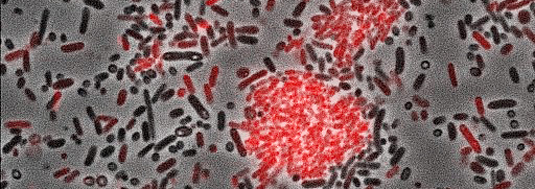
The micrograph shows the bacterium Photorhabdus luminescens. The cells labeled in red produce the aggregation factor. Credit: Ralf Heermann, LMU

The micrograph shows the bacterium Photorhabdus luminescens. The cells labeled in red produce the aggregation factor. Credit: Ralf Heermann, LMU

Share on FacebookShare on TwitterShare on LinkedinShare on RedditShare on Telegram

Researchers have identified a yet unknown bacterial cell-cell communication system.

The micrograph shows the bacterium Photorhabdus luminescens. The cells labeled in red produce the aggregation factor. (Source: Ralf Heermann, LMU)

In nature, bacteria are no mavericks but live in close association with neighboring bacteria. They have evolved specific cell-cell communication systems that allow them to detect the presence of others and even to build up cooperative networks.

LMU microbiologist PD Dr. Ralf Heermann and Professor Helge Bode of the Goethe-University in Frankfurt have just reported the discovery of a previously unknown bacterial “language”. Their findings are detailed in the latest issue of the journal “Nature Chemical Biology”. “Our results demonstrate that bacterial communication is much more complex than has been assumed to date,” Heermann says.

The bacterial communication system that is currently best understood uses N-acylhomoserine lactones (AHLs) as signals. These compounds are made by enzymes that belong to the group of LuxI-family synthases. Transmitting cells secrete the signal and neighboring cells recognize the concentration via a LuxR-type receptor. Signal perception changes the pattern of gene expression in the receiving cells, which results in alterations in their functional properties or behavior. However, many bacteria have LuxR receptors but lack any LuxI homolog, so that they cannot produce AHLs. These receptors are referred to as LuxR solos.

A new class of bacterial signaling molecules

Ralf Heermann and Helge Bode have now discovered a type of ligand that binds to LuxR solos. As model system, they chose the species Photorhabdus luminescens, a pathogenic bacterium that is lethal to insects.

“We have identified a new class of bacterial signaling molecules, which are produced by a previously unknown biochemical route,” explains Helge Bode, Merck Professor of Molecular Biotechnology at Goethe-Universität Frankfurt. It turns out that a LuxR solo of this bacterium responds to compounds called alpha-pyrones, specifically to photopyrones. Furthermore, the researchers have identified the pyrone synthase (PpyS) that catalyzes the biosynthesis of photopyrones. The pyrone-based signaling system allows the bacteria to recognize one another, whereupon they produce a surface factor that causes cell clumping. Heermann and Bode assume that this collective behavior makes the cells less vulnerable to the insect’s innate immune system, and then allows them to kill their victims by the production of various of toxins.“ P. luminescens is a useful model organism, because it is related to many human pathogens, including coliform bacteria such as enterohemorrhagic E. coli (EHEC) and well as plague bacteria,” Heermann points out.

The new findings are also of more general interest because communication systems of bacterial pathogens offer promising targets for antimicrobial drugs. Thus, agents that interfere with bacterial “small talk” could inhibit the production of toxins or prevent the formation of biofilms. Since those drugs would only prevent the expression of pathogenic traits, rather than killing bacteria as antibiotics do, the danger of drug resistances would be enormously diminished.

Story Source:

The above story is reprinted from materials provided by Ludwig Maximilian University of Munich.

Share12Tweet8Share2ShareShareShare2

Related Posts

Mitochondrial l-2-Hydroxyglutarate Signals Cellular Metabolism

May 20, 2026

Tent5a-Mediated Insulin mRNA Polyadenylation Controls Beta Cells

May 20, 2026

How Atlantic Herring Rewired Their Reproductive Strategy to Thrive in Changing Oceans

May 20, 2026

Texas Tech Awarded $4.5 Million Grant to Propel Semiconductor Research Innovations

May 20, 2026
Please login to join discussion

POPULAR NEWS

  • blank

    New Study Reveals Plants Can Detect the Sound of Rain

    733 shares
    Share 292 Tweet 183
  • Research Indicates Potential Connection Between Prenatal Medication Exposure and Elevated Autism Risk

    846 shares
    Share 338 Tweet 212
  • ESMO 2025: mRNA COVID Vaccines Enhance Efficacy of Cancer Immunotherapy

    300 shares
    Share 120 Tweet 75
  • Breastmilk Balances E. coli and Beneficial Bacteria in Infant Gut Microbiomes

    58 shares
    Share 23 Tweet 15

About

We bring you the latest biotechnology news from best research centers and universities around the world. Check our website.

Follow us

Recent News

Mitochondrial l-2-Hydroxyglutarate Signals Cellular Metabolism

Tent5a-Mediated Insulin mRNA Polyadenylation Controls Beta Cells

How Atlantic Herring Rewired Their Reproductive Strategy to Thrive in Changing Oceans

Subscribe to Blog via Email

Enter your email address to subscribe to this blog and receive notifications of new posts by email.

Join 82 other subscribers
  • Contact Us

Bioengineer.org © Copyright 2023 All Rights Reserved.

Welcome Back!

Login to your account below

Forgotten Password?

Retrieve your password

Please enter your username or email address to reset your password.

Log In
No Result
View All Result
  • Homepages
    • Home Page 1
    • Home Page 2
  • News
  • National
  • Business
  • Health
  • Lifestyle
  • Science

Bioengineer.org © Copyright 2023 All Rights Reserved.