• HOME
  • NEWS
  • EXPLORE
    • CAREER
      • Companies
      • Jobs
    • EVENTS
    • iGEM
      • News
      • Team
    • PHOTOS
    • VIDEO
    • WIKI
  • BLOG
  • COMMUNITY
    • FACEBOOK
    • INSTAGRAM
    • TWITTER
Monday, October 5, 2026
BIOENGINEER.ORG
No Result
View All Result
  • Login
  • HOME
  • NEWS
  • EXPLORE
    • CAREER
      • Companies
      • Jobs
        • Lecturer
        • PhD Studentship
        • Postdoc
        • Research Assistant
    • EVENTS
    • iGEM
      • News
      • Team
    • PHOTOS
    • VIDEO
    • WIKI
  • BLOG
  • COMMUNITY
    • FACEBOOK
    • INSTAGRAM
    • TWITTER
  • HOME
  • NEWS
  • EXPLORE
    • CAREER
      • Companies
      • Jobs
        • Lecturer
        • PhD Studentship
        • Postdoc
        • Research Assistant
    • EVENTS
    • iGEM
      • News
      • Team
    • PHOTOS
    • VIDEO
    • WIKI
  • BLOG
  • COMMUNITY
    • FACEBOOK
    • INSTAGRAM
    • TWITTER
No Result
View All Result
Bioengineer.org
No Result
View All Result
Home NEWS Science News Chemistry

NIST scientists get soft on 3D printing

Bioengineer by Bioengineer
September 22, 2020
in Chemistry
Reading Time: 3 mins read
0
IMAGE
Share on FacebookShare on TwitterShare on LinkedinShare on RedditShare on Telegram

New method could jump-start creation of tiny medical devices for the body
IMAGE

Credit: A. Strelcov/NIST

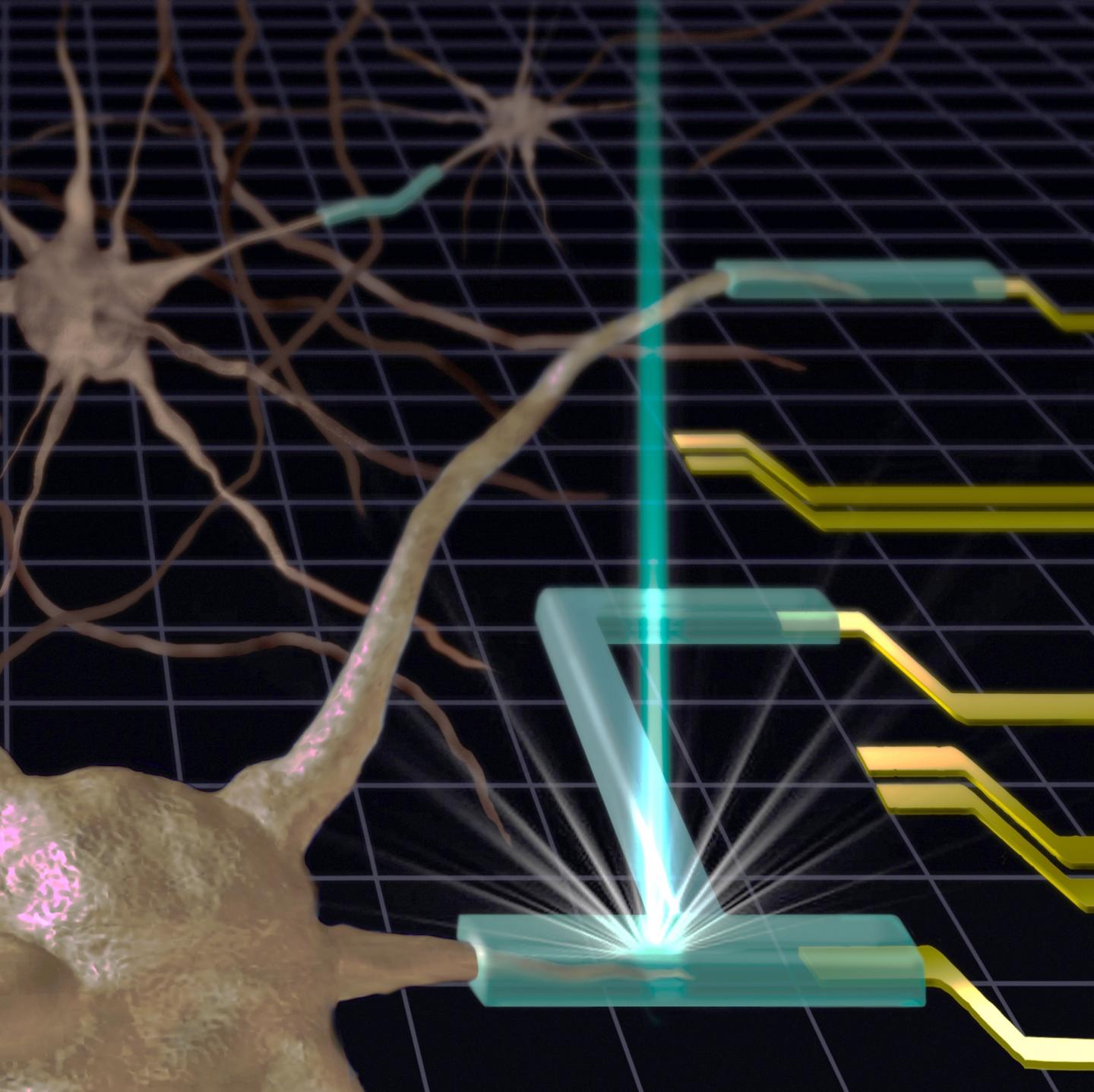
Researchers at the National Institute of Standards and Technology (NIST) have developed a new method of 3D-printing gels and other soft materials. Published in a new paper, it has the potential to create complex structures with nanometer-scale precision. Because many gels are compatible with living cells, the new method could jump-start the production of soft tiny medical devices such as drug delivery systems or flexible electrodes that can be inserted into the human body.

A standard 3D printer makes solid structures by creating sheets of material — typically plastic or rubber — and building them up layer by layer, like a lasagna, until the entire object is created.

Using a 3D printer to fabricate an object made of gel is a “bit more of a delicate cooking process,” said NIST researcher Andrei Kolmakov. In the standard method, the 3D printer chamber is filled with a soup of long-chain polymers — long groups of molecules bonded together — dissolved in water. Then “spices” are added — special molecules that are sensitive to light. When light from the 3D printer activates those special molecules, they stitch together the chains of polymers so that they form a fluffy weblike structure. This scaffolding, still surrounded by liquid water, is the gel.

Typically, modern 3D gel printers have used ultraviolet or visible laser light to initiate formation of the gel scaffolding. However, Kolmakov and his colleagues have focused their attention on a different 3D-printing technique to fabricate gels, using beams of electrons or X-rays. Because these types of radiation have a higher energy, or shorter wavelength, than ultraviolet and visible light, these beams can be more tightly focused and therefore produce gels with finer structural detail. Such detail is exactly what is needed for tissue engineering and many other medical and biological applications. Electrons and X-rays offer a second advantage: They do not require a special set of molecules to initiate the formation of gels.

But at present, the sources of this tightly focused, short-wavelength radiation — scanning electron microscopes and X-ray microscopes — can only operate in a vacuum. That’s a problem because in a vacuum the liquid in each chamber evaporates instead of forming a gel.

Kolmakov and his colleagues at NIST and at the Elettra Sincrotrone Trieste, in Italy, solved the issue and demonstrated 3D gel printing in liquids by placing an ultrathin barrier — a thin sheet of silicon nitride — between the vacuum and the liquid chamber. The thin sheet protects the liquid from evaporating (as it would ordinarily do in vacuum) but allows X-rays and electrons to penetrate into the liquid. The method enabled the team to use the 3D-printing approach to create gels with structures as small as 100 nanometers (nm) — about 1,000 times thinner than a human hair. By refining their method, the researchers expect to imprint structures on the gels as small as 50 nm, the size of a small virus.

Some future structures made with this approach could include flexible injectable electrodes to monitor brain activity, biosensors for virus detection, soft micro-robots, and structures that can emulate and interact with living cells and provide a medium for their growth.

“We’re bringing new tools — electron beams and X-rays operating in liquids — into 3D printing of soft materials,” said Kolmakov. He and his collaborators described their work in an article posted online Sept. 16 in ACS Nano.

###

Media Contact
Ben P. Stein
[email protected]

Original Source

https://www.nist.gov/news-events/news/2020/09/nist-scientists-get-soft-3d-printing

Related Journal Article

http://dx.doi.org/10.1021/acsnano.0c04266

Tags: BiochemistryBiologyBiomechanics/BiophysicsBiomedical/Environmental/Chemical EngineeringBiotechnologyChemistry/Physics/Materials SciencesMedicine/HealthNanotechnology/MicromachinesTechnology/Engineering/Computer Science
Share12Tweet8Share2ShareShareShare2

Related Posts

Electricity Meets Boron: Chemists Forge Elusive Carbon-Carbon Bonds from Simple Acids

Electricity Meets Boron: Chemists Forge Elusive Carbon-Carbon Bonds from Simple Acids

October 5, 2026
AI Meets the Fab: Fraunhofer IAF Brings Intelligent Chip Design and Sovereign III-V Pilot Lines to Stuttgart

AI Meets the Fab: Fraunhofer IAF Brings Intelligent Chip Design and Sovereign III-V Pilot Lines to Stuttgart

October 5, 2026

Chemists Fine-Tune Superplasticizer Recipe to Make Stronger, Flowing Concrete

October 5, 2026

Cabbage Extract Yields Iron Oxide Nanoparticles With Potent Biological Activity

October 5, 2026
Please login to join discussion

POPULAR NEWS

  • Alloys That Shrink Their Own Grains: New PIX Mechanism Refines Metals With Heat Alone

    Alloys That Shrink Their Own Grains: New PIX Mechanism Refines Metals With Heat Alone

    29 shares
    Share 12 Tweet 7
  • Endurance Exercise Reshapes the Liver in Males and Females Through Distinct Molecular Routes

    29 shares
    Share 12 Tweet 7
  • Single Transcription Factor PU.1 Rapidly Converts Fibroblasts into Macrophage-Lineage Cells

    29 shares
    Share 12 Tweet 7
  • New Scale Measures How Ready Nurse Educators Really Are for the AI Era

    29 shares
    Share 12 Tweet 7

About

We bring you the latest biotechnology news from best research centers and universities around the world. Check our website.

Follow us

Recent News

Alloys That Shrink Their Own Grains: New PIX Mechanism Refines Metals With Heat Alone

Endurance Exercise Reshapes the Liver in Males and Females Through Distinct Molecular Routes

Single Transcription Factor PU.1 Rapidly Converts Fibroblasts into Macrophage-Lineage Cells

Subscribe to Blog via Email

Success! An email was just sent to confirm your subscription. Please find the email now and click 'Confirm' to start subscribing.

Join 85 other subscribers
  • Contact Us

Bioengineer.org © Copyright 2023 All Rights Reserved.

Welcome Back!

Login to your account below

Forgotten Password?

Retrieve your password

Please enter your username or email address to reset your password.

Log In
No Result
View All Result
  • Homepages
    • Home Page 1
    • Home Page 2
  • News
  • National
  • Business
  • Health
  • Lifestyle
  • Science

Bioengineer.org © Copyright 2023 All Rights Reserved.