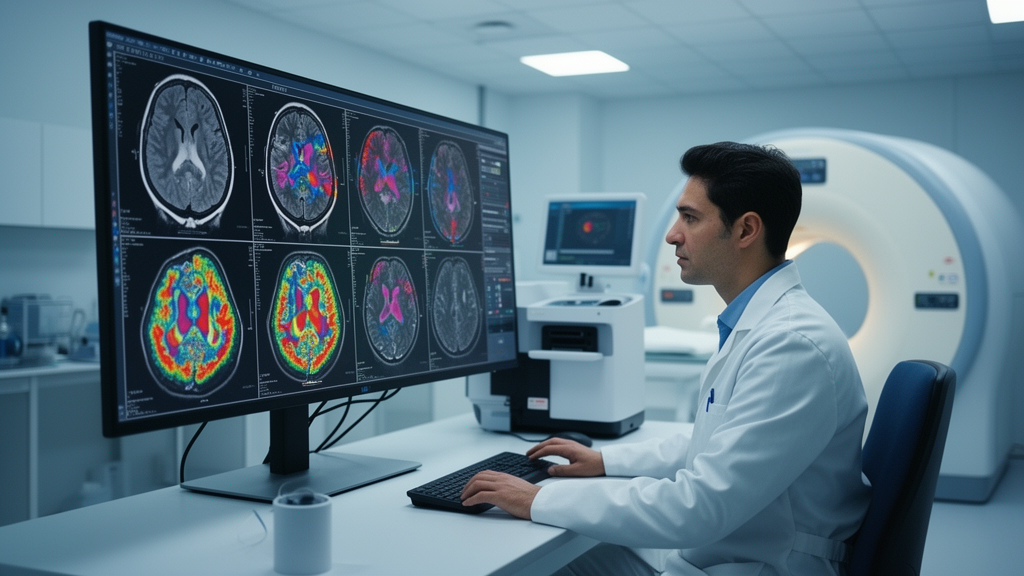
A Lehigh University-led research team has received a four-year, $2.8 million grant from the National Institute of Biomedical Imaging and Bioengineering to develop UniBrain, an artificial-intelligence platform designed to streamline the computational steps used to analyze brain scans. The project aims to unify image preprocessing and downstream brain-network analysis in one system while incorporating complementary information from multiple imaging modalities. Its long-term vision is to let researchers move from raw brain scans to interpretable outputs within a single platform, potentially supporting studies of neurological diseases including Alzheimer’s and Parkinson’s. The grant supports a development program, and the announcement does not report patient outcomes or establish clinical efficacy.
Conventional brain-imaging workflows commonly divide tasks such as image registration, segmentation, feature extraction and disease prediction into separate stages that may require data to be transferred among specialized software packages. The researchers say this process can take weeks or months for large datasets and can be difficult for clinicians and scientists without advanced computational training. UniBrain is intended to address that complexity by combining preprocessing and analysis within a unified framework. According to the team’s preliminary results, a unified deep-learning model made the process more efficient while matching or improving performance relative to conventional workflows. The news release does not provide detailed quantitative comparisons, identify the datasets used or specify the clinical conditions represented in those tests, so the scope of the reported performance remains limited.
The multi-institution project is led by Lifang He, an associate professor of computer science and engineering at Lehigh University. Its principal collaborators are Xiang Li of Massachusetts General Hospital and Harvard Medical School, Carl Yang of Emory University and Liang Zhan of the University of Pittsburgh. The team also includes Lehigh assistant professor Lichao Sun, along with Quanzheng Li, Randy Hirschtick, Daniel Barron, Boadie Dunlop and Ying Ding. According to the university, the collaborators represent fields including artificial intelligence, radiology, neuroscience and bioengineering. Their combined expertise is intended to address brain imaging, data harmonization and clinical validation as UniBrain is designed and developed. He described the project as an effort to create and deploy new AI tools while rethinking the entire neuroimaging analysis process from start to finish, requiring cooperation across several disciplines.
Researchers are also developing an agentic version of UniBrain with a ChatGPT-like interface. In the proposed design, researchers and physicians could upload raw magnetic resonance imaging data, ask questions in plain language and have the system automatically preprocess and analyze the data. The platform would generate interpretable results and reports highlighting imaging biomarkers potentially associated with disease. The investigators say this interaction model could make sophisticated analysis tools more accessible to people without advanced programming expertise and could help researchers identify subtle imaging biomarkers associated with neurological disorders that might otherwise be overlooked. These are proposed capabilities of a system still under development; the announcement describes the intended workflow rather than a completed clinical deployment or independently validated medical decision system. Over the four-year grant period, the team aims to advance toward a unified AI platform that combines raw-scan processing with interpretable research insights, with potential relevance to brain-imaging studies of Alzheimer’s and Parkinson’s disease and other neurological disorders.
Subject of Research: Development of an AI platform for integrated brain-imaging analysis
Article Title: Lehigh-led team developing end-to-end AI platform to streamline brain imaging analysis
Article References: Lehigh-led team developing end-to-end AI platform to streamline brain imaging analysis. Original publication (Bibliographic details unavailable.)
Image Credits: AI Generated
DOI: Not provided
Keywords: brain imaging, neuroimaging, artificial intelligence, MRI analysis, deep learning, NIH grant, Lehigh University, biomedical informatics, Alzheimer’s disease, Parkinson’s disease, Lehigh-led, team
News Source: Cassandra Pierce. (October 25, 2026). NIH-funded project develops unified AI platform for brain imaging analysis. Scienmag.