Osaka University researchers report an air-stable, reusable, non-noble metal catalyst for the environmentally friendly hydrogenation of glucose to sorbitol with high activity
Credit: Osaka University
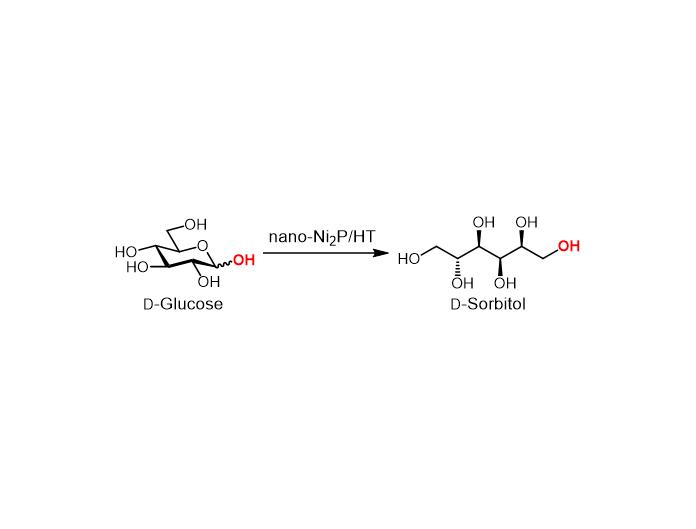
Osaka – Many different catalysts that promote the conversion of glucose to sorbitol have been studied; however, most offer certain properties while requiring compromises on others. Now, researchers from Osaka University have reported a hydrotalcite-supported nickel phosphide nanoparticle catalyst (nano-Ni2P/HT) that ticks all the boxes. Their findings are published in Green Chemistry.
Sorbitol is a versatile molecule that is widely used in the food, cosmetics, and pharmaceuticals industries. There is therefore a pressing need to produce sorbitol in a sustainable, low-cost, and green manner.
The nickel catalysts that are commonly used in the industrial hydrogenation of glucose to sorbitol are unstable in air and require hash reaction conditions. Rare metal alternatives–despite being more efficient–can be expensive and are susceptible to poisoning.
nano-Ni2P/HT is stable in air and has a high activity for the hydrogenation of glucose to sorbitol. In addition, nano-Ni2P/HT produces a particular sorbitol structure, known as D-sorbitol, at more than 99% yield. This high selectivity means that a high-purity product can be obtained.
The nano-Ni2P/HT-catalyzed hydrogenation can be carried out in water. Moreover, the catalyst shows good conversion and selectivity when the temperature is just 25°C–compared with 100-180°C for conventional processes–or when the hydrogen gas pressure is only 1 bar–compared with 50-150 bar. The energy saved by using these mild conditions would lead to greener and more sustainable procedures, as well as reduce operating costs.
“Our nano-Ni2P/HT catalyst outperformed conventional nickel alternatives in terms of both the catalytic activity and the amount of D-sorbitol that was produced, which is very encouraging,” study first author Sho Yamaguchi explains. “nano-Ni2P/HT also gave a better yield of D-sorbitol than a commercially available noble metal catalyst.”
Repeated use of the catalyst showed that nano-Ni2P/HT could be recycled with no significant loss of performance. The reaction could also be carried out at high glucose concentration (50 wt%), which demonstrates the viability of the catalyst for large scale use.
“The continual improvement of industrial catalyst is necessary to achieve sustainable, low-cost production with an environmental conscience,” says study corresponding author Takato Mitsudome. “We believe our catalyst will make an important contribution, not only to D-sorbitol production, but to the development of other processes that support the pharmaceutical, food, and cosmetics industries.”
###
The article, “Air-stable and reusable nickel phosphide nanoparticle catalyst for the highly selective hydrogenation of D-glucose to D-sorbitol,” was published in Green Chemistry at DOI: https:/
About Osaka University
Osaka University was founded in 1931 as one of the seven imperial universities of Japan and is now one of Japan’s leading comprehensive universities with a broad disciplinary spectrum. This strength is coupled with a singular drive for innovation that extends throughout the scientific process, from fundamental research to the creation of applied technology with positive economic impacts. Its commitment to innovation has been recognized in Japan and around the world, being named Japan’s most innovative university in 2015 (Reuters 2015 Top 100) and one of the most innovative institutions in the world in 2017 (Innovative Universities and the Nature Index Innovation 2017). Now, Osaka University is leveraging its role as a Designated National University Corporation selected by the Ministry of Education, Culture, Sports, Science and Technology to contribute to innovation for human welfare, sustainable development of society, and social transformation.
Website: https:/
Media Contact
Saori Obayashi
[email protected]
Original Source
https:/
Related Journal Article
http://dx.