• HOME
  • NEWS
  • EXPLORE
    • CAREER
      • Companies
      • Jobs
    • EVENTS
    • iGEM
      • News
      • Team
    • PHOTOS
    • VIDEO
    • WIKI
  • BLOG
  • COMMUNITY
    • FACEBOOK
    • INSTAGRAM
    • TWITTER
Saturday, June 27, 2026
BIOENGINEER.ORG
No Result
View All Result
  • Login
  • HOME
  • NEWS
  • EXPLORE
    • CAREER
      • Companies
      • Jobs
        • Lecturer
        • PhD Studentship
        • Postdoc
        • Research Assistant
    • EVENTS
    • iGEM
      • News
      • Team
    • PHOTOS
    • VIDEO
    • WIKI
  • BLOG
  • COMMUNITY
    • FACEBOOK
    • INSTAGRAM
    • TWITTER
  • HOME
  • NEWS
  • EXPLORE
    • CAREER
      • Companies
      • Jobs
        • Lecturer
        • PhD Studentship
        • Postdoc
        • Research Assistant
    • EVENTS
    • iGEM
      • News
      • Team
    • PHOTOS
    • VIDEO
    • WIKI
  • BLOG
  • COMMUNITY
    • FACEBOOK
    • INSTAGRAM
    • TWITTER
No Result
View All Result
Bioengineer.org
No Result
View All Result
Home NEWS Science News Chemistry

Next step in simulating the universe

Bioengineer by Bioengineer
December 1, 2020
in Chemistry
Reading Time: 2 mins read
0
IMAGE
Share on FacebookShare on TwitterShare on LinkedinShare on RedditShare on Telegram

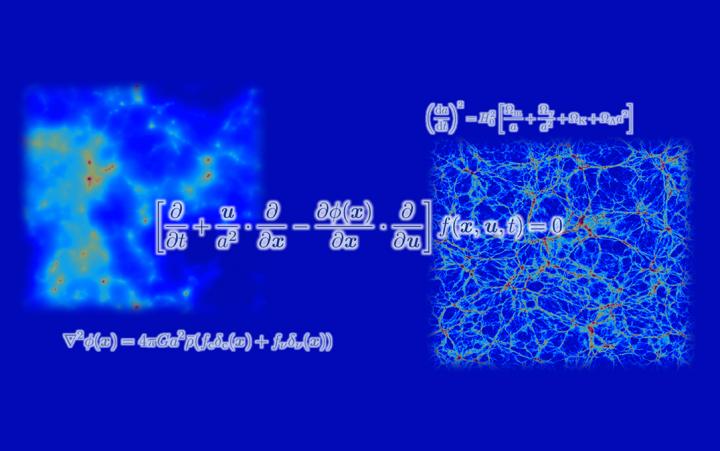
Researchers led by the University of Tsukuba devise a new approach to show how ghost-like neutrinos helped shape the Universe
IMAGE

Credit: University of Tsukuba

Tsukuba, Japan – Computer simulations have struggled to capture the impact of elusive particles called neutrinos on the formation and growth of the large-scale structure of the Universe. But now, a research team from Japan has developed a method that overcomes this hurdle.

In a study published this month in The Astrophysical Journal, researchers led by the University of Tsukuba present simulations that accurately depict the role of neutrinos in the evolution of the Universe.

Why are these simulations important? One key reason is that they can set constraints on a currently unknown quantity: the neutrino mass. If this quantity is set to a particular value in the simulations and the simulation results differ from observations, that value can be ruled out. However, the constraints can be trusted only if the simulations are accurate, which was not guaranteed in previous work. The team behind this latest research aimed to address this limitation.

“Earlier simulations used certain approximations that might not be valid,” says lead author of the study Lecturer Kohji Yoshikawa. “In our work, we avoided these approximations by employing a technique that accurately represents the velocity distribution function of the neutrinos and follows its time evolution.”

To do this, the research team directly solved a system of equations known as the Vlasov-Poisson equations, which describe how particles move in the Universe. They then carried out simulations for different values of the neutrino mass and systemically examined the effects of neutrinos on the large-scale structure of the Universe.

The simulation results demonstrate, for example, that neutrinos suppress the clustering of dark matter–the ‘missing’ mass in the Universe–and in turn galaxies. They also show that neutrino-rich regions are strongly correlated with massive galaxy clusters and that the effective temperature of the neutrinos varies substantially depending on the neutrino mass.

“Overall, our findings suggest that neutrinos considerably affect the large-scale structure formation, and that our simulations provide an accurate account for the important effect of neutrinos,” explains Lecturer Yoshikawa. “It is also reassuring that our new results are consistent with those from entirely different simulation approaches.”

###

This work represents a milestone in simulating the Universe and paves the way for further exploration of how neutrinos influence the formation and growth of the large-scale structure. For instance, the new simulation approach could be used to study the dynamics of neutrinos and unconventional types of dark matter. Ultimately, it might lead to a determination of the neutrino mass.

The article, “Cosmological Vlasov-Poisson Simulations of Structure Formation with Relic Neutrinos: Nonlinear Clustering and the Neutrino Mass,” was published in The Astrophysical Journal at DOI: 10.3847/1538-4357/abbd46

Media Contact
Naoko Yamashina
[email protected]

Related Journal Article

http://dx.doi.org/10.3847/1538-4357/abbd46

Tags: AstronomyAstrophysicsChemistry/Physics/Materials SciencesParticle Physics
Share13Tweet8Share2ShareShareShare2

Related Posts

AI and Physics Collaborate to Design Advanced Hydrogen Storage Materials

June 25, 2026

International Team Including Dresden Scientists Develops Novel Designer Proteins for Advanced Study of Living Tissue

June 25, 2026

New Study Uncovers Key Factors Driving Water Chemistry in Nanoscale Environments

June 25, 2026

Plasma Technology Extends Catalyst Lifespan in Hydrogen Production

June 24, 2026
Please login to join discussion

POPULAR NEWS

  • Saying Goodbye to PGY-6: Pediatric Fellowship Realities

    103 shares
    Share 41 Tweet 26
  • Multi-Hospital Study Reveals Long Covid Burden Is Twice as High as Current Estimates

    92 shares
    Share 36 Tweet 23
  • Detection of EDCs in Breast Milk and Infant Urine Up to Six Months Highlights Early Exposure Risks

    77 shares
    Share 31 Tweet 19
  • New Drug Candidate Developed at McMaster Shows Potential for Treating Brain Cancer

    58 shares
    Share 23 Tweet 15

About

We bring you the latest biotechnology news from best research centers and universities around the world. Check our website.

Follow us

Recent News

Tracking Lanthanide-Labeled Microplastics in Plants

POSTECH Researchers Slash Cost of Reconstituted Cell-Free Systems by 95%

AI and Physics Collaborate to Design Advanced Hydrogen Storage Materials

Subscribe to Blog via Email

Success! An email was just sent to confirm your subscription. Please find the email now and click 'Confirm' to start subscribing.

Join 82 other subscribers
  • Contact Us

Bioengineer.org © Copyright 2023 All Rights Reserved.

Welcome Back!

Login to your account below

Forgotten Password?

Retrieve your password

Please enter your username or email address to reset your password.

Log In
No Result
View All Result
  • Homepages
    • Home Page 1
    • Home Page 2
  • News
  • National
  • Business
  • Health
  • Lifestyle
  • Science

Bioengineer.org © Copyright 2023 All Rights Reserved.