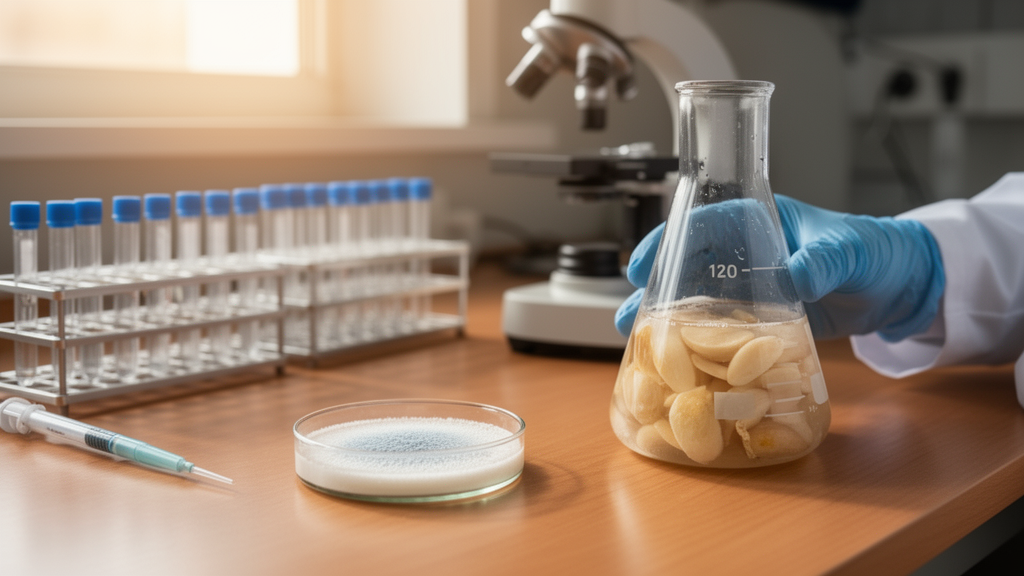
Cellulases, the enzymes that break down cellulose, are among the most industrially significant biocatalysts in bioprocessing technology, and a new study reports a locally isolated bacterial strain that produces them efficiently from an abundant agricultural byproduct. Researchers isolated and identified a strain of Bacillus mycoides, designated strain 6i, using 16S rRNA sequencing, and then set out to maximize its production of two cellulase activities, CMCase and FPase, using mango kernels as the substrate in submerged fermentation.
Optimization followed a two-stage statistical design. A Plackett-Burman design was first used to screen the many possible culture factors and identify the most significant ones, which turned out to be peptone, sodium chloride, and ammonium sulfate. A central composite design was then employed to fine-tune the levels of these three nutrients for the target enzymes produced by Bacillus mycoides strain 6i.
The optimized conditions yielded substantial enzyme titers. Maximum CMCase production of 118.08 IU/mL/min was recorded at 24 hours of incubation with 1.25% peptone, 1% NaCl, and 0.5% (NH4)2SO4. Highest FPase production, 118.0003 IU/mL/min, was recorded at 24 hours of incubation with 0.09% peptone, 0.65% NaCl, and 0.3% (NH4)2SO4. Both enzymes showed maximum activity at 70 degrees Celsius, with CMCase performing best at pH 7 and FPase at pH 5.
Beyond the production optimum, the team carried out a broader characterization of the enzymes, examining their behavior across temperature, pH, metal ions, solvents, surfactants, and detergents. Thermodynamic analysis gave activation energies of 33.20 and 11.33 kJ/mol for CMCase and FPase respectively, enthalpy changes of 44.0 and 11.4 kJ/mol, and entropy values of 49.84 and 42.21 J mol⁻¹ K⁻¹.
The study also compared two modeling approaches for the optimization itself. Response surface methodology produced R2 values of 94.55% for CMCase and 94.65% for FPase, while artificial neural network modeling reached 95.794% and 95.241% respectively. The authors note that ANN better captured the nonlinear relationships between variables than RSM, as indicated by the higher R2 values.
According to the authors, the work provides insights into the production, optimization, and characterization of cellulose-degrading enzymes from newly identified Bacillus strains, with potential relevance to enhanced biomass degradation. The article, published open access in Annals of Microbiology on 8 October 2026, is being shared early as a peer-reviewed, accepted version of record that remains subject to further edits.
Subject of Research: Optimization and thermodynamic characterization of cellulase production by Bacillus mycoides strain 6i using mango kernels in submerged fermentation
Article Title: RSM and ANN driven optimization and thermodynamic characterization of CMCase and FPase for enhanced biomass degradation from locally isolated Bacillus mycoides strain 6i in submerged fermentation
Article References: Islam, M., Ali, M. Z., Nugraheni, D., Haryati, T., Shakir, H. A., Khan, M., Hafiz, I., Irfan, M., & Sharifi-Rad, M. (2026). RSM and ANN driven optimization and thermodynamic characterization of CMCase and FPase for enhanced biomass degradation from locally isolated Bacillus mycoides strain 6i in submerged fermentation. Annals of Microbiology. https://doi.org/10.1186/s13213-026-01883-5
Image Credits: AI Generated
DOI: 10.1186/s13213-026-01883-5
Keywords: cellulase, CMCase, FPase, Bacillus mycoides, mango kernels, submerged fermentation, response surface methodology, artificial neural network, biomass degradation, enzyme optimization, thermodynamics, Annals of Microbiology
News Source: Drew Townsend. (October 28, 2026). Newly isolated Bacillus mycoides strain turns mango kernels into cellulase enzymes. Scienmag.