A new species of snake that feeds exclusively on birds’ eggs has been formally described from the Harenna Forest in Ethiopia, one of the last substantial tracts of natural forest in the Horn of Africa. Named Dasypeltis albigularis , or the White-throated Egg-eater, the animal joins approximately 20 previously known species in the genus Dasypeltis . The peer-reviewed description, published in the open-access journal Herpetozoa , draws on seven years of morphological comparisons, DNA sequencing and captive breeding observations.
The evidence supports recognition of the Harenna Forest snake as a species distinct from its superficially similar relative, the Montane Egg-eater, Dasypeltis atra . The investigation began when Arthur Tiutenko of Friedrich-Alexander-Universität Erlangen-Nürnberg received a juvenile female egg-eater from a local collaborator in Harenna Forest. The snake initially appeared to be an already known species, but Tiutenko noticed morphological differences as it grew toward adult size.
To investigate whether those differences represented a genuine biological distinction, he crossed the female with a male of D. atra , the closely related species it resembled. The resulting hybrid offspring displayed a mixture of traits from both parents, providing early evidence that the Harenna Forest snake was separate. Genetic analyses of both mitochondrial and nuclear DNA showed that D. albigularis and D. atra were genetically distinct despite their superficial resemblance.
The description was led by Tiutenko with colleagues from Ludwig-Maximilians-Universität Munich and South Africa’s National Museum in Bloemfontein. Identification therefore did not rest on color alone: the researchers combined visible anatomical differences with inherited traits observed in hybrid offspring and molecular evidence from two forms of DNA. Many egg-eating snakes remain difficult to distinguish because numerous species are uniformly black, brown or gray and possess few obvious external markings, making the combined approach important for establishing the proposed new species.
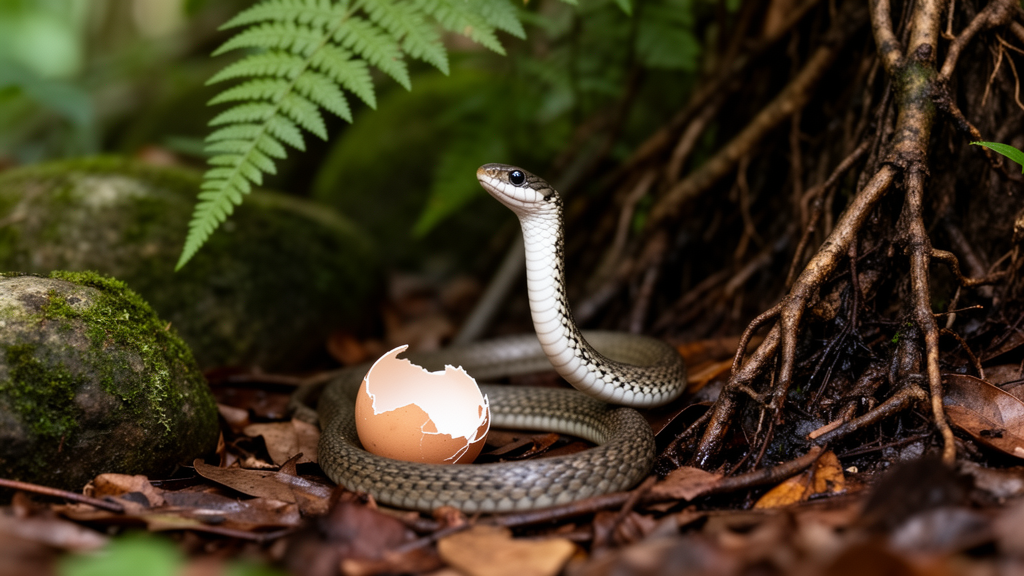
D. albigularis can be distinguished from its relatives by pale, sometimes bluish-tinged skin visible between its scales and by a distinctive white throat and belly. Its scientific name means “white-throated” in Latin, and the common name White-throated Egg-eater refers to the same feature. Unlike some relatives, the new species also appears not to produce the rasping, hissing sound that many egg-eating snakes use to deter predators by rubbing their scales together.
Females reach up to 92 centimeters in length, making the species somewhat smaller than D. atra and its other closest relatives. These observations describe the traits reported for the newly described species; the supplied account does not establish its broader distribution or abundance across Harenna Forest. The snake lives in dense forest at elevations of 1,500 to 1,700 meters above sea level, in an area whose undergrowth includes wild coffee plants.
It feeds on the eggs of tree-nesting birds. Members of Dasypeltis are harmless snakes that survive entirely on eggs, using specialized vertebrae in the throat to crack shells before swallowing them. The discovery adds a documented species to this specialized feeding group and identifies a further member of Ethiopia’s forest biota.
Tiutenko described D. albigularis as the 20th taxon he had named and formally described; he also reported that several additional species and one subgenus remained awaiting publication.
Subject of Research: Formal description and genetic identification of a new egg-eating snake species from Ethiopia
Article Title: New species of egg-eating snake described from Harenna Forest in Ethiopia
Article References: New species of egg-eating snake described from Harenna Forest in Ethiopia. Original publication (Bibliographic details unavailable.)
Image Credits: AI Generated
DOI: Not provided
Keywords: Dasypeltis albigularis, egg-eating snake, new species, Harenna Forest, Ethiopia, taxonomy, genetic analysis, morphology, captive breeding, Horn of Africa, species, egg-eating
News Source: Juliet Wilcox. (October 26, 2026). New white-throated egg-eating snake described from Ethiopia’s forest. Scienmag.