• HOME
  • NEWS
  • EXPLORE
    • CAREER
      • Companies
      • Jobs
    • EVENTS
    • iGEM
      • News
      • Team
    • PHOTOS
    • VIDEO
    • WIKI
  • BLOG
  • COMMUNITY
    • FACEBOOK
    • INSTAGRAM
    • TWITTER
Tuesday, July 7, 2026
BIOENGINEER.ORG
No Result
View All Result
  • Login
  • HOME
  • NEWS
  • EXPLORE
    • CAREER
      • Companies
      • Jobs
        • Lecturer
        • PhD Studentship
        • Postdoc
        • Research Assistant
    • EVENTS
    • iGEM
      • News
      • Team
    • PHOTOS
    • VIDEO
    • WIKI
  • BLOG
  • COMMUNITY
    • FACEBOOK
    • INSTAGRAM
    • TWITTER
  • HOME
  • NEWS
  • EXPLORE
    • CAREER
      • Companies
      • Jobs
        • Lecturer
        • PhD Studentship
        • Postdoc
        • Research Assistant
    • EVENTS
    • iGEM
      • News
      • Team
    • PHOTOS
    • VIDEO
    • WIKI
  • BLOG
  • COMMUNITY
    • FACEBOOK
    • INSTAGRAM
    • TWITTER
No Result
View All Result
Bioengineer.org
No Result
View All Result
Home NEWS Science News Biology

New wheelchair design: A hand gear for better ergonomics

Bioengineer by Bioengineer
February 13, 2019
in Biology
Reading Time: 3 mins read
0
IMAGE
Share on FacebookShare on TwitterShare on LinkedinShare on RedditShare on Telegram

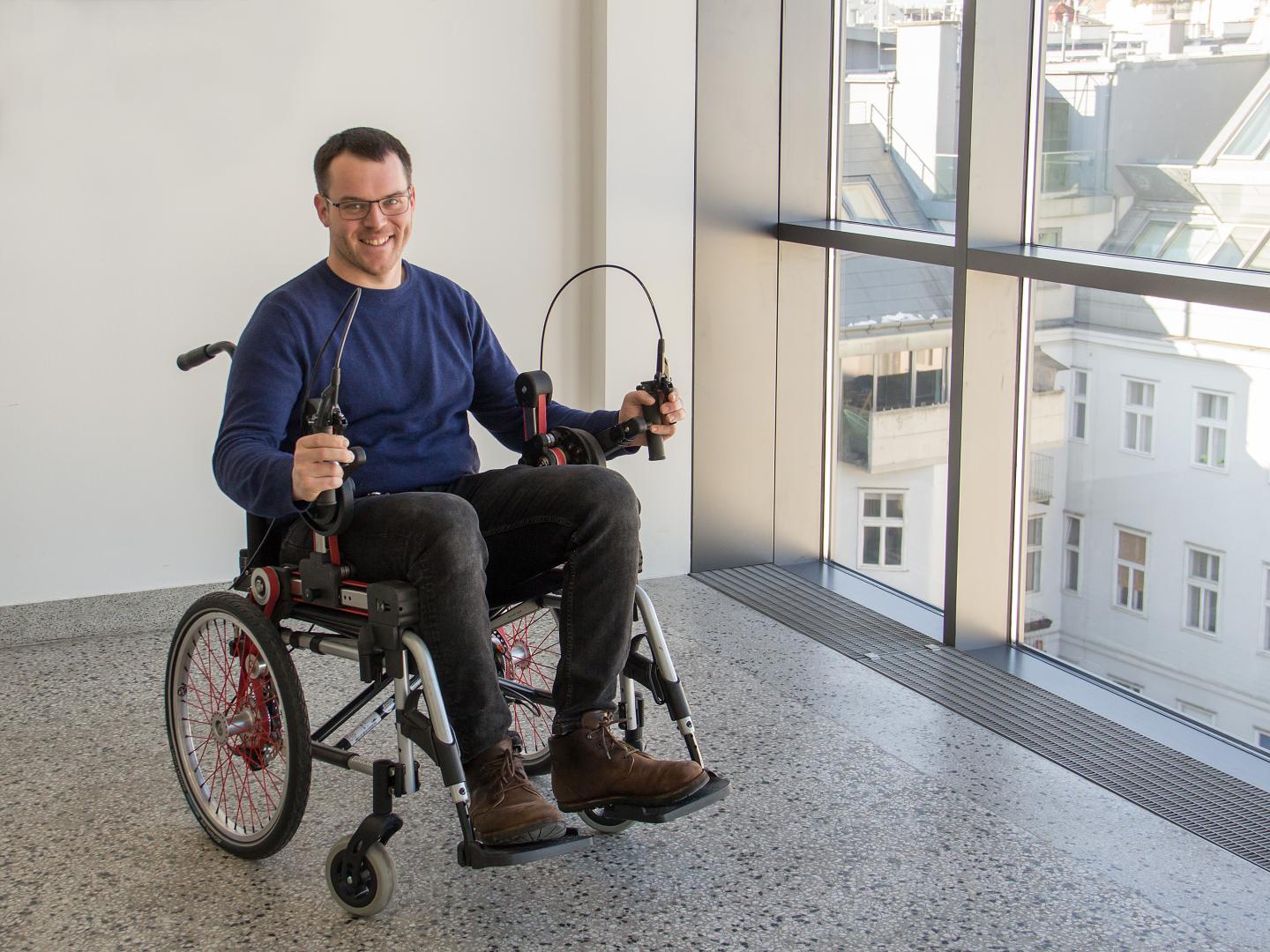
Using biomedical modelling, researchers at TU Wien have developed a completely new type of wheelchair; specially designed handles make the drive more efficient and ergonomic
IMAGE

Credit: TU Wien

Anyone who thinks that a wheelchair is a simple piece of equipment with no room for improvement is sorely mistaken. The research team for biomechanics and rehabilitation engineering at TU Wien (Vienna) has now developed a completely new drive system. The wheelchair is not moved via a handrim on the wheel, but with the help of a newly designed hand gear. This is more ergonomic and far better suited to the natural movement patterns of the upper body. The new wheelchair type has recently been registered for a patent, now the researchers are looking for industrial partners.

Joints are not made for wheelchair use

“The motion sequence when using a wheelchair is usually quite unnatural”, explains Prof. Margit Gföhler (Institute of Engineering Design and Product Development, TU Wien). “Moving a wheelchair using a conventional handrim puts your joints into extreme positions, which our bodies are simply not made for.” This is the reason why many people suffer from wheelchair-induced joint injuries and joint pain.

To change this, Margit Gföhler and her research team developed a biomechanical computer model to analyse various motion sequences of the upper body. “We considered the following questions: What would be the optimal motion sequence? What movements are best suited to the way in which the shoulders and arms work?” says Gföhler.

The motion sequence determined to be best suited in the biomechanical simulations was then implemented in a mechanical drive system. The result is a wheelchair driven by two hand gears. During each revolution, the levers change their length, creating an egg-shaped movement rather than a circular movement. The hand gears are mounted on the wheelchair’s armrests and drive the rear wheels via a toothed belt. As a result, the wheels can be made smaller than usual. Thanks to its compact dimensions, the hand gear does not make the wheelchair wider or larger, so the drive is suitable for everyday indoor use.

Better angles, less effort

The new wheelchair technology underwent a range of tests, some of them in collaboration with the ‘Weißer Hof’ rehabilitation centre in Klosterneuburg, Austria. “The responses were very positive: people were pleased that the joints no longer have to move outside the natural angular range and that the wheelchair enables continuous movement without interruption”, relates Margit Gföhler. Spirometric tests were also carried out: these involve analysing the breath to measure how strenuous a certain activity is. The new drive technology enables the same speeds to be reached as before but with significantly reduced effort.

Margit Gföhler is optimistic, “Our new wheelchair concept really could improve many people’s quality of life.” “We hope to find a partner in the industry soon to develop our design into a commercial product.” The new wheelchair drive system has now been registered for a patent with the help of TU Wien’s Research and Transfer Support office.

###

Contact:

Prof. Margit Gföhler

Institute of Engineering Design and Product Development

TU Wien

Getreidemarkt 9, 1060 Vienna, Austria

Tel.: +43-1-58801-30615

[email protected]

Media Contact
Florian Aigner
[email protected]
43-155-801-41027

Original Source

https://www.tuwien.ac.at/en/news/news_detail/article/126523/

Tags: Biomedical/Environmental/Chemical EngineeringBiotechnologyMechanical EngineeringTechnology/Engineering/Computer Science
Share12Tweet8Share2ShareShareShare2

Related Posts

Here are a few rewritten headlines for a science magazine post, each with a slightly different tone: Intriguing & poetic: How do organs sculpt themselves? Sea stars hold the secret Direct & research-focused: Sea stars reveal the hidden rules of organ formation Metaphorical & inviting: Tiny architects beneath the waves: What sea stars teach us about building organs Short & punchy: Star-shaped clues to how our organs take shape Question-led: Could a sea star show us how organs form? Elegant & feature-style: The body’s blueprint, glimpsed in a sea star’s arm

July 6, 2026
Bacteria evolve faster with unconventional gene copies — Biology

Bacteria evolve faster with unconventional gene copies

July 6, 2026

Neighbours rewire soil feedback via root microbiome shifts

July 6, 2026

Evolution-Inspired Biosensors Revolutionize Lipid Tracking in Real Time

July 2, 2026
Please login to join discussion

POPULAR NEWS

  • Detection of EDCs in Breast Milk and Infant Urine Up to Six Months Highlights Early Exposure Risks

    77 shares
    Share 31 Tweet 19
  • New Drug Candidate Developed at McMaster Shows Potential for Treating Brain Cancer

    58 shares
    Share 23 Tweet 15
  • Saying Goodbye to PGY-6: Pediatric Fellowship Realities

    103 shares
    Share 41 Tweet 26
  • KTU Researchers Explore Ultrasound’s Role in Enhancing Blood Flow Beyond Diagnostics

    53 shares
    Share 21 Tweet 13

About

We bring you the latest biotechnology news from best research centers and universities around the world. Check our website.

Follow us

Recent News

Flame retardant BDE-209 targets molecularly linked to ulcerative colitis

Ultra-high frequency particle impacts mimic rockbursts to shatter hard rock

Kidney transplant outcomes in older adults studied by German researchers

Subscribe to Blog via Email

Enter your email address to subscribe to this blog and receive notifications of new posts by email.

Join 83 other subscribers
  • Contact Us

Bioengineer.org © Copyright 2023 All Rights Reserved.

Welcome Back!

Login to your account below

Forgotten Password?

Retrieve your password

Please enter your username or email address to reset your password.

Log In
No Result
View All Result
  • Homepages
    • Home Page 1
    • Home Page 2
  • News
  • National
  • Business
  • Health
  • Lifestyle
  • Science

Bioengineer.org © Copyright 2023 All Rights Reserved.