• HOME
  • NEWS
  • EXPLORE
    • CAREER
      • Companies
      • Jobs
    • EVENTS
    • iGEM
      • News
      • Team
    • PHOTOS
    • VIDEO
    • WIKI
  • BLOG
  • COMMUNITY
    • FACEBOOK
    • INSTAGRAM
    • TWITTER
Tuesday, October 6, 2026
BIOENGINEER.ORG
No Result
View All Result
  • Login
  • HOME
  • NEWS
  • EXPLORE
    • CAREER
      • Companies
      • Jobs
        • Lecturer
        • PhD Studentship
        • Postdoc
        • Research Assistant
    • EVENTS
    • iGEM
      • News
      • Team
    • PHOTOS
    • VIDEO
    • WIKI
  • BLOG
  • COMMUNITY
    • FACEBOOK
    • INSTAGRAM
    • TWITTER
  • HOME
  • NEWS
  • EXPLORE
    • CAREER
      • Companies
      • Jobs
        • Lecturer
        • PhD Studentship
        • Postdoc
        • Research Assistant
    • EVENTS
    • iGEM
      • News
      • Team
    • PHOTOS
    • VIDEO
    • WIKI
  • BLOG
  • COMMUNITY
    • FACEBOOK
    • INSTAGRAM
    • TWITTER
No Result
View All Result
Bioengineer.org
No Result
View All Result
Home NEWS Science News Chemistry

New therapy promotes vascular repair following stroke

Bioengineer by Bioengineer
June 24, 2019
in Chemistry
Reading Time: 2 mins read
0
IMAGE
Share on FacebookShare on TwitterShare on LinkedinShare on RedditShare on Telegram

IMAGE

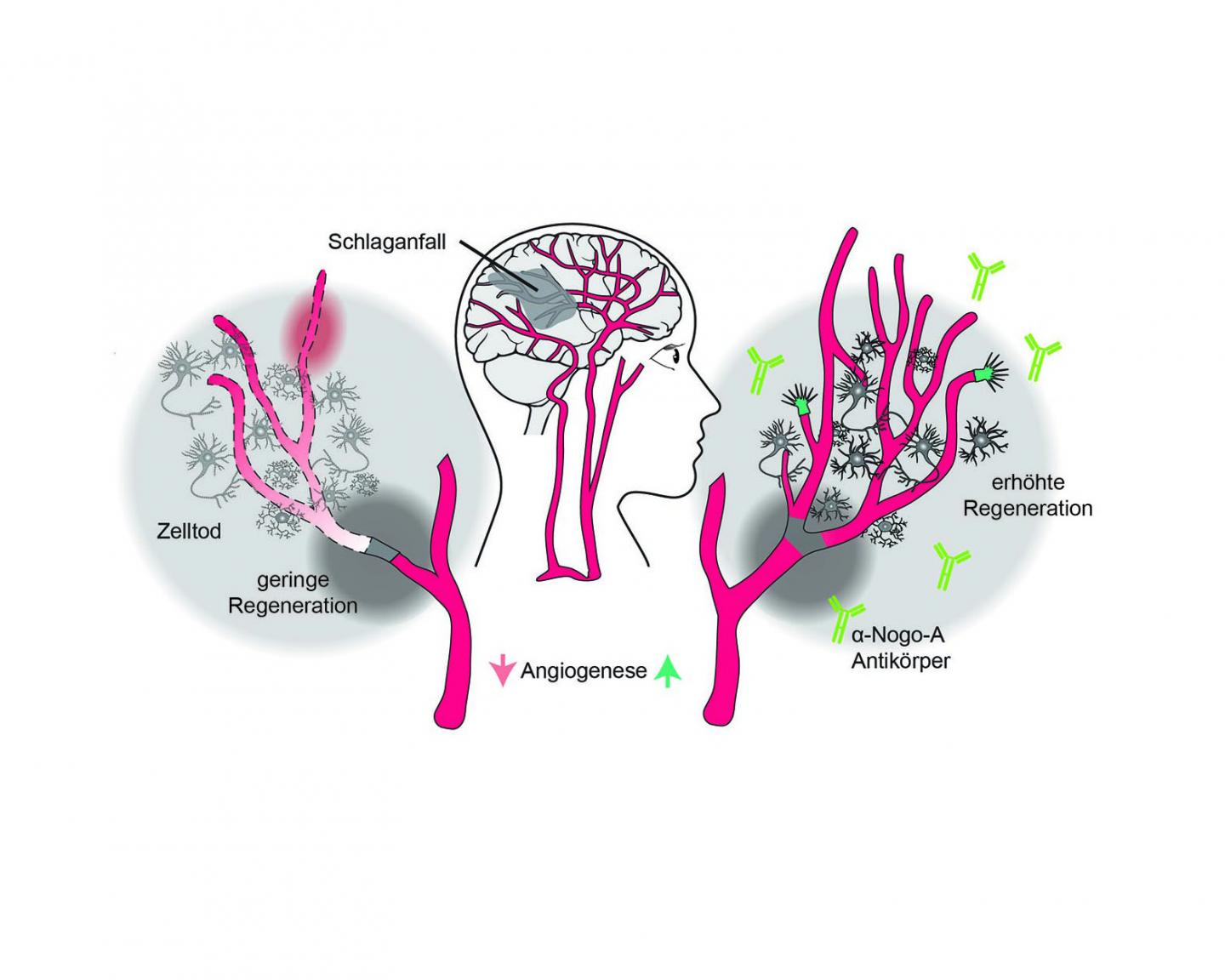
Credit: Illustration: Ruslan Rust

Following a stroke, antibodies that inhibit the signaling molecule Nogo-A can help repair blood vessels in the affected brain regions. This also promotes the regaining of motor functions, researchers at the University of Zurich have shown in a mouse model. The study opens up new avenues for treatment.

Each year, around 16,000 people in Switzerland and 15 million people worldwide suffer a stroke. Two thirds of those affected die or remain in permanent need of care due to the brain’s limited capacity to regenerate damaged tissue and neural circuits. At present, despite intensive research efforts only few medical therapy options are available that reduce the serious consequences after cerebral stroke.

Signaling molecule Nogo-A regulates blood vessel sprouting

A promising new approach to promote the recovery of physiological functions aims to repair the system of blood vessels in the affected brain regions. The system supplies the injured tissue with oxygen and key nutrients. In people who have suffered a stroke, this repair process is inhibited by a number of mechanisms. A few years ago, the research group of UZH Professor Martin Schwab used a mouse model to, among other things, show that the signaling molecule Nogo-A not only reduces the growth of nerve fibers, but also regulates blood vessel sprouting in the brain and could thus also inhibit their repair.

Motor function improvement thanks to vascular growth

In a new study with mice, the researchers genetically deactivated the Nogo-A molecule or one of its corresponding receptors S1PR2. The blood vessels in these mice showed improved regenerative capacity, and they recovered affected motor skills better than those of the mice in the control group. These findings were reproduced in a therapeutic approach using anti-Nogo-A antibodies in mice following a stroke, which too led to the re-formation of a robust and functional vascular network around the affected brain regions. “The nervous system of the treated mice showed better recovery and their motor functions were less affected, which we ascribe to vascular regeneration,” says first author and UZH neuroscientist Ruslan Rust.

Nogo-A antibodies already in clinical tests for spinal cord injuries

Previous experimental efforts to enhance vessel growth have almost exclusively focused on vascular growth factor supplementation, an approach that has been shown to be clinically unviable due to adverse side effects such as increased risk of hemorrhage. “Our findings provide a promising alternative approach to treating stroke patients,” says Rust, “not least since anti-Nogo-A antibodies are already being used in clinical testing for spinal cord injuries.”

###

Media Contact
Ruslan Rust
[email protected]

Related Journal Article

http://dx.doi.org/10.1073/pnas.1905309116

Tags: BiochemistryBiologyCardiologyCell BiologyMedicine/HealthMolecular BiologyNeurochemistryPharmaceutical ChemistryPharmaceutical ScienceStroke
Share12Tweet8Share2ShareShareShare2

Related Posts

Handheld NIR Scanner and Bilinear Surface Model Crack Rapid Gluten Quality Testing in Whole Wheat Flour

Handheld NIR Scanner and Bilinear Surface Model Crack Rapid Gluten Quality Testing in Whole Wheat Flour

October 6, 2026
Dunes Follow a Hidden Physics: Young Coastal Dune Landscapes Self-Organize Like Phase-Separating Fluids

Dunes Follow a Hidden Physics: Young Coastal Dune Landscapes Self-Organize Like Phase-Separating Fluids

October 6, 2026

Fungus Hidden Inside Ginger Yields Fatty Acid That Kills Malaria Mosquito Larvae

October 6, 2026

Why Ripe Chili Peppers Smell Fruitier: Ripening Links Heat and Aroma

October 5, 2026
Please login to join discussion

POPULAR NEWS

  • Alloys That Shrink Their Own Grains: New PIX Mechanism Refines Metals With Heat Alone

    Alloys That Shrink Their Own Grains: New PIX Mechanism Refines Metals With Heat Alone

    29 shares
    Share 12 Tweet 7
  • Endurance Exercise Reshapes the Liver in Males and Females Through Distinct Molecular Routes

    29 shares
    Share 12 Tweet 7
  • Single Transcription Factor PU.1 Rapidly Converts Fibroblasts into Macrophage-Lineage Cells

    29 shares
    Share 12 Tweet 7
  • New Scale Measures How Ready Nurse Educators Really Are for the AI Era

    29 shares
    Share 12 Tweet 7

About

We bring you the latest biotechnology news from best research centers and universities around the world. Check our website.

Follow us

Recent News

Alloys That Shrink Their Own Grains: New PIX Mechanism Refines Metals With Heat Alone

Endurance Exercise Reshapes the Liver in Males and Females Through Distinct Molecular Routes

Single Transcription Factor PU.1 Rapidly Converts Fibroblasts into Macrophage-Lineage Cells

Subscribe to Blog via Email

Success! An email was just sent to confirm your subscription. Please find the email now and click 'Confirm' to start subscribing.

Join 85 other subscribers
  • Contact Us

Bioengineer.org © Copyright 2023 All Rights Reserved.

Welcome Back!

Login to your account below

Forgotten Password?

Retrieve your password

Please enter your username or email address to reset your password.

Log In
No Result
View All Result
  • Homepages
    • Home Page 1
    • Home Page 2
  • News
  • National
  • Business
  • Health
  • Lifestyle
  • Science

Bioengineer.org © Copyright 2023 All Rights Reserved.