• HOME
  • NEWS
  • EXPLORE
    • CAREER
      • Companies
      • Jobs
    • EVENTS
    • iGEM
      • News
      • Team
    • PHOTOS
    • VIDEO
    • WIKI
  • BLOG
  • COMMUNITY
    • FACEBOOK
    • INSTAGRAM
    • TWITTER
Thursday, May 14, 2026
BIOENGINEER.ORG
No Result
View All Result
  • Login
  • HOME
  • NEWS
  • EXPLORE
    • CAREER
      • Companies
      • Jobs
        • Lecturer
        • PhD Studentship
        • Postdoc
        • Research Assistant
    • EVENTS
    • iGEM
      • News
      • Team
    • PHOTOS
    • VIDEO
    • WIKI
  • BLOG
  • COMMUNITY
    • FACEBOOK
    • INSTAGRAM
    • TWITTER
  • HOME
  • NEWS
  • EXPLORE
    • CAREER
      • Companies
      • Jobs
        • Lecturer
        • PhD Studentship
        • Postdoc
        • Research Assistant
    • EVENTS
    • iGEM
      • News
      • Team
    • PHOTOS
    • VIDEO
    • WIKI
  • BLOG
  • COMMUNITY
    • FACEBOOK
    • INSTAGRAM
    • TWITTER
No Result
View All Result
Bioengineer.org
No Result
View All Result
Home NEWS Science News Biology

New technology allows fleets to double fishing capacity — and deplete fish stocks faster

Bioengineer by Bioengineer
September 16, 2019
in Biology
Reading Time: 2 mins read
0
IMAGE
Share on FacebookShare on TwitterShare on LinkedinShare on RedditShare on Telegram

IMAGE

Credit: The University of British Columbia | Sea Around Us.

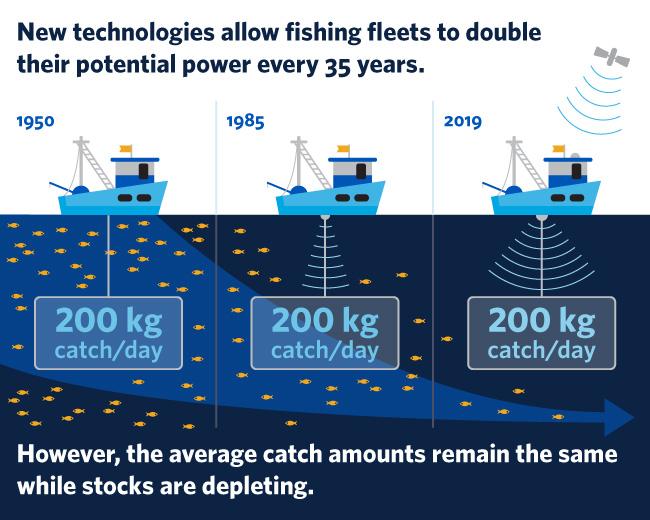
Technological advances are allowing commercial fishing fleets to double their fishing power every 35 years and put even more pressure on dwindling fish stocks, new research has found.

Researchers from the Sea Around Us initiative at the University of British Columbia analyzed more than 50 studies related to the increase in vessels’ catching power and found that the introduction of mechanisms such as GPS, fishfinders, echo-sounders or acoustic cameras, has led to an average two per cent yearly increase in boats’ capacity to capture fish.

“This means that if a fleet has 10 boats today, one generation later, the same 10 boats have the fishing power of 20 vessels. The next generation, they have the power of 40 boats, and so on,” said Deng Palomares, the Sea Around Us project manager and lead author of the study, which was published today in Ecology and Society.

An increase in fishing power is known as ‘technological creep’ and it’s usually ignored by fisheries managers who are in charge of regulating how many days and hours and technique each vessel under their oversight is supposed to fish in a given period.

“This ‘technological creep’ is also ignored by most fisheries scientists in charge of proposing policies,” said Daniel Pauly, the Sea Around Us principal investigator. “They tend to conduct short-term studies that only take into account nominal effort, which is, for example, the number of boats that fish using longlines in one year, employing ‘x’ number of people. However, they are disregarding the effective effort those vessels are deploying thanks to the technology that allows them to either maintain their catches or catch more fish.”

In their paper, Palomares and Pauly propose a new equation that allows fisheries managers and scientists to easily estimate technological creep precisely and determine a fleet’s effective effort.

“This is important because if you don’t understand that the increase in power is happening, then you don’t understand that you can deplete a stock,” Pauly said. “We already know that marine fisheries catches have been declining by 1.2 million tonnes per year since 1996 so, by prompting boats to fish deeper and farther into the high seas, these new technologies are only helping the industry compensate for the diminishing abundance of fish populations.”

###

Media Contact
Valentina Ruiz Leotaud
[email protected]

Original Source

https://news.ubc.ca/2019/09/16/new-technology-allows-fleets-to-double-fishing-capacity-and-deplete-fish-stocks-faster/

Related Journal Article

http://dx.doi.org/10.5751/ES-11136-240331

Tags: AgricultureFisheries/AquacultureOceanographyZoology/Veterinary Science
Share13Tweet8Share2ShareShareShare2

Related Posts

“‘Last Titan’: Discovery of Southeast Asia’s Largest Dinosaur Unveiled” — Biology

“‘Last Titan’: Discovery of Southeast Asia’s Largest Dinosaur Unveiled”

May 14, 2026
Study Offers In-Depth Analysis of Changes in Toxin-Producing Phytoplankton Populations — Biology

Study Offers In-Depth Analysis of Changes in Toxin-Producing Phytoplankton Populations

May 14, 2026

UMass Chan Scientists Pioneer Gene Editing Technology That Rewrites Entire Genome Chapters

May 13, 2026

Scientists Observe Rice Plants Capturing and Eliminating Fall Armyworm Caterpillars

May 13, 2026
Please login to join discussion

POPULAR NEWS

  • Research Indicates Potential Connection Between Prenatal Medication Exposure and Elevated Autism Risk

    842 shares
    Share 337 Tweet 211
  • New Study Reveals Plants Can Detect the Sound of Rain

    729 shares
    Share 291 Tweet 182
  • Salmonella Haem Blocks Macrophages, Boosts Infection

    62 shares
    Share 25 Tweet 16
  • Breastmilk Balances E. coli and Beneficial Bacteria in Infant Gut Microbiomes

    57 shares
    Share 23 Tweet 14

About

We bring you the latest biotechnology news from best research centers and universities around the world. Check our website.

Follow us

Recent News

ALS Progresses Through a Domino-Like Chain Reaction Initiated in Nerve Cells

Liquid Metal Nano-Gyroid Enables Ultra-Resilient Electronics

Intense Precipitation Reduces Terrestrial Water Storage

Subscribe to Blog via Email

Enter your email address to subscribe to this blog and receive notifications of new posts by email.

Join 82 other subscribers
  • Contact Us

Bioengineer.org © Copyright 2023 All Rights Reserved.

Welcome Back!

Login to your account below

Forgotten Password?

Retrieve your password

Please enter your username or email address to reset your password.

Log In
No Result
View All Result
  • Homepages
    • Home Page 1
    • Home Page 2
  • News
  • National
  • Business
  • Health
  • Lifestyle
  • Science

Bioengineer.org © Copyright 2023 All Rights Reserved.