Researchers from Tokyo Medical and Dental University (TMDU) uncover an important relationship between two genes critical to pancreatic cancer patient prognosis
Credit: Department of Molecular Oncology, TMDU
Researchers from Tokyo Medical and Dental University (TMDU) uncover an important relationship between two genes critical to pancreatic cancer patient prognosis
Tokyo, Japan – Pancreatic cancer remains one of the deadliest malignancies worldwide. Since five-year survival rate for pancreatic ductal adenocarcinoma (PDAC) is only about 3% in patients, PDAC is very difficult to treat with surgery worldwide. To develop novel treatment methods, the biology of PDAC at the molecular level needs to be better understood.
In a recent article published in Cancer Science, researchers from Tokyo Medical and Dental University (TMDU) have identified a new target gene that has strong clinical implications in PDAC cases.
Previous studies have demonstrated that cancer cells express high levels of a special enzyme—histone H3K4 methyltransferase—that is encoded by SETD1A gene. This enzyme regulates gene expression by adding a methyl chemical group to histone proteins (essential structural components of chromatin) of specific target genes through a process called methylation. However, the mechanism causing overexpression of this enzyme and its effect on cancer cells remain unclear. Following histone methylation, the target genes become active. This is especially significant if SETD1A target genes can support cancer development and progression. Therefore, researchers from TMDU became interested in understanding the role of SETD1A overexpression in PDAC.
“Although previous work has shown that SETD1A is overexpressed in various cancer, such as gastric and lung cancer, the specific molecular events of SETD1A are not understood in PDAC,” says lead author Takeshi Ishii. “SETD1A target genes in PDAC have also not yet been identified.”
The researchers observed high levels of SETD1A expression in 51.4% of the human PDAC samples they analyzed. They also determined that SETD1A was an independent prognostic factor for disease-free survival, meaning that after tumor resection, patients with high SETD1A levels live in a disease-free state for a shorter duration than those with low SETD1A levels. These results demonstrate the clinical importance of SETD1A expression in PDAC.
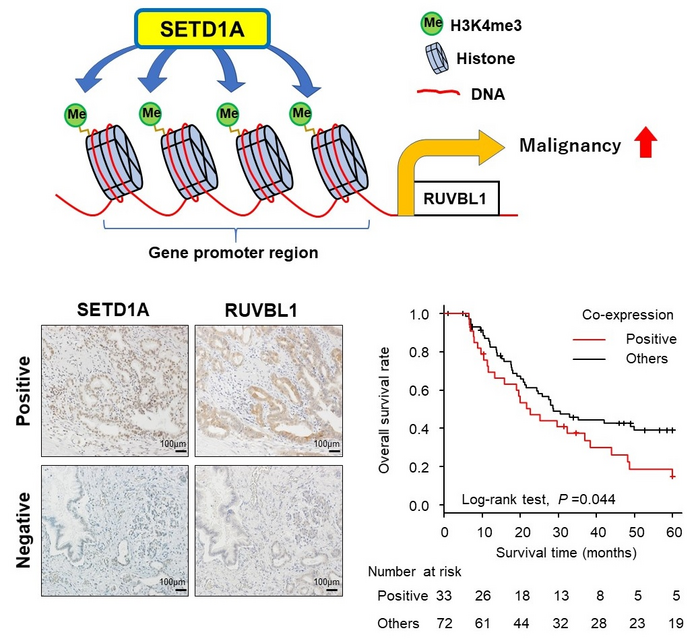
Then, they used artificially cultured PDAC cells to examine how changing SETD1A expression would affect cell behavior. When they overexpressed SETD1A levels, both cell growth and cell migration ability increased. In another set of PDAC cells, researchers used molecular techniques to interfere with SETD1A expression and then analyzed other genes that were affected by this. “Using a technique called RNA sequencing, we examined overall gene expression after knocking down SETD1A and found that another gene known as RUVBL1 was expressed at lower levels,” explains senior author Shinji Tanaka.
Further work suggested that SETD1A can methylate histones near the RUVBL1 gene and activate its gene expression. Knocking down RUVBL1 expression in PDAC cells had similar biological effects to those observed earlier with SETD1A interference. “Analysis of survival rates revealed that PDAC patients with high SETD1A and RUVBL1 levels had poorer overall survival, suggesting that their co-expression is an important prognostic biomarker for this cancer,” says Takeshi Ishii.
The study results provide deeper insights into the significance of SETD1A and RUVBL1 expression in PDAC and may offer crucial details to help clinicians with critical treatment decisions for patients suffering from this serious disease.
###
The article, “Identification of a novel target of SETD1A histone methyltransferase and the clinical significance in pancreatic cancer,” was published in Cancer Science at DOI:10.1111/cas.1561
Journal
Cancer Science
DOI
10.1111/cas.15615
Article Title
Identification of a novel target of SETD1A histone methyltransferase and the clinical significance in pancreatic cancer