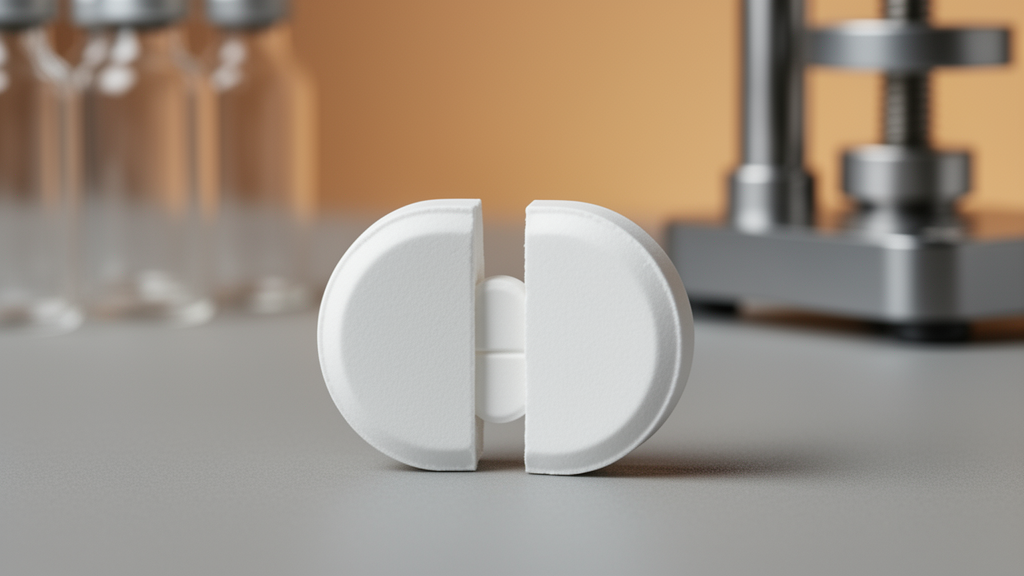
Acetazolamide has long been the only drug approved by the US Food and Drug Administration for both the prevention and treatment of high-altitude illness, yet the oral forms on the market each carry a trade-off. Immediate-release tablets act quickly but must be taken frequently, while extended-release capsules delay the drug’s onset by more than two hours, which is an awkward property for travelers ascending rapidly into thin air. A team of Chinese researchers now reports a proof-of-concept tablet that tries to resolve this conflict by packing both release behaviors into a single pill, using a manufacturing approach known as tablet-in-tablet compression. The work, published in Drugs in R&D, describes the formulation’s design, optimization, and laboratory performance, while stopping short of any claim about how the tablet would behave in the human body.
The new dosage form, which the authors call ACZ-TIT, is built in two stages. An extended-release core tablet is first compressed from a matrix of polyethylene oxide, a water-soluble polymer that hydrates into a gel and slows drug diffusion. This core is then centered inside a die, surrounded by an outer layer of immediate-release powder containing its own small dose of acetazolamide plus a disintegrant, and the whole assembly is compressed again. After swallowing, the outer layer is meant to break apart within seconds, delivering an initial burst of drug, while the exposed core gradually swells and releases the remaining acetazolamide over many hours. Unlike osmotic-pump technologies, this dry-coating route requires no semipermeable membrane or laser drilling, which the authors argue makes it attractive for early-stage development of a relatively high-dose drug.
The motivation lies in the pharmacology of altitude sickness itself. Acute mountain sickness arises when rapid ascent to hypobaric hypoxia disturbs cerebral and cardiopulmonary function, producing headache, dizziness, nausea, vomiting, palpitations, and breathlessness; unrecognized, it can progress to high-altitude pulmonary or cerebral edema, both associated with high mortality. More than 100 million people travel to high altitudes each year, and reported incidence of acute mountain sickness ranges from 10 to 85 percent, rising with altitude. Acetazolamide, a carbonic anhydrase inhibitor developed in the 1950s, has an oral bioavailability of 70 to 90 percent and an elimination half-life of roughly 3 to 9 hours, properties that make it a plausible candidate for a combined rapid-and-sustained oral formulation. The authors note that a daily dose of 250 to 500 mg is considered appropriate for prophylaxis and treatment of altitude illness, although the therapeutic plasma concentration window for this indication has not been clearly established.
Before any compression experiments, the team ran pre-formulation checks on the drug itself. Capillary melting-point measurements showed acetazolamide beginning to melt at 254 degrees Celsius and liquefying completely by 256 degrees, with visible thermal decomposition, a narrow range the authors read as a sign of a relatively pure starting material. Compatibility with the five candidate excipients—polyethylene oxide, hydroxypropyl methylcellulose, hydroxypropyl cellulose, microcrystalline cellulose, and croscarmellose sodium—was tested in 1:1 physical mixtures stored for 10 days under accelerated conditions of 40 degrees Celsius and 75 percent relative humidity. Fourier transform infrared spectroscopy found no new absorption bands and no loss of characteristic peaks; differential scanning calorimetry showed the drug’s melting endotherm at 250 to 260 degrees preserved in every mixture; and powder X-ray diffraction retained the drug’s sharp crystalline peaks near 2θ values of 20 and 30 degrees even after accelerated storage. New overlapping diffraction signals that appeared in stored mixtures were attributed to recrystallization of the polyethylene oxide polymer rather than any change in the drug’s crystal form.
Solubility testing across four media simulating gastrointestinal pH conditions revealed only modest variation. Acetazolamide dissolved at 1.59 g/L in pH 6.8 phosphate buffer, 1.37 g/L in pH 1.2 hydrochloric acid, 1.34 g/L in pH 4.5 acetate buffer, and 1.27 g/L in purified water, a maximal difference of just 0.32 g/L. The authors explain this flatness by the drug’s ionization behavior: as a sulfonamide derivative with weakly acidic groups at pKa values of roughly 7.2 and 10.3, acetazolamide remains largely nonionized across the tested pH range of 1.2 to 6.8. Because of these small differences, the team adopted the pH 4.5 acetate buffer and water medium specified in the Chinese pharmacopoeia as the primary dissolution medium for screening, while running additional comparisons in the other media.
Dose architecture posed its own problem. The FDA recommends a minimum prophylactic daily dose of 500 mg, but a single 500 mg tablet proved too large for comfortable swallowing, so the team adopted a split-dose strategy targeting 250 mg per tablet. An initial plan of 62.5 mg in the immediate-release outer layer—half the strength of marketed 125 mg immediate-release tablets—was reconsidered because the outer layer’s rapid release combined with the core’s initial burst could push peak plasma concentrations undesirably high. The final design settled on 50 mg of acetazolamide in the outer layer and 200 mg in the extended-release core, a 20:80 split the authors flag as provisional pending future pharmacokinetic studies.
Optimization of the core proceeded through single-factor screening and then response surface methodology. Among the candidate polymers, polyethylene oxide batches came closest to the development benchmarks—less than 15 percent release at 0.5 hours and more than 80 percent at 10 hours—values drawn from the dissolution profile of the marketed extended-release capsule Diamox and used explicitly as screening targets rather than bioequivalence goals. The WSR 301 grade was selected, and release slowed markedly as polymer content rose from 50 to 70 mg, with similarity factor values of 44.97 and 32.83 against the 50 mg reference confirming meaningful differences. Increasing the microcrystalline cellulose filler accelerated release by diluting the gel-forming polymer, while varying tablet hardness between 55 and 75 N barely moved the profile, with similarity factors of 93.17 and 77.31. A three-level factorial response surface design treating polymer and filler content as critical variables produced a quadratic model for release at 0.5 hours and a linear model for release at 10 hours, both statistically significant. The software’s predicted optimum—63.009 mg of polymer and 117.622 mg of filler, forecasting 12.52 percent release at 0.5 hours and 79.99 percent at 10 hours—was validated with three manufactured batches that released 11.69 to 14.22 percent at 0.5 hours and 80.65 to 81.67 percent at 10 hours, and the team finalized the simpler round numbers of 60 mg and 120 mg.
The finished tablet-in-tablet delivered the intended biphasic curve in vitro: a mean cumulative release of 25.3 percent, roughly 63.2 mg, at 0.5 hours, rising to 86.5 percent at 10 hours, with a maximum intrabatch relative standard deviation of 6.1 percent indicating good batch uniformity. Compared with the marketed extended-release capsule, the new tablet released substantially more drug during the first hour and then released more gradually thereafter, a pattern the authors attribute to formulation design rather than point-by-point matching of the reference product. Multi-medium dissolution testing in pH 1.2, pH 4.5, pH 6.8, and water yielded similarity factor values above 50 for both formulations against their pH 4.5 references, suggesting only modest pH sensitivity, although the marketed capsule showed more visible early-phase differences before the curves converged. Kinetic fitting across zero-order, first-order, Higuchi, and Ritger-Peppas models identified the Ritger-Peppas equation as the best description of release between 0.5 and 16 hours, with a coefficient of determination of 0.993 and an exponent of 0.45, consistent with diffusion through the hydrated polymer gel rather than osmotic pumping or erosion-dominated release.
Quality control results met the applied Chinese pharmacopoeia standards across the board. The final tablets showed weight variation of approximately 2.65 percent, hardness of 112.0 ± 21.2 N, friability of 0.18 percent, and assay of 98.3 ± 1.2 percent, with related substances within specified limits. The immediate-release outer layer disintegrated in 5 to 8 seconds depending on disintegrant level, far below the 15-minute pharmacopeial limit, and 1 percent croscarmellose sodium was chosen on cost and process grounds since higher levels brought no meaningful improvement. Filler screening for the outer layer found an 18 percent tablet breakage rate at 395 mg of microcrystalline cellulose but none at 445 or 495 mg, leading to the selection of 445 mg.
The authors are careful about what these results do and do not establish. No validated minimum effective concentration, peak concentration target, or steady-state pharmacokinetic target exists for altitude illness prophylaxis, so any advantages of the biphasic design—earlier peak times than extended-release capsules, moderated peaks relative to a full immediate-release dose, or broader exposure across the dosing interval—remain hypotheses requiring dedicated in vivo pharmacokinetic and pharmacodynamic confirmation. The in vitro findings likewise cannot be read as evidence of equivalent in vivo performance. Further limitations acknowledged in the paper include the absence of an antioxidant in this prototype despite the known sensitivity of polyethylene oxide to oxidative chain scission, with antioxidants and high-barrier packaging planned for future development, along with impurity profiling and long-term stability studies still needed before any clinical translation. As it stands, the study demonstrates that a single tablet combining fast initial release with sustained diffusion-controlled delivery of acetazolamide is technically feasible and manufacturable to pharmacopeial quality standards, leaving the clinical question open for the in vivo work to come.
Subject of Research: Development and optimization of a biphasic-release acetazolamide tablet-in-tablet formulation for high-altitude illness prophylaxis
Article Title: Development and Optimization of a Biphasic-Release Acetazolamide Tablet-in-Tablet Formulation
Article References: Wang, S.-K., Li, W., Guo, M.-M., Han, M., Long, Z.-C., He, J.-H., Xie, X.-Y., Zeng, Y., & Liu, H. (2026). Development and Optimization of a Biphasic-Release Acetazolamide Tablet-in-Tablet Formulation. Drugs in R&D, 26(2), 169-186. https://doi.org/10.1007/s40268-026-00546-9
Image Credits: AI Generated
DOI: 10.1007/s40268-026-00546-9
Keywords: acetazolamide, high-altitude illness, tablet-in-tablet, biphasic release, extended-release, immediate-release, formulation optimization, response surface methodology, dissolution testing, drug-excipient compatibility, Ritger-Peppas model, pharmaceutics
News Source: Louis Brooks. (October 29, 2026). New Tablet-in-Tablet Design Aims for Fast and Lasting Altitude Sickness Drug. Scienmag.