Research may have implications for Alzheimer’s Disease or preventing the immune system from rejecting organ transplants, Baylor-led study finds
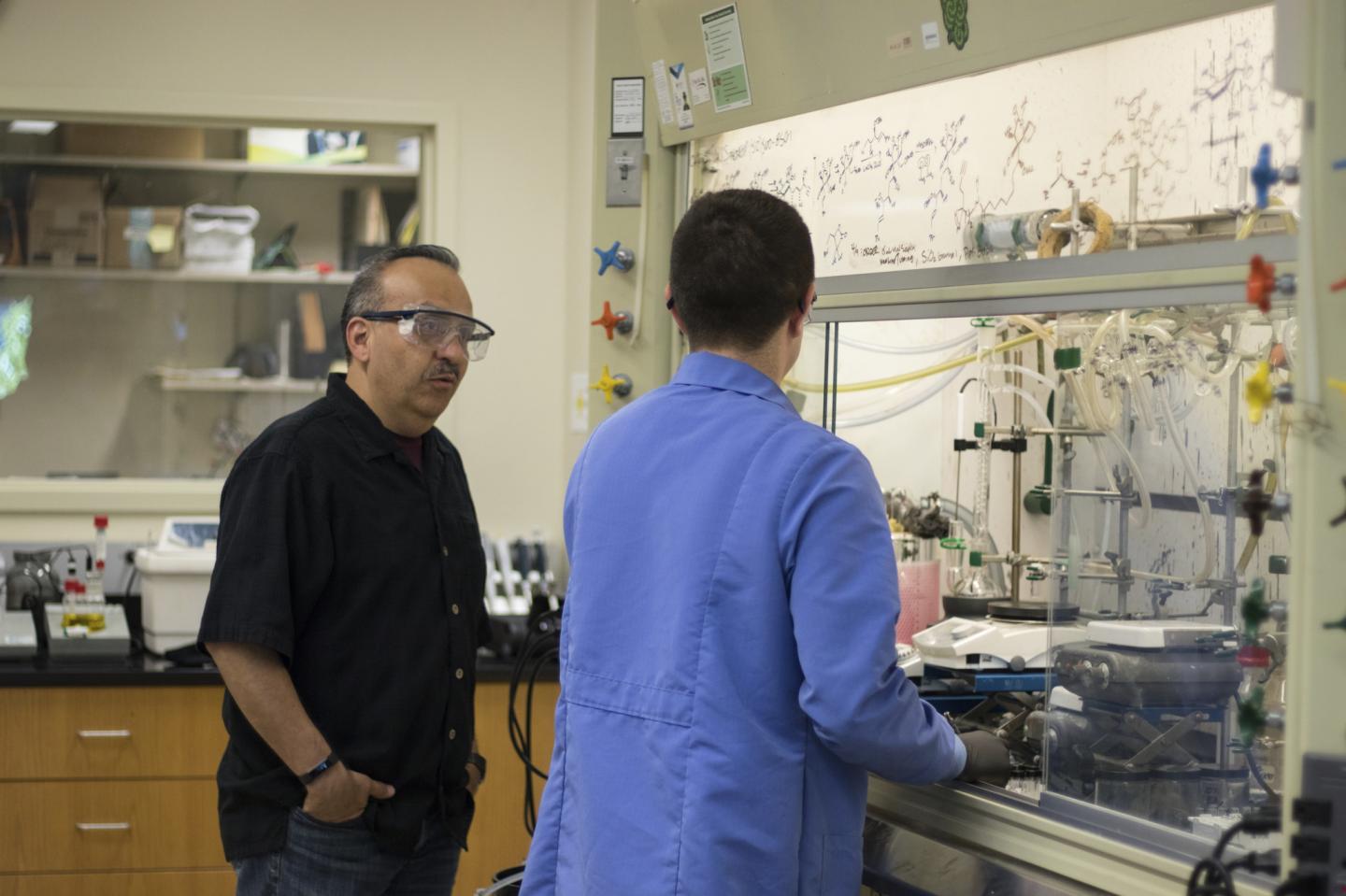
Credit: Photo by Roxane M. Jourdain
A new chemical synthesis strategy to harvest the rich information found in natural products — organic compounds isolated from natural sources — has led to the identification of novel, simpler derivatives with potential to selectively protect neurons, important for neurodegenerative diseases like Alzheimer’s disease, or to prevent the immune system from rejecting organ transplants, according to a Baylor University-led study.
The study is published in the journal Nature Chemistry.
Researchers caution that their research has led only to potential drug leads rather than drug discovery, and that possible applications likely would be many years away and would require extensive development by pharmaceutical companies. But the research is significant because the strategy to reach these drug leads has the potential to profoundly reduce the time it takes to go from an initial complex natural product to simplified versions ripe for further development.
The pilot study for this new approach began with gracilin A, a natural product derived from a sea sponge, which other researchers had found to have medicinal potential but lacked detailed structure and bioactivity relationships, said lead author Daniel Romo, Ph.D., The Schotts Professor of Chemistry in Baylor’s College of Arts & Sciences.
The streamlined synthetic method — called “pharmacophore-directed retrosynthesis” (PDR) — is “like the difference between constructing an eight-story building when all you need may be a six- or seven-floor building,” Romo said. A pharmacophore is the minimal structure required for activity of a bioactive molecule.
Romo likens his synthesis group to molecular engineers building molecules rather than buildings.
“We thought, ‘Why not come up with a hypothesis regarding what might be essential for bioactivity, integrate that minimal structure into our first-floor plans, and then gradually build up the rest of the natural product, floor by floor, while performing biological studies at every floor on the way up to the top floor?'” Romo said.
The long-term goal is quicker identification of simpler versions of the natural product that retain the bioactivity of interest. This can be done en route to synthesizing the more complex natural product target “by stopping and looking at what is on the fifth, sixth and seventh floors on your way up to the top floor,” Romo said.
This could greatly reduce the time to identify useful compounds derived from natural products, which also could ultimately impact the cost of drugs.
Chemists from Baylor University, the Universidad de Santiago de Compostela in Lugo, Spain, and the University of Aberdeen in Aberdeen, Scotland, used PDR to identify several derivatives of gracilin A that, unlike the natural product itself, were found to selectively bind one of two closely related proteins, cyclophilin A (CypA) and cyclophilin D (CypD).
CypA is involved with the immune response, and inhibition of this protein target leads to immunosuppression, an activity critical for preventing organ transplant rejection. CypD is involved in aberrant cellular processes that are implicated in neurodegenerative diseases, such as Alzheimer’s and atherosclerosis.
Romo said he hopes that pharmaceutical companies will find the PDR strategy appealing and look once again to natural products as leads for drug discovery in addition to more traditional approaches currently practiced.
“PDR could mitigate some of the concerns with the complexity of natural products, which contributed to the decline of natural products as starting points for drug discovery in the first place,” Romo said.
###
This research was supported by a grant (MERIT Award R37 GM052964) from the Institute of General Medical Sciences of the National Institutes of Health.
Media Contact
Terry Goodrich
[email protected]
Original Source
https:/
Related Journal Article
http://dx.