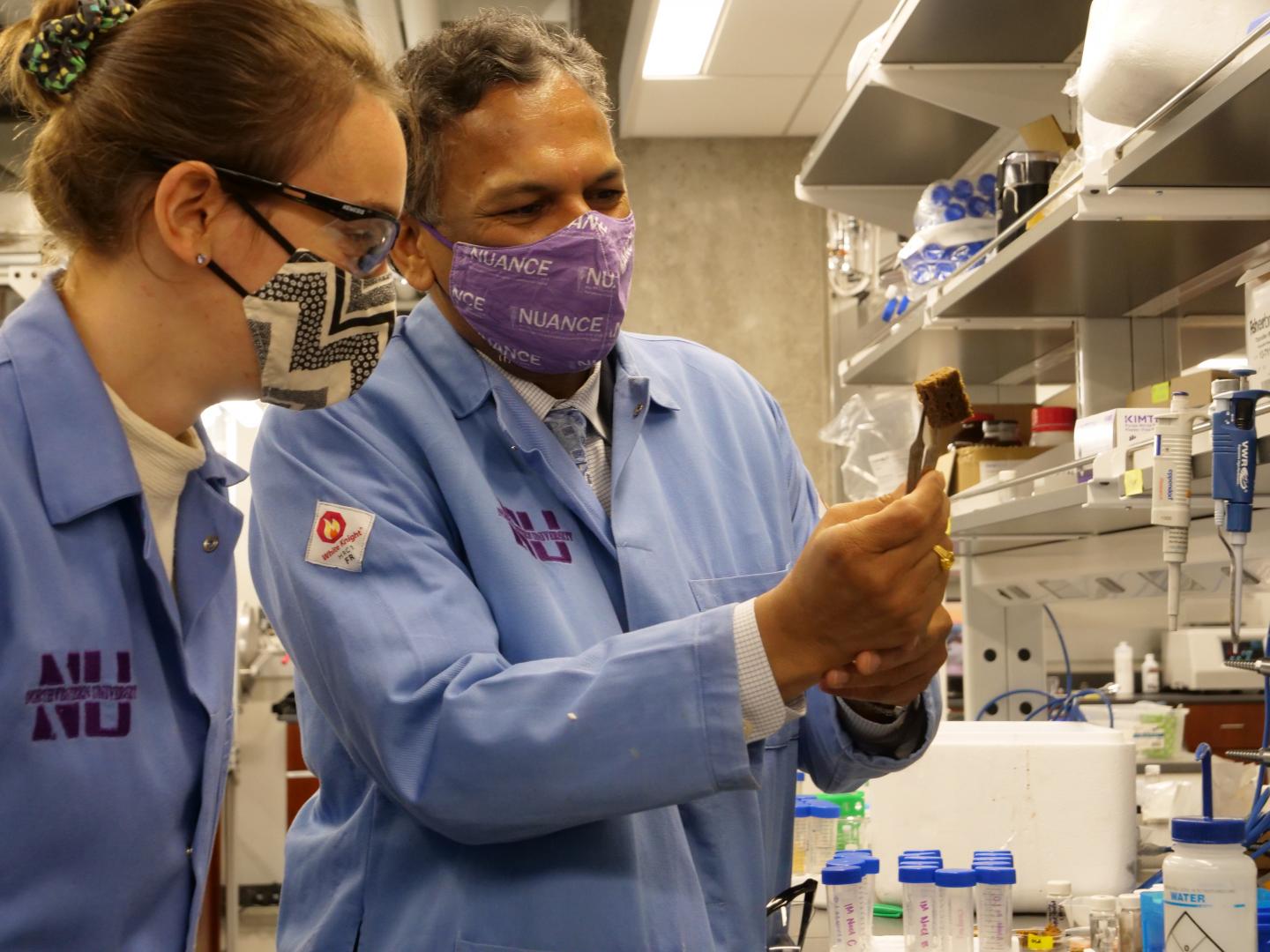
First used to soak up oil in water, new sponge sequesters excess phosphate from water
Phosphate pollution in rivers, lakes and other waterways has reached dangerous levels, causing algae blooms that starve fish and aquatic plants of oxygen. Meanwhile, farmers worldwide are coming to terms with a dwindling reserve of phosphate fertilizers that feed half the world’s food supply.
Inspired by Chicago’s many nearby bodies of water, a Northwestern University-led team has developed a way to repeatedly remove and reuse phosphate from polluted waters. The researchers liken the development to a “Swiss Army knife” for pollution remediation as they tailor their membrane to absorb and later release other pollutants.
The research will be published during the week of May 31 in the Proceedings of the National Academy of Science.
Phosphorus underpins both the world’s food system and all life on earth. Every living organism on the planet requires it: phosphorous is in cell membranes, the scaffolding of DNA and in our skeleton. Though other key elements like oxygen and nitrogen can be found in the atmosphere, phosphorous has no analog. The small fraction of usable phosphorous comes from the Earth’s crust, which takes thousands or even millions of years to weather away. And our mines are running out.
A 2021 article in The Atlantic by Julia Rosen cited Isaac Asimov’s 1939 essay, in which the American writer and chemist dubbed phosphorous “life’s bottleneck.”
Given the shortage of this non-renewable natural resource, it is sadly ironic that many of our lakes are suffering from a process known as eutrophication, which occurs when too many nutrients enter a natural water source. As phosphate and other minerals build up, aquatic vegetation and algae become too dense, depleting oxygen from water and ultimately killing aquatic life.
“We used to reuse phosphate a lot more,” said Stephanie Ribet, the paper’s first author. “Now we just pull it out of the ground, use it once and flush it away into water sources after use. So, it’s a pollution problem, a sustainability problem and a circular economy problem.”
Ecologists and engineers traditionally have developed tactics to address the mounting environmental and public health concerns around phosphate by eliminating phosphate from water sources. Only recently has the emphasis shifted away from removing to recovering phosphate.
“One can always do certain things in a laboratory setting,” said Vinayak Dravid, the study’s corresponding author. “But there’s a Venn Diagram when it comes to scaling up, where you need to be able to scale the technology, you want it to be effective and you want it to be affordable. There was nothing in that intersection of the three before, but our sponge seems to be a platform that meets all these criteria.”
Dravid is the Abraham Harris Professor of Materials Science and Engineering at Northwestern’s McCormick School of Engineering, the founding director of the Northwestern University Atomic and Nanoscale Characterization Experimental Center (NUANCE), and director of the Soft and Hybrid Nanotechnology Experimental Resource (SHyNE). Dravid also serves as the director of global initiatives for Northwestern’s International Institute of Nanotechnology. Ribet is a Ph.D. student in Dravid’s lab and the paper’s first author.
The team’s Phosphate Elimination and Recovery Lightweight (PEARL) membrane is a porous, flexible substrate (such as a coated sponge, cloth or fibers) that selectively sequesters up to 99% of phosphate ions from polluted water. Coated with nanostructures that bind to phosphate, the PEARL membrane can be tuned by controlling the pH to either absorb or release nutrients to allow for phosphate recovery and reuse of the membrane for many cycles.
Current methods to remove phosphate are based on complex, lengthy, multi-step methods. Most of them do not also recover the phosphate during removal and ultimately generate a great deal of physical waste. The PEARL membrane provides a simple one-step process to remove phosphate that also efficiently recovers it. It’s also reusable and generates no physical waste.
Using samples from Chicago’s Water Reclamation District, the researchers tested their theory with the added complexity of real water samples.
“We often call this a ‘nanoscale solution to a gigaton problem,'” Dravid said. “In many ways the nanoscale interactions that we study have implications for macrolevel remediation.”
The team has demonstrated that the sponge-based approach is effective on scales, ranging from milligrams to kilograms, suggesting promise in scaling even further.
This research builds on a former development from the same team – Vikas Nandwana, a member of the Dravid group and co-author on the present study was the first author -called the OHM (oleophilic hydrophobic multifunctional) sponge that used the same sponge platform to selectively remove and recover oil resulting from oil contamination in water. By modifying the nanomaterial coating in the membrane, the team plans to next use their “plug-and-play”-like framework to go after heavy metals. Ribet also said multiple pollutants could be addressed at once by applying multiple materials with tailored affinities.
“This water remediation challenge hits so close to home,” Ribet said. “The western basin of Lake Erie is one of the main areas you think of when it comes to eutrophication, and I was inspired by learning more about the water remediation challenges in our Great Lakes neighborhood.”
###
The research, “Phosphate Elimination and Recovery Lightweight (PEARL) Membrane: A Sustainable Environmental Remediation Approach,” was supported by the National Science Foundation (award number DMR-1929356). Research for the paper made use of SHyNE resource facilities, which are supported by the NSF National Nanotechnology Coordinated Infrastructure (NSF-NCCI) program.
Benjamin Shindel, Roberto dos Reis and Vikas Nandwana — all from Northwestern — coauthored the paper.
Media Contact
Lila Reynolds
[email protected]