• HOME
  • NEWS
  • EXPLORE
    • CAREER
      • Companies
      • Jobs
    • EVENTS
    • iGEM
      • News
      • Team
    • PHOTOS
    • VIDEO
    • WIKI
  • BLOG
  • COMMUNITY
    • FACEBOOK
    • INSTAGRAM
    • TWITTER
Friday, June 26, 2026
BIOENGINEER.ORG
No Result
View All Result
  • Login
  • HOME
  • NEWS
  • EXPLORE
    • CAREER
      • Companies
      • Jobs
        • Lecturer
        • PhD Studentship
        • Postdoc
        • Research Assistant
    • EVENTS
    • iGEM
      • News
      • Team
    • PHOTOS
    • VIDEO
    • WIKI
  • BLOG
  • COMMUNITY
    • FACEBOOK
    • INSTAGRAM
    • TWITTER
  • HOME
  • NEWS
  • EXPLORE
    • CAREER
      • Companies
      • Jobs
        • Lecturer
        • PhD Studentship
        • Postdoc
        • Research Assistant
    • EVENTS
    • iGEM
      • News
      • Team
    • PHOTOS
    • VIDEO
    • WIKI
  • BLOG
  • COMMUNITY
    • FACEBOOK
    • INSTAGRAM
    • TWITTER
No Result
View All Result
Bioengineer.org
No Result
View All Result
Home NEWS Science News Chemistry

New superlattice by CCNY team could lead to sustainable quantum electronics

Bioengineer by Bioengineer
August 18, 2020
in Chemistry
Reading Time: 2 mins read
0
IMAGE
Share on FacebookShare on TwitterShare on LinkedinShare on RedditShare on Telegram

IMAGE

Credit: Image by Lukas Zhao

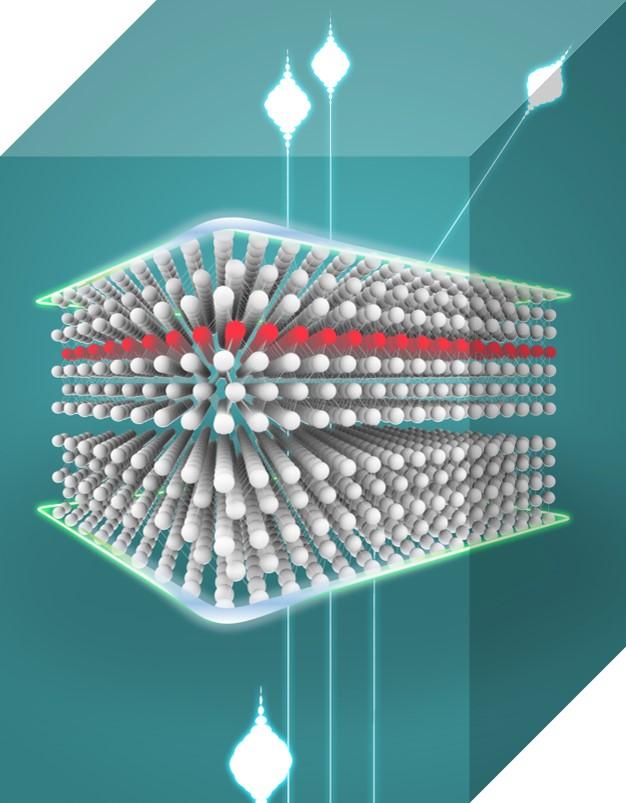
A team of international physicists led by Lia Krusin-Elbaum of the City College of New York, has created a new topological magnetic superlattice material, that at a high temperature can conduct electrical current without dissipation and lost energy. The finding, detailed in a paper published in Nature Physics, could be the basis of research leading to an entire new quantum materials class that can potentially provide a platform for error-free quantum computing.

The material in the form of crystals is created in a laboratory chamber. Atoms, in this process, naturally arrange into well-organized layers – a novel ordered magnetic superlattice – which the City College team tests in the Krusin Lab for quantized electrical transport.

The research centers around the Quantum Anomalous Hall Effect (QAHE), which describes an insulator that conducts dissipationless current in discrete channels on its surfaces. Because QAHE current does not lose energy as it travels, it is akin to a superconducting current and has the potential if industrialized to advance energy-efficient technologies.

“The main advance of this work is that the new higher temperature QAHE regime is robust, eminently tunable through electron irradiation and thermal vacancy redistribution, and can be modified on-demand by adjusting the superlattice sequence, leading to a platform for topological superconductivity,” said Krusin-Elbaum, professor in CCNY’s Division of Science.

Krusin-Elbaum and her graduate student Haiming Deng said they can advance this platform to other topological magnets. The ultimate goal would be to help transform future quantum electronics with the material. The CCNY-based Harlem Center for Quantum Materials is a partner in the research. It strives to solve fundamental problems in novel functional materials systems that have vital scientific and technological importance.

###

The research is supported in part by the National Science Foundation.

Media Contact
Jay Mwamba
[email protected]

Original Source

https://www.ccny.cuny.edu/news/new-superlattice-ccny-team-could-lead-sustainable-quantum-electronics

Tags: Atomic PhysicsAtomic/Molecular/Particle PhysicsChemistry/Physics/Materials SciencesElectromagneticsMaterialsMolecular PhysicsNanotechnology/MicromachinesParticle PhysicsSuperconductors/Semiconductors
Share12Tweet8Share2ShareShareShare2

Related Posts

AI and Physics Collaborate to Design Advanced Hydrogen Storage Materials

June 25, 2026

International Team Including Dresden Scientists Develops Novel Designer Proteins for Advanced Study of Living Tissue

June 25, 2026

New Study Uncovers Key Factors Driving Water Chemistry in Nanoscale Environments

June 25, 2026

Plasma Technology Extends Catalyst Lifespan in Hydrogen Production

June 24, 2026
Please login to join discussion

POPULAR NEWS

  • Saying Goodbye to PGY-6: Pediatric Fellowship Realities

    103 shares
    Share 41 Tweet 26
  • Multi-Hospital Study Reveals Long Covid Burden Is Twice as High as Current Estimates

    92 shares
    Share 36 Tweet 23
  • Detection of EDCs in Breast Milk and Infant Urine Up to Six Months Highlights Early Exposure Risks

    77 shares
    Share 31 Tweet 19
  • New Drug Candidate Developed at McMaster Shows Potential for Treating Brain Cancer

    58 shares
    Share 23 Tweet 15

About

We bring you the latest biotechnology news from best research centers and universities around the world. Check our website.

Follow us

Recent News

Tracking Lanthanide-Labeled Microplastics in Plants

POSTECH Researchers Slash Cost of Reconstituted Cell-Free Systems by 95%

AI and Physics Collaborate to Design Advanced Hydrogen Storage Materials

Subscribe to Blog via Email

Success! An email was just sent to confirm your subscription. Please find the email now and click 'Confirm' to start subscribing.

Join 82 other subscribers
  • Contact Us

Bioengineer.org © Copyright 2023 All Rights Reserved.

Welcome Back!

Login to your account below

Forgotten Password?

Retrieve your password

Please enter your username or email address to reset your password.

Log In
No Result
View All Result
  • Homepages
    • Home Page 1
    • Home Page 2
  • News
  • National
  • Business
  • Health
  • Lifestyle
  • Science

Bioengineer.org © Copyright 2023 All Rights Reserved.