• HOME
  • NEWS
  • EXPLORE
    • CAREER
      • Companies
      • Jobs
    • EVENTS
    • iGEM
      • News
      • Team
    • PHOTOS
    • VIDEO
    • WIKI
  • BLOG
  • COMMUNITY
    • FACEBOOK
    • INSTAGRAM
    • TWITTER
Monday, May 11, 2026
BIOENGINEER.ORG
No Result
View All Result
  • Login
  • HOME
  • NEWS
  • EXPLORE
    • CAREER
      • Companies
      • Jobs
        • Lecturer
        • PhD Studentship
        • Postdoc
        • Research Assistant
    • EVENTS
    • iGEM
      • News
      • Team
    • PHOTOS
    • VIDEO
    • WIKI
  • BLOG
  • COMMUNITY
    • FACEBOOK
    • INSTAGRAM
    • TWITTER
  • HOME
  • NEWS
  • EXPLORE
    • CAREER
      • Companies
      • Jobs
        • Lecturer
        • PhD Studentship
        • Postdoc
        • Research Assistant
    • EVENTS
    • iGEM
      • News
      • Team
    • PHOTOS
    • VIDEO
    • WIKI
  • BLOG
  • COMMUNITY
    • FACEBOOK
    • INSTAGRAM
    • TWITTER
No Result
View All Result
Bioengineer.org
No Result
View All Result
Home NEWS Science News Chemistry

New study suggests supermassive black holes could form from dark matter

Bioengineer by Bioengineer
February 24, 2021
in Chemistry
Reading Time: 3 mins read
0
IMAGE
Share on FacebookShare on TwitterShare on LinkedinShare on RedditShare on Telegram

IMAGE

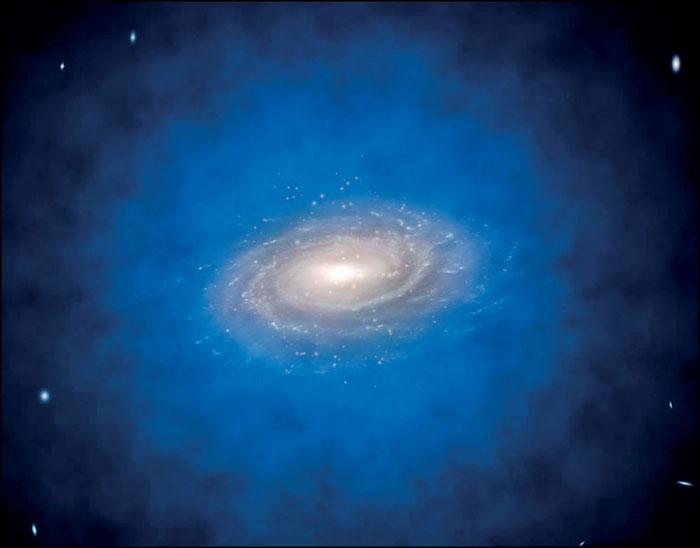
Credit: ESO / L. Calçada

A new theoretical study has proposed a novel mechanism for the creation of supermassive black holes from dark matter. The international team find that rather than the conventional formation scenarios involving ‘normal’ matter, supermassive black holes could instead form directly from dark matter in high density regions in the centres of galaxies. The result has key implications for cosmology in the early Universe, and is published in Monthly Notices of the Royal Astronomical Society.

Exactly how supermassive black holes initially formed is one of the biggest problems in the study of galaxy evolution today. Supermassive black holes have been observed as early as 800 million years after the Big Bang, and how they could grow so quickly remains unexplained.

Standard formation models involve normal baryonic matter – the atoms and elements that that make up stars, planets, and all visible objects – collapsing under gravity to form black holes, which then grow over time. However the new work investigates the potential existence of stable galactic cores made of dark matter, and surrounded by a diluted dark matter halo, finding that the centres of these structures could become so concentrated that they could also collapse into supermassive black holes once a critical threshold is reached.

According to the model this could have happened much more quickly than other proposed formation mechanisms, and would have allowed supermassive black holes in the early Universe to form before the galaxies they inhabit, contrary to current understanding.

Carlos R. Argüelles, the researcher at Universidad Nacional de La Plata and ICRANet who led the investigation comments: “This new formation scenario may offer a natural explanation for how supermassive black holes formed in the early Universe, without requiring prior star formation or needing to invoke seed black holes with unrealistic accretion rates.”

Another intriguing consequence of the new model is that the critical mass for collapse into a black hole might not be reached for smaller dark matter halos, for example those surrounding some dwarf galaxies. The authors suggest that this then might leave smaller dwarf galaxies with a central dark matter nucleus rather than the expected black hole. Such a dark matter core could still mimic the gravitational signatures of a conventional central black hole, whilst the dark matter outer halo could also explain the observed galaxy rotation curves.

“This model shows how dark matter haloes could harbour dense concentrations at their centres, which may play a crucial role in helping to understand the formation of supermassive black holes,” added Carlos.

“Here we’ve proven for the first time that such core-halo dark matter distributions can indeed form in a cosmological framework, and remain stable for the lifetime of the Universe.”

The authors hope that further studies will shed more light on supermassive black hole formation in the very earliest days of our Universe, as well as investigating whether the centres of non-active galaxies, including our own Milky Way, may play host to these dense dark matter cores.

###

Media Contact
Morgan Hollis
[email protected]

Original Source

https://ras.ac.uk/news-and-press/research-highlights/new-study-suggests-supermassive-black-holes-could-form-dark

Related Journal Article

http://dx.doi.org/10.1093/mnras/staa3986

Tags: AstronomyAstrophysicsSpace/Planetary Science
Share12Tweet8Share2ShareShareShare2

Related Posts

Miniature Sensor Uses Light to Detect Touch — Chemistry

Miniature Sensor Uses Light to Detect Touch

May 8, 2026
Iron Minerals Determine Whether Dissolved Organic Matter Fuels Microbes or Becomes Long-Term Carbon Storage — Chemistry

Iron Minerals Determine Whether Dissolved Organic Matter Fuels Microbes or Becomes Long-Term Carbon Storage

May 8, 2026

Kate Evans Appointed Associate Lab Director for Biological and Environmental Systems Science at ORNL

May 8, 2026

Advancing Multiscale Modeling and Overcoming Operational Challenges in Autothermal CO₂-to-Methanol Reactors

May 8, 2026
Please login to join discussion

POPULAR NEWS

  • Research Indicates Potential Connection Between Prenatal Medication Exposure and Elevated Autism Risk

    840 shares
    Share 336 Tweet 210
  • New Study Reveals Plants Can Detect the Sound of Rain

    727 shares
    Share 290 Tweet 181
  • Salmonella Haem Blocks Macrophages, Boosts Infection

    61 shares
    Share 24 Tweet 15
  • Breastmilk Balances E. coli and Beneficial Bacteria in Infant Gut Microbiomes

    57 shares
    Share 23 Tweet 14

About

We bring you the latest biotechnology news from best research centers and universities around the world. Check our website.

Follow us

Recent News

New Post-Hoc Analysis Explores Daily Oral Orforglipron Use in Adults Over 65 with Obesity, Regardless of Diabetes Status

Evaluating Digoxin Use in Patients with Symptomatic Rheumatic Heart Disease

Evaluating the Effectiveness and Safety of Digitalis Glycosides in Treating Heart Failure

Subscribe to Blog via Email

Enter your email address to subscribe to this blog and receive notifications of new posts by email.

Join 82 other subscribers
  • Contact Us

Bioengineer.org © Copyright 2023 All Rights Reserved.

Welcome Back!

Login to your account below

Forgotten Password?

Retrieve your password

Please enter your username or email address to reset your password.

Log In
No Result
View All Result
  • Homepages
    • Home Page 1
    • Home Page 2
  • News
  • National
  • Business
  • Health
  • Lifestyle
  • Science

Bioengineer.org © Copyright 2023 All Rights Reserved.