• HOME
  • NEWS
  • EXPLORE
    • CAREER
      • Companies
      • Jobs
    • EVENTS
    • iGEM
      • News
      • Team
    • PHOTOS
    • VIDEO
    • WIKI
  • BLOG
  • COMMUNITY
    • FACEBOOK
    • INSTAGRAM
    • TWITTER
Friday, May 15, 2026
BIOENGINEER.ORG
No Result
View All Result
  • Login
  • HOME
  • NEWS
  • EXPLORE
    • CAREER
      • Companies
      • Jobs
        • Lecturer
        • PhD Studentship
        • Postdoc
        • Research Assistant
    • EVENTS
    • iGEM
      • News
      • Team
    • PHOTOS
    • VIDEO
    • WIKI
  • BLOG
  • COMMUNITY
    • FACEBOOK
    • INSTAGRAM
    • TWITTER
  • HOME
  • NEWS
  • EXPLORE
    • CAREER
      • Companies
      • Jobs
        • Lecturer
        • PhD Studentship
        • Postdoc
        • Research Assistant
    • EVENTS
    • iGEM
      • News
      • Team
    • PHOTOS
    • VIDEO
    • WIKI
  • BLOG
  • COMMUNITY
    • FACEBOOK
    • INSTAGRAM
    • TWITTER
No Result
View All Result
Bioengineer.org
No Result
View All Result
Home NEWS Science News Chemistry

New study presents stretchable and colorless solar cells, using Si microwire composites

Bioengineer by Bioengineer
March 9, 2020
in Chemistry
Reading Time: 3 mins read
0
IMAGE
Share on FacebookShare on TwitterShare on LinkedinShare on RedditShare on Telegram

IMAGE

Credit: UNIST


As solar cells become more transparent, you may now add transparent panels of solar cells on windows of buildings and electronic devices to generate electricity. Furthermore, in adding flexibility to this, its product range will be even expanded to assure the future mobile applications for wearable devices.

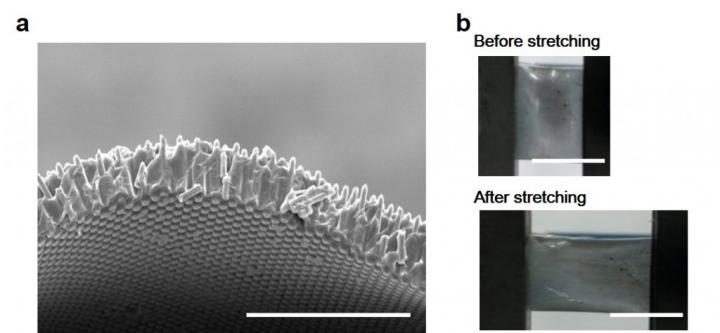
A research team, led by Professor Kyoung Jin Choi in the School of Materials Science and Engineering at UNIST has introduced a flexible and transparent solar cell, using silicon microwire composites. The new solar cell takes a structure in which cylindrical silicon rods are embedded in a flexible and transparent polymer material. As the visible lights passes between polymer materials without silicon rods, it appears entirely transparent to the human eye. It is also designed to control the sunlight reflected from the silicon rods, thereby increasing efficiency.

When sunlight reaches Earth, the energy is absorbed, transmitted, or reflected. In the case of solar cells, they generate electricity when light is absorbed in their photoactive layers. Whereas, an object that appears to be transparent are when the visible light of solar radiation passes through it. Therefore, making silicon-based solar cells transparent will reduce the amount of solar radiation absorbed, which may actually result in decreasing their efficiency.

To overcome such limitation, Professor Choi’s team used transparent and flexible polymer substrates and specially shaped silicon rods. In this solar cell, a silicon rod acts as a photoactive layer, absorbing sunlight and producing electricity. These silicone rods are arranged at intervals which are transparent and invisible to the naked eye. As a result, the new solar cell maintains the transparent and flexible properties of the substrate itself.

In the study, the research team has changed the shape of the SiMW tip dramatically for increased light absorption, while maintaining transparency. With the conventional solar cells, reflection occurs, as well as the absorption and transmission of light. Most of them are unable to take advantage of the reflected light, but the researchers created a structure to absorb it back into the solar cell. Based on the analysis of the light absorption mechanism in the silicon rods, the team designed the light reflected from the top of the bar to be absorbed by the bar next to it.

“This is a new attempt to apply the results of analyzing the theoretical light absorption mechanism to the development of high performance transparent solar cells,” says Sung Bum Kang (Combined MS/Phd program in the School of Materials Science and Engineering, UNIST), the first author of the study. “Thus, this recycling structure that reuses has increased the efficiency of the entire solar cell.”

“Existing transparent solar cells were manufactured on rigid glass substrates, so their application range was limited,” says Professor Choi. “The new solar cell is expected to maintain its initial efficiency of more than 95% even after dozens of bending tests, and be applied to a variety of buildings, vehicle glass, and portable electronic devices.”

###

The findings of this research have been published in Light: Science and Application, a peer-reviewed, open access scientific journal published by the Nature Publishing Group on December 12, 2019. This study has been supported by the Mid-career Research Program through the National Research Foundation (NRF).

Journal Reference

Kang, S.B., Kim, J., Jeong, M.H. et al., “Stretchable and colorless freestanding microwire arrays for transparent solar cells with flexibility,” Light Sci Appl 8, 121 (2019).

Media Contact
JooHyeon Heo
[email protected]
82-522-171-223

Original Source

https://www.asiaresearchnews.com/content/stretchable-and-colorless-freestanding-microwire-arrays-transparent-solar-cells-flexibility

Tags: Chemistry/Physics/Materials SciencesIndustrial Engineering/ChemistryMaterialsResearch/DevelopmentSuperconductors/SemiconductorsTechnology Transfer
Share12Tweet8Share2ShareShareShare2

Related Posts

Smart Hydrogels Revolutionize Information Security with Photo-Patterning and Multi-Stimuli Responsive Structural Colors — Chemistry

Smart Hydrogels Revolutionize Information Security with Photo-Patterning and Multi-Stimuli Responsive Structural Colors

May 15, 2026
Scientists Overcome Longstanding Challenge in Measuring Semiconductor Defects — Chemistry

Scientists Overcome Longstanding Challenge in Measuring Semiconductor Defects

May 14, 2026

Wall Design Highlights Deaf and Hard-of-Hearing Experience at #ASA190

May 14, 2026

New Method Finds More Efficient Route Between Earth and Moon Than Ever Before

May 14, 2026
Please login to join discussion

POPULAR NEWS

  • Research Indicates Potential Connection Between Prenatal Medication Exposure and Elevated Autism Risk

    843 shares
    Share 337 Tweet 211
  • New Study Reveals Plants Can Detect the Sound of Rain

    729 shares
    Share 291 Tweet 182
  • Salmonella Haem Blocks Macrophages, Boosts Infection

    62 shares
    Share 25 Tweet 16
  • Breastmilk Balances E. coli and Beneficial Bacteria in Infant Gut Microbiomes

    58 shares
    Share 23 Tweet 15

About

We bring you the latest biotechnology news from best research centers and universities around the world. Check our website.

Follow us

Recent News

Digital Health Fear Patterns in Older Cancer Patients

A*STAR Scientists Unveil Novel Technique to Decipher RNA Structure’s Impact on Health and Disease

Smart Hydrogels Revolutionize Information Security with Photo-Patterning and Multi-Stimuli Responsive Structural Colors

Subscribe to Blog via Email

Enter your email address to subscribe to this blog and receive notifications of new posts by email.

Join 82 other subscribers
  • Contact Us

Bioengineer.org © Copyright 2023 All Rights Reserved.

Welcome Back!

Login to your account below

Forgotten Password?

Retrieve your password

Please enter your username or email address to reset your password.

Log In
No Result
View All Result
  • Homepages
    • Home Page 1
    • Home Page 2
  • News
  • National
  • Business
  • Health
  • Lifestyle
  • Science

Bioengineer.org © Copyright 2023 All Rights Reserved.