Credit: Andreas Möller
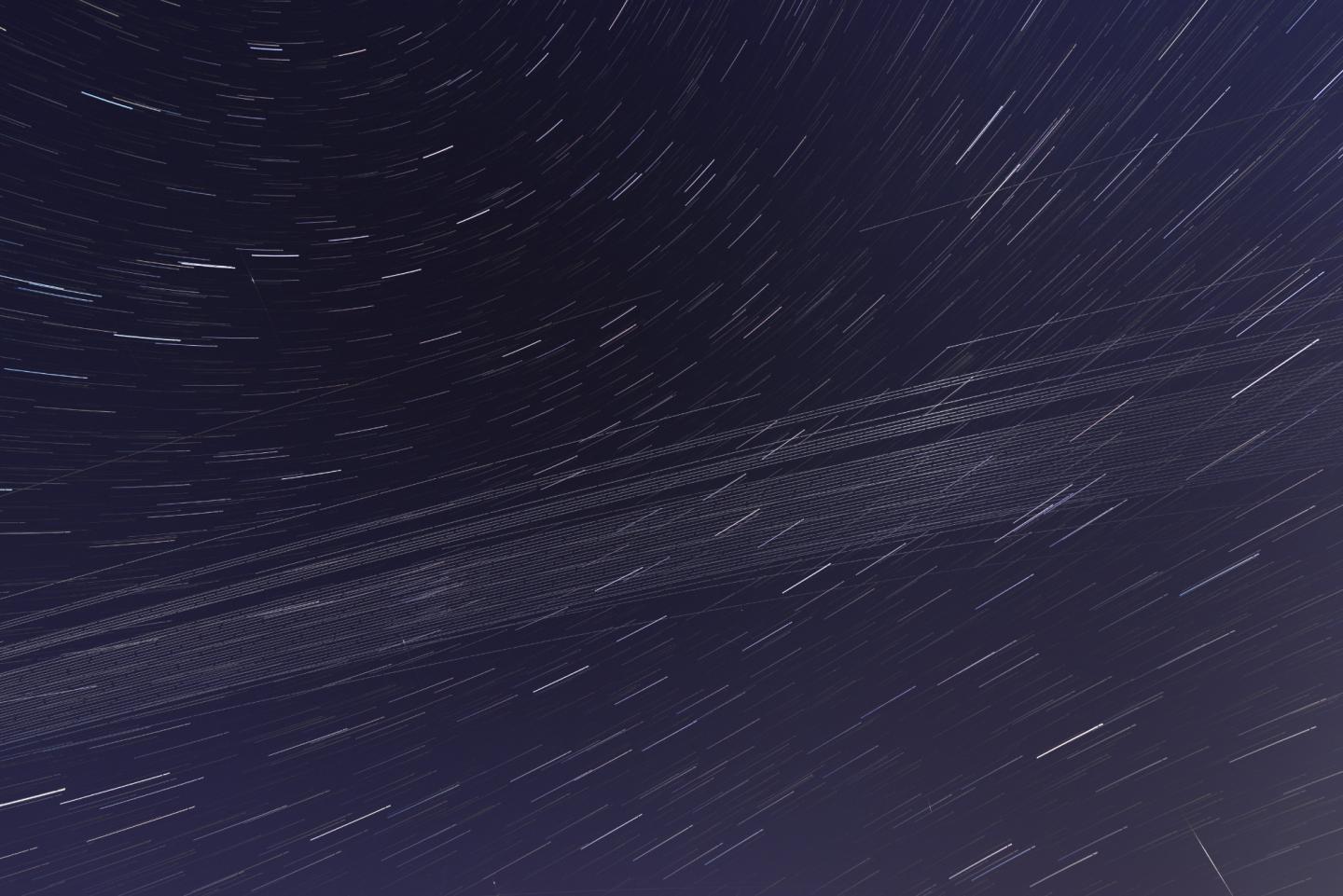
Scientists reported new research results today suggesting that artificial objects in orbit around the Earth are brightening night skies on our planet significantly more than previously understood.
The research, accepted for publication in Monthly Notices of the Royal Astronomical Society: Letters, finds that the number of objects orbiting Earth could elevate the overall brightness of the night sky by more than 10 percent above natural light levels across a large part of the planet. This would exceed a threshold that astronomers set over 40 years ago for considering a location “light polluted”.
“Our primary motivation was to estimate the potential contribution to night sky brightness from external sources, such as space objects in Earth’s orbit,” said Miroslav Kocifaj of the Slovak Academy of Sciences and Comenius University in Slovakia, who led the study. “We expected the sky brightness increase would be marginal, if any, but our first theoretical estimates have proved extremely surprising and thus encouraged us to report our results promptly.”
The work is the first to consider the overall impact of space objects on the night sky rather than the effect of individual satellites and space debris affecting astronomers’ images of the night sky. The team of researchers, based at institutions in Slovakia, Spain and the US, modelled the space objects’ contribution to the overall brightness of the night sky, using the known distributions of the sizes and brightnesses of the objects as inputs to the model.
The study includes both functioning satellites as well as assorted debris such as spent rocket stages. While telescopes and sensitive cameras often resolve space objects as discrete points of light, low-resolution detectors of light such as the human eye see only the combined effect of many such objects. The effect is an overall increase in the diffuse brightness of the night sky, potentially obscuring sights such as the glowing clouds of stars in the Milky Way, as seen away from the light pollution of cities.
“Unlike ground-based light pollution, this kind of artificial light in the night sky can be seen across a large part of the Earth’s surface,” explained John Barentine, Director of Public Policy for the International Dark-Sky Association and a study co-author. “Astronomers build observatories far from city lights to seek dark skies, but this form of light pollution has a much larger geographical reach.”
Astronomers have expressed unease in recent years about the growing number of objects orbiting the planet, particularly large fleets of communications satellites known informally as ‘mega-constellations’.
In addition to crowding the night sky with more moving sources of artificial light, the arrival of this technology increases the probability of collisions among satellites or between satellites and other objects, generating further debris. Recent reports sponsored by the US National Science Foundation and the United Nations Office for Outer Space Affairs identified mega-constellations as a threat to the continued utility of astronomy facilities on the ground and in low-Earth orbit. In the UK the Royal Astronomical Society has established several working groups to understand the impact of mega-constellations on optical and radio astronomical facilities used by scientists.
The results published today imply a further brightening of the night sky proportional to the number of new satellites launched and their optical characteristics in orbit. Satellite operators like SpaceX have recently worked to lower the brightness of their spacecraft through design changes. Despite these mitigating efforts though, the collective effect of a sharp increase in the number of orbiting objects stands to change the experience of the night sky for many across the globe.
The researchers hope that their work will change the nature of the ongoing dialog between satellite operators and astronomers concerning how best to manage the orbital space around the Earth.
“Our results imply that many more people than just astronomers stand to lose access to pristine night skies,” Barentine said. “This paper may really change the nature of that conversation.”
###
Media Contact
Robert Massey
[email protected]
Original Source
https:/
Related Journal Article
http://dx.