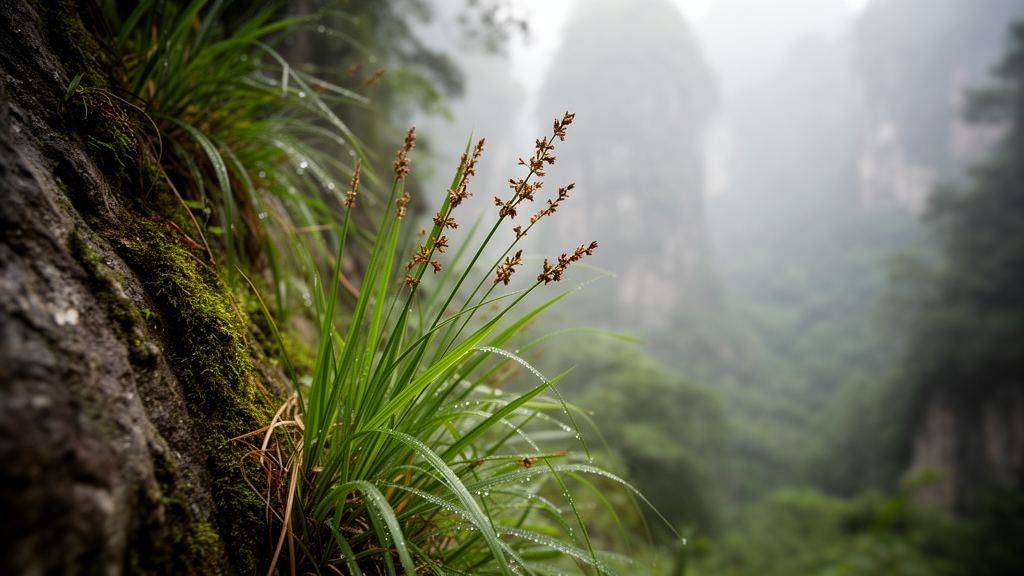
Botanists surveying forested mountain slopes in southern China have uncovered a sedge unlike any previously catalogued, and a combination of field observation, scanning electron microscopy and DNA sequencing now confirms it as a species new to science. The plant, formally named Carex ensiformis, belongs to Carex subg. Siderosticta, the earliest-diverging branch of the entire sedge genus, and was collected during fieldwork in Hezhou City in Guangxi and Jianghua County in Hunan, with additional herbarium material later traced to Lianshan County in Guangdong. The description, published as an open access original article in Botanical Studies, rests on nine field-collected vouchers and a five-marker phylogenetic dataset, and it adds a distinctive member to one of the most morphologically puzzling groups in the family Cyperaceae.
Carex is a giant among flowering plant genera, comprising more than 2,000 species and ranking as the most species-rich genus in the sedge family, with a distribution that spans nearly the whole world. Recent phylogenetic studies have recognized six major lineages within the genus, namely the Siderostictae, Schoenoxiphium, Unispicate, Uncinia, Vignea and core Carex clades, and on that basis a revised infrageneric classification now divides Carex into six subgenera, 62 formally named Linnaean sections and 49 informal groups. China stands out as one of the major centers of diversity for the genus, with more than 600 species currently documented across the country. Within this framework, subg. Siderosticta occupies a special position: it represents the earliest-diverging lineage within Carex and is sister to all remaining species in the genus, making every new discovery within the group potentially informative about the early evolutionary history of sedges as a whole.
Subg. Siderosticta is endemic to East and Southeast Asia, with its diversity center in the latter region, and it currently comprises about 30 species traditionally assigned to four morphology-based sections: sect. Siderostictae with 13 species, sect. Hemiscaposae with 12, sect. Surculosae with three, and sect. Hypolytroides with two. Species of sect. Hemiscaposae, the group to which the new species was first assigned on morphological grounds, are highly distinctive within Carex. They combine lateral leafless culms, paniculate inflorescences, androgynous spikes and remarkably broad, pseudopetiolate leaves that can reach up to 12 centimeters in width. The section is distributed mainly across south-central to southeastern China, including seven endemic species, and extends into Vietnam and Laos. Inflorescence architecture within the section is highly variable and has traditionally served as a critical set of diagnostic characters for telling species apart.
The story of the new species began during botanical field surveys, when researchers encountered a distinctive Carex in the forests of Hezhou City and Jianghua County. Through comprehensive morphological and micromorphological observations, molecular phylogenetic analyses and examination of relevant herbarium specimens and literature, they determined it to be a new species belonging to the traditionally circumscribed sect. Hemiscaposae within subg. Siderosticta. During the subsequent examination of herbarium material, additional populations turned up from Lianshan County in Guangdong, broadening the known range of the plant. The specimens examined came from Guangdong, Guangxi and Hunan provinces, and the authors studied relevant material of subg. Siderosticta, including type specimens, deposited in herbaria including E, GXMI, GXMG, HAST, IBK, IBSC, K, KUN, P, PE, WIN and ZJFC, supplementing the physical collections with online images from the Chinese Virtual Herbarium and JSTOR Global Plants.
The morphological evidence places C. ensiformis squarely within the traditional circumscription of sect. Hemiscaposae. It has lateral culms, tufted basal leaves, complex inflorescences with paniculate branches, bisexual androgynous spikes, and spikes that all arise from flowerless utriculiform cladoprophylls. The plant is a rhizomatous, stoloniferous perennial with lateral culms 20 to 55 centimeters tall, ribbon-like basal leaves 20 to 40 centimeters long and 1 to 2.5 centimeters wide, and a compound panicle with 7 to 14 branches, each branch bearing 5 to 15 spikes. Its staminate and pistillate glumes are small, at 1 to 1.5 millimeters, the ellipsoid utricles measure 1.7 to 2.5 millimeters including the beak, and the ovoid, trigonous nutlets are about 1.5 millimeters long. The specific epithet ensiformis refers to the sword-shaped leaves, and the plant flowers and fruits from late March to early May.
Among known species, C. ensiformis most closely resembles C. damiaoshanensis, but the differences are consistent and measurable. The new species has 7 to 14 inflorescence branches compared with 4 to 6 in C. damiaoshanensis, each branched inflorescence carries 5 to 15 spikes rather than 3 or 4, its utricles are 1.7 to 2.5 millimeters long against 4 to 5 millimeters, the utricle apex contracts abruptly into a beak only 0.2 to 0.5 millimeters long instead of one roughly 2 millimeters long, and its nutlets are ovoid and about 1.5 millimeters long rather than obovoid and 2 to 2.5 millimeters. The two species also differ in geography: C. ensiformis is mainly distributed in northern Guangxi, northern Guangdong and southern Hunan, whereas C. damiaoshanensis is currently known only from the Damiao Mountain region of Guangxi.
Micromorphology added a second, independent line of evidence. The researchers used scanning electron microscopy on mature utricles and nutlets of the new species, collected from Jianghua in Hunan, together with comparative material of C. damiaoshanensis from Jiuwanshan National Nature Reserve in Guangxi. Nutlets were pretreated by soaking in a mixture of concentrated sulfuric acid and glacial acetic acid at a volumetric ratio of 1:9 for 12 hours to remove residual silica from the surface, rinsed, ultrasonically cleaned in 70 percent ethanol, air-dried, mounted on stubs, gold-coated and photographed under a Hitachi SU8010 SEM. Both species share ellipsoid, obtusely trigonous, glabrous utricles with many longitudinal veins, and nutlet epidermal cells that are mainly irregular five- or six-gonal, each with a large silica platform and a single large silica body at its center. The decisive differences lie in the details: C. ensiformis has slightly undulate anticlinal cell walls of the nutlet epidermis, versus straight walls in C. damiaoshanensis, along with a markedly shorter beak at the nutlet apex and a distinctly shorter utricle beak.
The molecular work relied on deep genome skimming. Four individuals of C. ensiformis were sampled, representing three populations from Hezhou and one from Jianghua, and fresh leaves were dried in silica gel before total genomic DNA was extracted using a modified CTAB method. Sequencing on a BGI DNBSEQ-T7 platform generated 150 base pair paired-end reads, from which the target fragments of three plastid markers, matK, ndhF and rps16, and two nuclear markers, ETS and ITS, were extracted using a combined assembly and local alignment strategy with GetOrganelle, local BLAST searches and Samtools. These newly retrieved fragments were combined with 74 sequences downloaded from NCBI representing 29 samples and 26 species, with C. baccans and C. cruciata serving as outgroups. Maximum likelihood analyses in IQ-TREE with 1,000 ultrafast bootstrap replicates and Bayesian inference in MrBayes produced largely congruent topologies, the only incongruence involving the placement of C. glossostigma.
The phylogenetic results were unambiguous about the new species itself. Both analyses consistently recovered the four individuals of C. ensiformis as a strongly supported monophyletic clade, with a Bayesian posterior probability of 1.00 and ultrafast bootstrap support of 95 percent, resolved as sister to a clade comprising C. densifimbriata, C. densifimbriata var. hirsuta and C. liouana. Species of sects. Siderostictae, Hemiscaposae and Surculosae together formed a sister clade to the two species of sect. Hypolytroides, with all species within the sections highly supported. Notably, sect. Hemiscaposae as traditionally circumscribed was not recovered as monophyletic in either analysis. The authors are careful about what this means: although C. ensiformis falls within a well-supported clade of species traditionally assigned to the section, this supports the species’ affinity with the section rather than demonstrating the monophyly of the section itself, and further taxon sampling and additional molecular data will be needed to clarify the phylogenetic limits of the group.
An interesting tension emerges from combining the two lines of evidence. Phylogenetically, C. ensiformis is sister to C. densifimbriata, yet the two species are readily distinguishable morphologically, a mismatch the authors interpret in light of convergent evolution and phenotypic plasticity in vegetative traits such as culm height, leaf morphology and inflorescence size. Reproductive characters, particularly those of the utricle and nutlet, are generally more conserved and carry greater taxonomic weight, which is why the SEM observations proved so valuable. On conservation grounds, the species has been recorded from seven localities across Guangxi, Hunan and Guangdong, with an estimated extent of occurrence of approximately 4,000 square kilometers, a threshold for Vulnerable under IUCN criterion B1. However, it does not meet the additional conditions required for a threatened category: its populations occur in relatively continuous, well-preserved high-elevation forest habitats at 750 to 1,050 meters, there is no evidence of continuing decline in extent of occurrence, area of occupancy, habitat quality or mature individual numbers, and no extreme fluctuations have been observed. It is therefore assessed as Least Concern. The discovery enriches the species diversity of subg. Siderosticta and suggests that the sedge flora of southern China, where additional cryptic or narrowly distributed species may still await discovery, remains incompletely documented.
Subject of Research: Description of a new sedge species, Carex ensiformis, from southern China based on morphological and molecular phylogenetic evidence.
Article Title: Carex ensiformis (C. subg. Siderosticta), a new species from southern China based on morphological and molecular evidence
Article References: Lu, Z., Lu, Y., & Jin, X. (2026). Carex ensiformis (C. subg. Siderosticta), a new species from southern China based on morphological and molecular evidence. Botanical Studies, 67(1), Article 11. https://doi.org/10.1186/s40529-026-00498-y
Image Credits: AI Generated
DOI: 10.1186/s40529-026-00498-y
Keywords: Carex, Carex ensiformis, Cyperaceae, subg. Siderosticta, new species, taxonomy, phylogenetics, southern China, SEM micromorphology, sect. Hemiscaposae, integrative taxonomy, herbarium specimens
News Source: Margaret Porter. (October 28, 2026). New Sedge Species from Southern China Reshapes Ideas of Carex Diversity. Scienmag.