• HOME
  • NEWS
  • EXPLORE
    • CAREER
      • Companies
      • Jobs
    • EVENTS
    • iGEM
      • News
      • Team
    • PHOTOS
    • VIDEO
    • WIKI
  • BLOG
  • COMMUNITY
    • FACEBOOK
    • INSTAGRAM
    • TWITTER
Saturday, May 16, 2026
BIOENGINEER.ORG
No Result
View All Result
  • Login
  • HOME
  • NEWS
  • EXPLORE
    • CAREER
      • Companies
      • Jobs
        • Lecturer
        • PhD Studentship
        • Postdoc
        • Research Assistant
    • EVENTS
    • iGEM
      • News
      • Team
    • PHOTOS
    • VIDEO
    • WIKI
  • BLOG
  • COMMUNITY
    • FACEBOOK
    • INSTAGRAM
    • TWITTER
  • HOME
  • NEWS
  • EXPLORE
    • CAREER
      • Companies
      • Jobs
        • Lecturer
        • PhD Studentship
        • Postdoc
        • Research Assistant
    • EVENTS
    • iGEM
      • News
      • Team
    • PHOTOS
    • VIDEO
    • WIKI
  • BLOG
  • COMMUNITY
    • FACEBOOK
    • INSTAGRAM
    • TWITTER
No Result
View All Result
Bioengineer.org
No Result
View All Result
Home NEWS Science News Chemistry

New scenario for the India-Asia collision dynamics

Bioengineer by Bioengineer
July 28, 2020
in Chemistry
Reading Time: 2 mins read
0
IMAGE
Share on FacebookShare on TwitterShare on LinkedinShare on RedditShare on Telegram

IMAGE

Credit: ©Science China Press

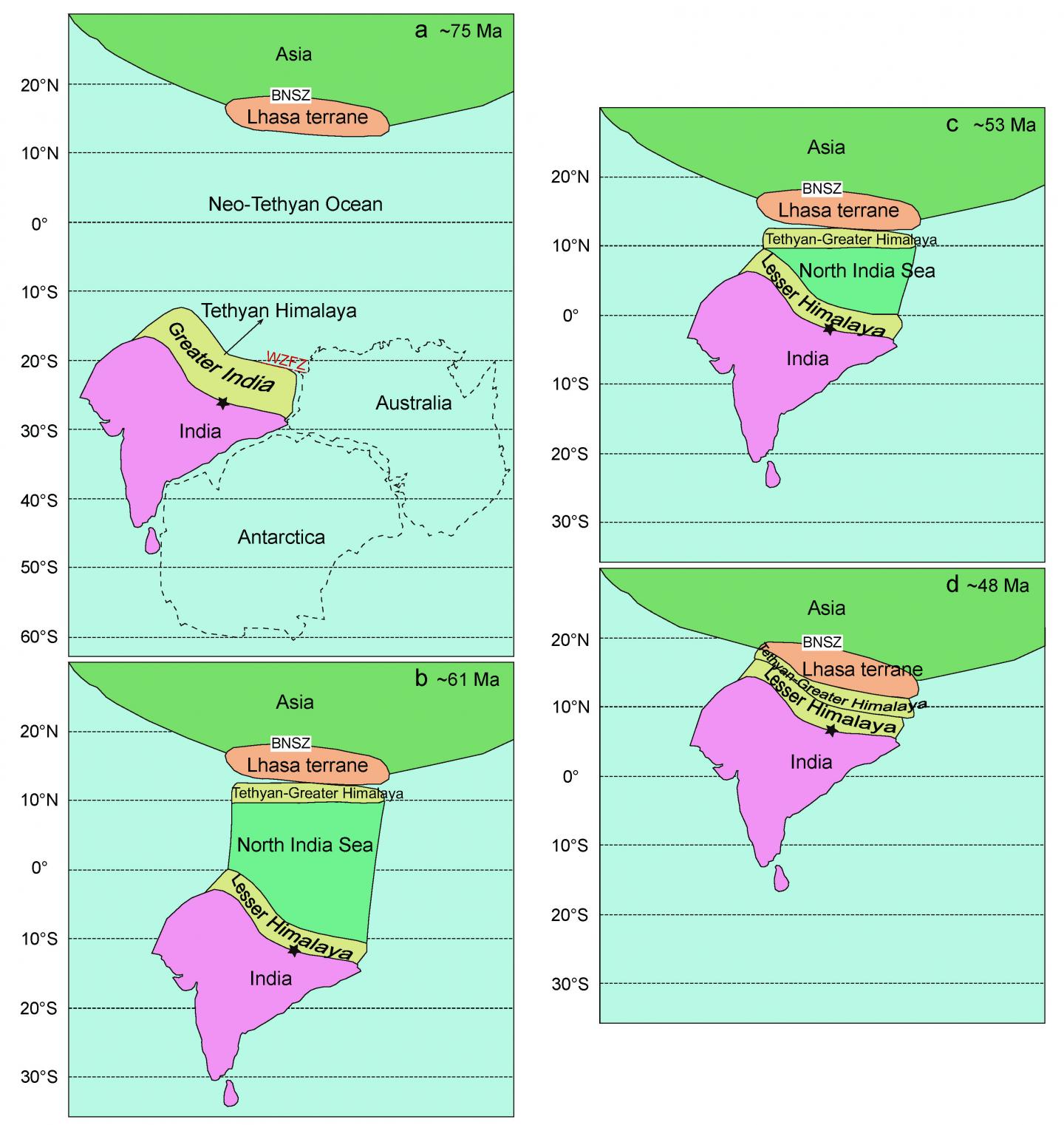
To elucidate the timing, location and geodynamic models of the India-Asia collision, Yuan and colleagues conducted paleomagnetic and rock magnetic analyses on two key successions that were deposited on the distal northern part of the Indian passive margin (Tethyan Himalaya terrane), where Upper Cretaceous oceanic red beds (CORBs) of the Chuangde Formation are exposed in the Cailangba A and B sections of the Gyangze area, and Upper Cretaceous to Paleocene red siliceous shales of the lower Sangdanlin Formation are exposed in the Sangdanlin and Mubala sections of the Saga area. The lower Sangdanlin Formation contains the first Asian detritus, and thus determines the collision age.

Paleomagnetic and rock magnetic analyses reveal that these rocks comprise i) secondary magnetic signals carried by chemical hematite and ii) primary magnetic signals of dual polarities carried by detrital hematite. These results indicate that the Tethyan Himalaya terrane was situated at a paleolatitude of 19.4° ± 1.8°S during the late Cretaceous (76.2-74.0 Ma) and moved rapidly northward to reach a paleolatitude of 13.7° ± 2.5°N in the mid-Paleocene (62.5-59.2 Ma). The late Cretaceous results show that at ~75 Ma the Tethyan Himalaya terrane was still significantly separated from the Lhasa terrane by ~3600 km.

The new paleomagnetic data sets imply that the Tethyan Himalaya terrane rifted from India after ~75 Ma, generating the North India Sea. This study further documents a new two-stage continental collision. The northward drifting Tethyan Himalaya terrane collided with Asia at ~61 Ma, and then amalgamated with India with a diachronously closing North India Sea between ~53 Ma and ~48 Ma. This new scenario matches the history of India-Asia convergence rates and reconciles multiple lines of geologic evidence for the India-Asia collision.

This new two-stage collision hypothesis between India and Asia provides crucial constraints for continental collision dynamics, the uplift and deformation history of the Tibetan Plateau, and paleogeography and biodiversity patterns in Asia. Furthermore, the new findings provide key boundary conditions for climate models linking Himalaya-Tibetan orogenesis with global climate change.

###

See the article:

Yuan J, Yang ZY, Deng CL,?Krijgsman W, Hu XM, Li SH, Shen ZS, Qin HF, An W, He HY, Ding L, Guo ZT, Zhu RX, 2020. Rapid drift of the Tethyan Himalaya terrane before two-stage India-Asia collision. National Science Review. DOI: 10.1093/nsr/nwaa173

Link:

https://doi.org/10.1093/nsr/nwaa173

Media Contact
Chenglong Deng
[email protected]

Related Journal Article

http://dx.doi.org/10.1093/nsr/nwaa173

Tags: Climate ChangeEarth ScienceGeographyGeology/SoilGeophysics/GravityPlate Tectonics
Share13Tweet8Share2ShareShareShare2

Related Posts

New Drexel Study Reveals Key to Keeping Students on Track in Physics Learning — Chemistry

New Drexel Study Reveals Key to Keeping Students on Track in Physics Learning

May 15, 2026
Reversible Glue Technology Powers Up with Electric Activation — Chemistry

Reversible Glue Technology Powers Up with Electric Activation

May 15, 2026

Sweet as Honey: Unveiling a New Heat Transport Regime in Ultrathin Semiconductors

May 15, 2026

High-Precision Boltzmann Luminescent Nanothermometry Achieved Through Predictive Rules

May 15, 2026
Please login to join discussion

POPULAR NEWS

  • Research Indicates Potential Connection Between Prenatal Medication Exposure and Elevated Autism Risk

    843 shares
    Share 337 Tweet 211
  • New Study Reveals Plants Can Detect the Sound of Rain

    730 shares
    Share 291 Tweet 182
  • Salmonella Haem Blocks Macrophages, Boosts Infection

    62 shares
    Share 25 Tweet 16
  • Breastmilk Balances E. coli and Beneficial Bacteria in Infant Gut Microbiomes

    58 shares
    Share 23 Tweet 15

About

We bring you the latest biotechnology news from best research centers and universities around the world. Check our website.

Follow us

Recent News

New Actinomycin Derivatives Target Malaria More Selectively

Mobile App Enhances Exercise for Older Adults’ Cognition

Botulinum Toxin Reduces Urinary Retention Post-Hemorrhoidopexy

Subscribe to Blog via Email

Enter your email address to subscribe to this blog and receive notifications of new posts by email.

Join 82 other subscribers
  • Contact Us

Bioengineer.org © Copyright 2023 All Rights Reserved.

Welcome Back!

Login to your account below

Forgotten Password?

Retrieve your password

Please enter your username or email address to reset your password.

Log In
No Result
View All Result
  • Homepages
    • Home Page 1
    • Home Page 2
  • News
  • National
  • Business
  • Health
  • Lifestyle
  • Science

Bioengineer.org © Copyright 2023 All Rights Reserved.