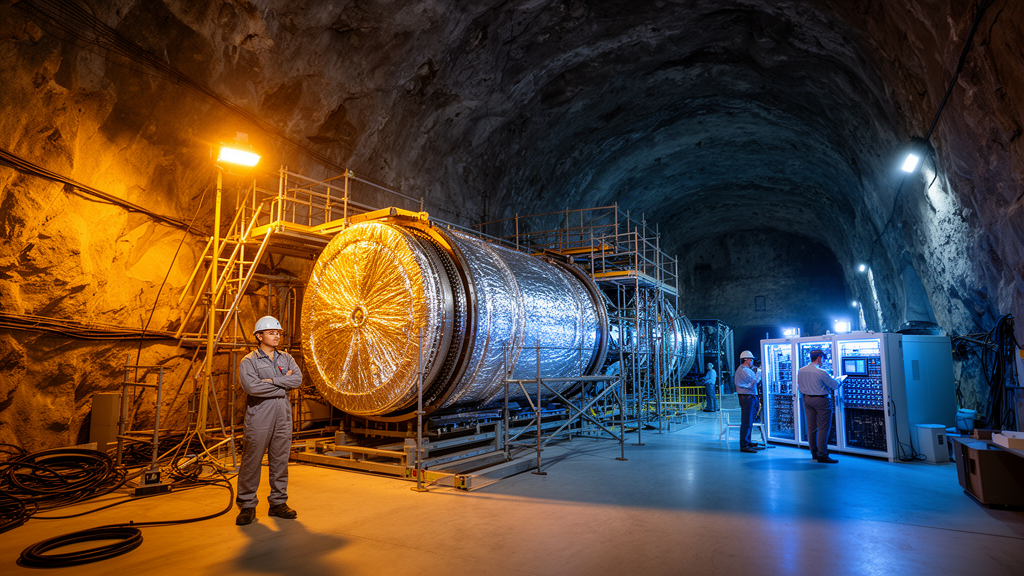
A comprehensive overview of the Sanford Underground Research Facility (SURF) has been published in the Annual Review of Nuclear and Particle Science, offering readers a detailed account of the operations, experiments and future ambitions underway at the laboratory in Lead, South Dakota.
The article, titled “Construction and Science of SURF,” was authored by Dr. Jaret Heise, director of science at SURF, and carries a publication date of 14 September 2026. It discusses the history, features and current status of the facility, as well as its scientific program and plans for future evolution.
“It’s an honor and a privilege to be invited to write an Annual Review article that showcases the incredible story of SURF,” Heise said. “Over a period of almost two decades, SURF has attracted an amazing community of researchers, and my hope is that the details captured in the paper will be useful to current and future experiments, while recognizing pioneering and foundational efforts of earlier groups.”
The paper includes a synopsis of the facility’s history, noting that scientific efforts at SURF began in 2007 during reentry into the former mining complex. Research activity has grown steadily in the years since: to date, nearly 80 groups have conducted research on various levels of the facility, and roughly 900 researchers have been active there since it opened.
The published review documents how the facility has developed into a venue hosting a broad range of experiments in nuclear and particle physics and related disciplines.
Looking ahead, the paper highlights an ongoing effort to establish an underground Quantum User Facility at the 4850 Level of the facility. According to the review, this deep laboratory could stimulate new research opportunities in both quantum computing and quantum sensing, extending SURF’s reach beyond its traditional physics program.
Heise also points to another possible direction for the facility’s future: a unique vertical shaft capability that could host gravitational-wave detectors and other experiments exploring aspects of fundamental physics, astrophysics and cosmology, including searches for ultralight dark matter. These plans are presented in the paper as potential avenues for attracting future research to the site.
The review acknowledges the large number of scientific colleagues and technical staff who, over many years, contributed to the realization of the facility and its science programs. Heise additionally credits philanthropist T. Denny Sanford and the State of South Dakota for financing SURF’s initial construction, and notes that current operations are funded by the US Department of Energy, Office of Science, Office of High Energy Physics.
The article appears in the Annual Review of Nuclear and Particle Science under the DOI 10.1146/annurev-nucl-100724-024247, and was released as a peer-reviewed publication through the South Dakota Science and Technology Authority.
Subject of Research: An overview of the Sanford Underground Research Facility, its scientific program and future plans
Article Title: Construction and science of SURF published in the Annual Review of Nuclear and Particle Science
Article References: Construction and science of SURF published in the Annual Review of Nuclear and Particle Science. Original publication (Bibliographic details unavailable.)
Image Credits: AI Generated
DOI: Not provided
Keywords: SURF, Sanford Underground Research Facility, particle physics, nuclear physics, dark matter, quantum computing, quantum sensing, gravitational waves, astrophysics, cosmology, South Dakota, Annual Review of Nuclear and Particle Science
News Source: Katie Riggs. (October 27, 2026). New review paper details two decades of science at Sanford Underground Research Facility. Scienmag.