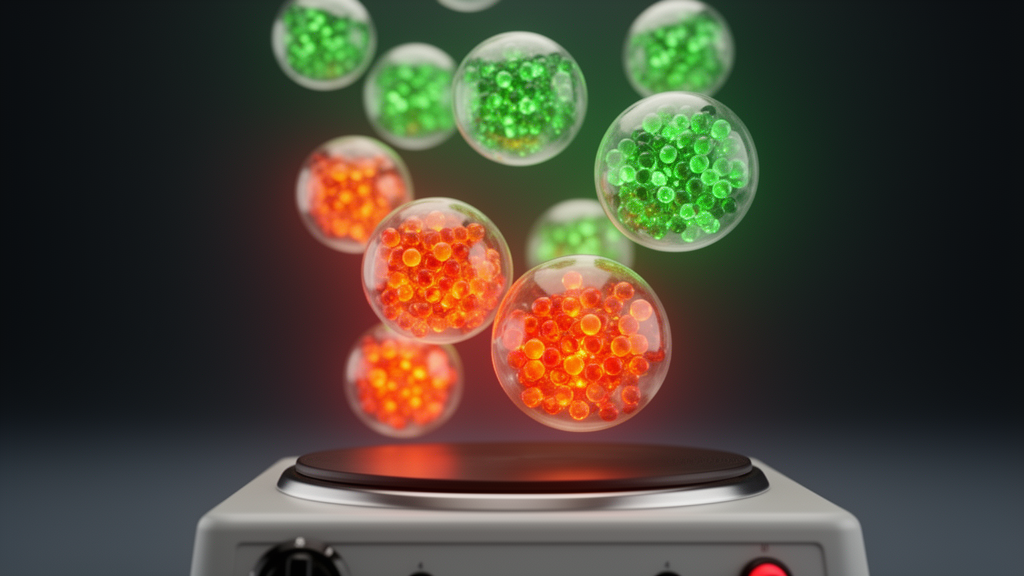
A fluorescent dye locked inside a thermo-responsive polymer nanoparticle can be switched between yellow and blue simply by warming the water around it, according to a study published in Discover Polymers. They used N,N’-methylenebis(acrylamide) as a crosslinker and potassium persulfate as an initiator, then loaded the particles with perylene, a hydrophobic fluorescent dye, by swelling them in a perylene-containing tetrahydrofuran solution, washing the particles and redispersing them in water.
The key to the color switch is the lower critical solution temperature, or LCST, a property characteristic of PNIPAM gels and particles. Below the LCST, PNIPAM chains are hydrated and the polymer network swells with water; above the LCST, the chains dehydrate and the network collapses. In the reported nanoparticles this transition was observed over a narrow window of roughly 31 to 33 degrees Celsius. The team defined the apparent LCST as 33 degrees Celsius, based on the temperature at which the percentage transmittance of the dispersion at 700 nanometers began to decrease during heating at 0.5 degrees Celsius per minute. On cooling, transmittance began to recover at about 31 degrees Celsius, revealing a small thermal hysteresis whose molecular origin the authors note was not directly investigated.
Dynamic light scattering quantified the volume change dramatically. The hydrodynamic radius of the plain PNIPAM nanoparticles fell from 441 plus or minus 37 nanometers at 20 degrees Celsius to 170 plus or minus 1 nanometer at 50 degrees Celsius, an approximately 61.5 percent decrease, with the particle size distribution remaining unimodal at both temperatures. Light scattering intensity rose from 0.70 to 5.3 megacounts per second across the same transition, which the authors attribute to the increased refractive index contrast of dehydrated, more hydrophobic particles relative to water. Transmission electron microscopy confirmed spherical particles in both states, with mean radii of 285 plus or minus 10 nanometers at 20 degrees and 182 plus or minus 3 nanometers at 50 degrees, although the authors caution that because TEM specimens were dried at room temperature, the TEM dimensions do not directly represent particle size in dispersion, and the contraction is primarily supported by the DLS measurements.
Before interpreting the perylene behavior, the researchers probed the intraparticle environment with Nile Red, a dye whose fluorescence responds to the polarity of its surroundings. Nile Red-loaded nanoparticles fluoresced weakly below the LCST with an emission maximum at relatively long wavelengths, but above the LCST the intensity increased and the emission maximum shifted to shorter wavelengths; under 365-nanometer ultraviolet light, almost no fluorescence was visible to the naked eye at 20 degrees, whereas clear red fluorescence appeared at 50 degrees. The authors interpret this as evidence of a less polar, more hydrophobic local environment forming as the particles dehydrate, while stressing that Nile Red can also aggregate or self-quench, so the experiment serves as qualitative evidence for a temperature-induced change in the intraparticle environment rather than a quantitative polarity measurement.
The central observation concerns perylene. In the perylene-loaded nanoparticles, both monomer emission, the structured fluorescence of effectively dispersed perylene molecules peaking at 443 nanometers, and broad, longer-wavelength excimer emission, arising from excited-state perylene-perylene interactions and peaking around 550 nanometers, were present at 20 degrees. The ratio of excimer to monomer intensity, defined as the fluorescence intensities at 550 and 443 nanometers, was 0.62 at 20 degrees and dropped to 0.15 at 50 degrees. Under ultraviolet light the dispersion appeared yellow at 20 degrees, dominated by the broad excimer band, and blue at 50 degrees, dominated by structured monomer emission. The authors emphasize that these spectroscopic terms do not refer to the monomeric or dimeric packing motifs of crystalline perylene polymorphs.
Counterintuitively, the excimer contribution fell when the particles collapsed, even though dehydration might be expected to concentrate the hydrophobic dye and promote close contacts. The authors propose that below the LCST, the swollen, highly hydrated network cannot uniformly dissolve perylene, so the hydrophobic dye localizes in limited hydrophobic regions within the hydrated network, promoting local perylene-perylene associations that favor excimer emission. Above the LCST, the collapsed, polymer-rich interior instead favors a different balance of perylene-perylene configurations, reducing the relative long-wavelength contribution. As a reference without a crosslinked network, a perylene-saturated aqueous sample containing PNIPAM homopolymer showed much stronger excimer emission, with the intensity ratio falling from 10.9 at 20 degrees to 3.6 at 50 degrees, a decrease the authors attribute to a temperature-induced change in the dispersion or association state of perylene.
Supporting spectroscopic evidence came from fluorescence excitation spectra recorded at 20 and 50 degrees Celsius while monitoring emission at 443 and 550 nanometers. The excitation profiles at the two monitoring wavelengths were not identical in the spectral region unaffected by scattering, suggesting that the monomer and long-wavelength emissions involve different ground-state perylene populations and are consistent with a contribution from pre-associated perylene species to the long-wavelength emission. Confocal laser scanning microscopy confirmed that particle-associated fluorescence persisted after washing, qualitatively showing that perylene remained associated with the nanoparticles, though the apparent particle diameter of roughly 1.5 micrometers in those images was likely overestimated because of limited optical resolution and fluorescence blurring.
The switching proved durable in cycling tests. When the intensity ratio was tracked with temperature, it decreased with heating and dropped sharply around 32 degrees, close to the LCST, linking the fluorescence change to the volume phase transition. Over 10 consecutive heating-cooling cycles between 20 and 50 degrees, the ratio consistently fell on heating and was restored on cooling, without systematic deterioration across the tested sequence. The authors note, however, that possible perylene leakage and changes in absolute fluorescence intensity were not independently quantified, and the particle size of the loaded nanoparticles was slightly larger than that of the unloaded particles, a difference they advise interpreting with caution because DLS sizes can be influenced by sample preparation and measurement conditions.
The authors are careful about the limits of their interpretation. Fluorescence excitation spectroscopy does not directly determine the nanoscale spatial distribution of perylene, so spatial redistribution or reorganization within the collapsed network remains a proposed interpretation rather than a directly demonstrated mechanism. Even so, the study demonstrates a dispersible colloidal platform in which the emission color of unmodified perylene is reversibly tuned by temperature-driven changes in the local environment, an advantage over bulk gels because temperature-induced size changes can be measured by DLS and correlated with fluorescence in the same dispersion. The researchers suggest potential uses as fluorescent temperature indicators, optical switches and stimuli-responsive fluorescent probes, and as components in organic electronics and biological studies, while framing these as possibilities rather than demonstrated applications.
Subject of Research: Thermo-responsive fluorescence color switching of perylene-loaded poly(N-isopropylacrylamide) nanoparticles across their volume phase transition
Article Title: Reversible switching of perylene emission colors by thermo-responsive volume changes in poly(N-isopropylacrylamide) nanoparticles
Article References: Kakitani, R., Hamasaki, A., Kizaki, C., Vu, T. N., & Yusa, S.-I. (2026). Reversible switching of perylene emission colors by thermo-responsive volume changes in poly(N-isopropylacrylamide) nanoparticles. Discover Polymers, 3(1), Article 32. https://doi.org/10.1007/s44347-026-00072-6
Image Credits: AI Generated
DOI: 10.1007/s44347-026-00072-6
Keywords: PNIPAM, perylene, nanoparticles, LCST, fluorescence, excimer emission, monomer emission, thermo-responsive polymers, dynamic light scattering, stimuli-responsive materials, soap-free emulsion polymerization, fluorescence spectroscopy
News Source: Neil Sanderson. (October 27, 2026). Temperature flips the color of perylene-loaded polymer nanoparticles. Scienmag.