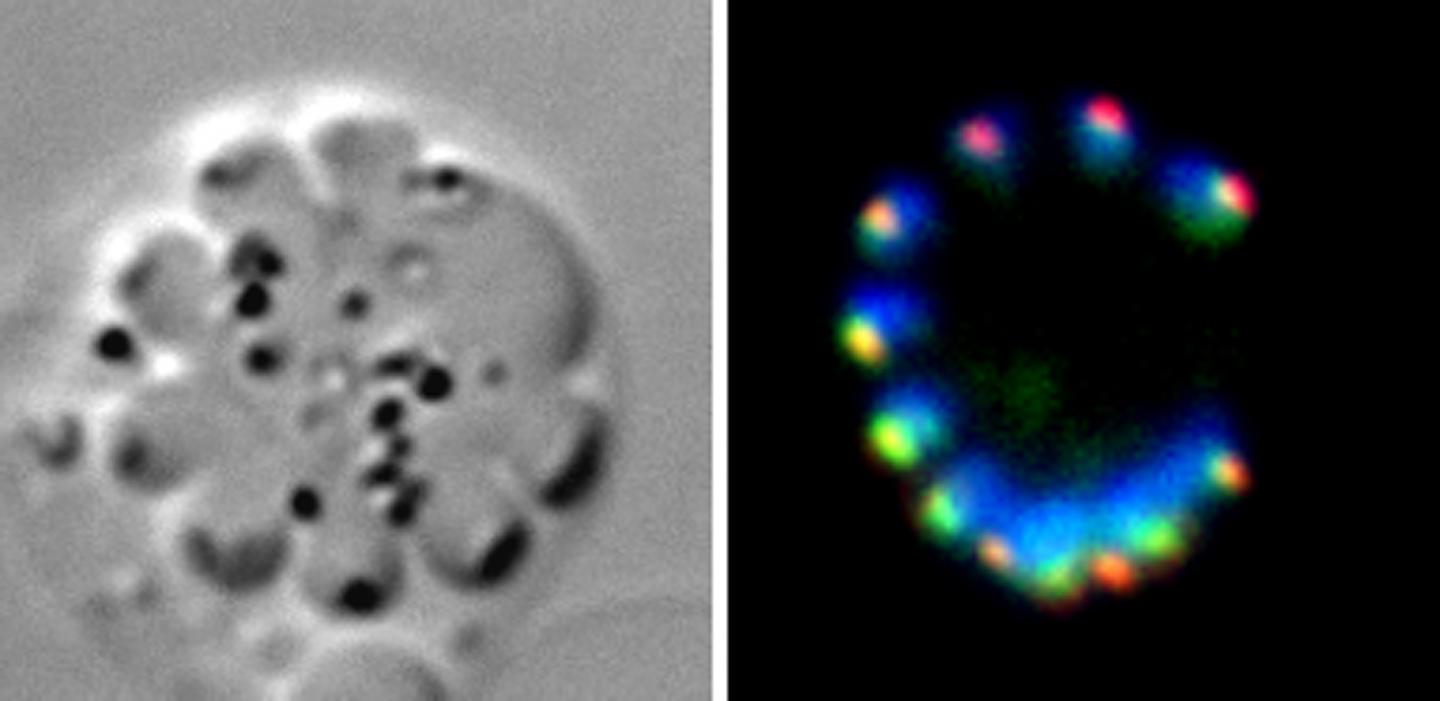
Credit: The University of Nottingham
Scientists have made a major breakthrough in understanding how the parasite that causes malaria is able to multiply at such an alarming rate, which could be a vital clue in discovering how it has evolved, and how it can be stopped.
For the first time, scientists have shown how certain molecules play an essential role in the rapid reproduction of parasite cells, which cause this deadly disease.
This could be the next step towards being able to prevent the malaria parasite from reproducing.
The research, which is co-led by Rita Tewari, Professor of Parasite Cell Biology in the School of Life Sciences at the University of Nottingham and Professor Karine Le Roch at the University of California Riverside, USA, could pave the way in helping to eradicate the disease.
The study, which is published in Cell Reports, was a collaborative effort with scientists from the Universities of Dundee, and Warwick in the UK, the University of Bern, Switzerland, ICGEB, India and the Francis Crick Institute.
Malaria is one of the world’s biggest killer infections and is responsible for almost half a million deaths a year, mainly in tropical developing countries. The disease is caused by a one-celled parasite called Plasmodium. It is passed on from person to person as female Anopheles mosquitoes pick up the parasite from infected people when they bite to get the blood needed to nurture their eggs. Inside the mosquito the parasites reproduce, multiply and develop.
As part of their latest research, the team wanted to better understand how the parasite’s cell divides and multiplies especially within a mosquito.
Proteins are large, complex molecules that play many critical roles in the body. They do most of the work in cells and are required for the structure, function, and regulation of the body’s tissues and organs. Each organism has DNA organised into a certain number of chromosomes and needs condensins in order to ‘split’ this DNA when they multiply. Condensins are large protein complexes that play a central role in chromosome assembly and segregation during mitosis and meiosis.
In the malaria parasite (Plasmodium), the role of condensins in multiplication and proliferation was unclear. The team looked at two of the crucial condensin subunits, called SMC2 and SMC4, which are required to maintain the structure of chromosomes in a cell of other organisms.
Professor Tewari said: “We have tried to understand how these molecules work in the unusual pattern of multiplication by the parasite. We found that these molecules are there at all the stages of multiplication and they are present only at a certain part of the chromosome, which is called the centromere. We wanted to understand how does the parasite multiply? How do these molecules organise themselves and the DNA in those cells? It is fascinating how a single cell can carry out so many different modes of multiplication, and we need to understand how it does this.”
After analysing the parasite, the team found a very unusual type of cell division, showing that the malaria parasite has evolved ways to ensure its survival by way of its cell division.
Professor Tewari says: “This particular parasite is very adaptable. Even if you kill it in the human blood stream, it can move into the mosquito stage. Over time, it has adapted to survive and has a lot of genetic plasticity, which is why it is difficult to control the disease.
“We need to understand what gives the parasite this plasticity and what it needs at every stage to survive, so it is crucial to understand how the parasite cell divides. The aim of our research is not to develop a drug immediately, but to answer the fundamental question of how the parasite divides and survives and the machinery it uses. The parasite has diverse modes of multiplying, so even if a drug or an effective vaccine is created, they may be able to adapt and we need to understand how. This is a next step towards that goal.”
Professor Le Roch says: “By understanding the fundamental aspect of parasite biology, we are decrypting how the parasite divides, and how the different mechanisms regulating cell division can affect the ability of the parasite to thrive and replicate exponentially inside its hosts. If we identify the molecular components that are essential for the replication of this parasite, we will be able to develop novel and long-lasting therapeutic strategies against this devastating disease.”
###
This research is funded by MRC and BBSRC to Professor Tewari’s group and by NIH grants to Prof Karine Le Roch’s group.
Media Contact
Charlotte Anscombe
[email protected]
44-011-574-84417
Related Journal Article
http://dx.