• HOME
  • NEWS
  • EXPLORE
    • CAREER
      • Companies
      • Jobs
    • EVENTS
    • iGEM
      • News
      • Team
    • PHOTOS
    • VIDEO
    • WIKI
  • BLOG
  • COMMUNITY
    • FACEBOOK
    • INSTAGRAM
    • TWITTER
Monday, August 24, 2026
BIOENGINEER.ORG
No Result
View All Result
  • Login
  • HOME
  • NEWS
  • EXPLORE
    • CAREER
      • Companies
      • Jobs
        • Lecturer
        • PhD Studentship
        • Postdoc
        • Research Assistant
    • EVENTS
    • iGEM
      • News
      • Team
    • PHOTOS
    • VIDEO
    • WIKI
  • BLOG
  • COMMUNITY
    • FACEBOOK
    • INSTAGRAM
    • TWITTER
  • HOME
  • NEWS
  • EXPLORE
    • CAREER
      • Companies
      • Jobs
        • Lecturer
        • PhD Studentship
        • Postdoc
        • Research Assistant
    • EVENTS
    • iGEM
      • News
      • Team
    • PHOTOS
    • VIDEO
    • WIKI
  • BLOG
  • COMMUNITY
    • FACEBOOK
    • INSTAGRAM
    • TWITTER
No Result
View All Result
Bioengineer.org
No Result
View All Result
Home NEWS Science News Health

New remote-controlled ‘smart’ platform helps in cardiovascular disease treatment

Bioengineer by Bioengineer
December 3, 2019
in Health
Reading Time: 2 mins read
0
IMAGE
Share on FacebookShare on TwitterShare on LinkedinShare on RedditShare on Telegram

IMAGE

Credit: DU Xuemin


According to the World Health Organization, cardiovascular (CV) disease has become the leading cause of death worldwide. However, vascular regeneration is a promising treatment for cardiovascular disease. Remodeling the endothelium – i.e., forming a confluent vascular endothelial cell monolayer on the lumen – plays a vital role in this process.

Rapid endothelialization poses challenges, however, when using existing synthetic biomaterials, due to their static properties. Such materials cannot offer dynamic, on-demand means for manipulating specific vascular endothelial cell functions at different stages of endothelium remodeling.

A joint research group led by Dr. DU Xuemin at the Shenzhen Institutes of Advanced Technology (SIAT) of the Chinese Academy of Sciences recently demonstrated a remote-controlled “smart” platform that effectively directs programmed vascular endothelium remodeling in a temporally controllable manner. The study was published in National Science Review [2019].

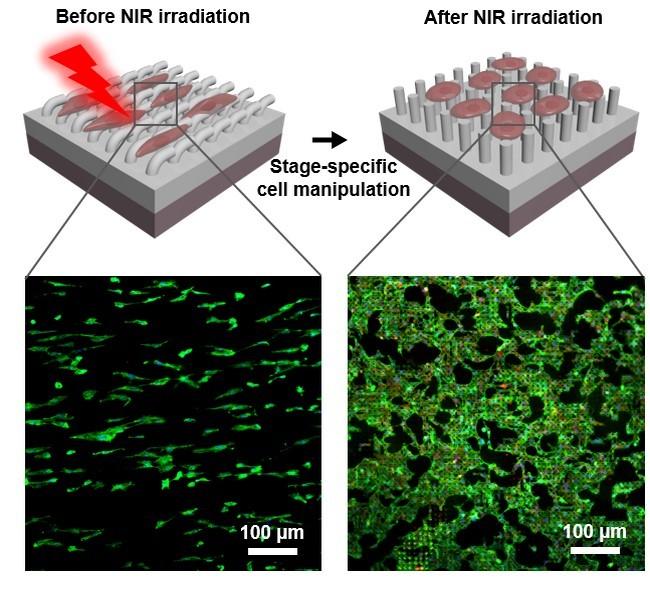
The researchers first prepared a bilayer platform with programmable surface topographies using a shape-memory polymer and gold nanorods acting as a photothermal agent. The bilayer platform allowed on-demand manipulation of vascular endothelial cell functions, thus meeting the requirements of endothelium remodeling.

During the endothelialization process of native blood vessels, vascular endothelial cells and progenitor cells are first recruited to regeneration sites. This is followed by the adhesion and spreading of the vascular endothelial cells to form a confluent vascular endothelial cell monolayer. In the human body, such a process is implemented through extracellular matrix (ECM)-mediated stepwise modulation of vascular endothelial cell functions at different stages.

“The new platform possesses originally stable anisotropic microgroove array topography. This topography can significantly direct cell polarization and thereby enhance the collective migration of vascular endothelial cells,” said ZHAO Qilong, first author of the study.

Upon 10 s of near-infrared (NIR) irradiation, the heat generated on the bottom layer induced the surface topographies of the platform to change from their original anisotropic microgroove array to a permanent isotropic micropillar array.

The focal adhesion and spreading of vascular endothelial cells were subsequently promoted at the later stage of endothelialization by the platform after the topographies were changed. The remote-controlled “smart” platform promoted different functions of vascular endothelial cells in turn, thus mimicking dynamic ECM-mediated effects throughout the endothelialization process for the first time using synthetic biomaterials.

“Traditionally, biomaterials and tissue engineering scaffolds offer suitable platforms to support cell attachment and ingrowth. We aim to develop biomaterials with dynamic properties to actively modulate different cell functions in specific spatiotemporal manners, just like the native ECM in our bodies. We believe biomaterials with dynamic properties will contribute to the progress of wound healing and complex tissue/organ regeneration,” said Dr. DU Xuemin from SIAT.

###

Media Contact
ZHANG Xiaomin
[email protected]

Related Journal Article

http://dx.doi.org/10.1093/nsr/nwz188

Tags: Biomedical/Environmental/Chemical EngineeringBiotechnologyCardiologyMedicine/Health
Share12Tweet8Share2ShareShareShare2

Related Posts

Study reveals surge in type 2 diabetes among people under 20

August 24, 2026

Blocking glucosylceramide production kills cancer cells via lysosomal dysfunction, not ceramide buildup

August 23, 2026

ZCCHC4 boosts replication-dependent histone mRNA translation by interacting with eIF3

August 23, 2026

Tirzepatide Versus GLP-1 Agonists for Stroke Risk in Atrial Fibrillation and Diabetes

August 22, 2026
Please login to join discussion

POPULAR NEWS

  • Study reveals surge in type 2 diabetes among people under 20

    29 shares
    Share 12 Tweet 7
  • KAIST discovers pathway to faster-charging, longer-lasting electric vehicle batteries

    29 shares
    Share 12 Tweet 7
  • Blocking glucosylceramide production kills cancer cells via lysosomal dysfunction, not ceramide buildup

    29 shares
    Share 12 Tweet 7
  • ZCCHC4 boosts replication-dependent histone mRNA translation by interacting with eIF3

    29 shares
    Share 12 Tweet 7

About

We bring you the latest biotechnology news from best research centers and universities around the world. Check our website.

Follow us

Recent News

Study reveals surge in type 2 diabetes among people under 20

KAIST discovers pathway to faster-charging, longer-lasting electric vehicle batteries

Blocking glucosylceramide production kills cancer cells via lysosomal dysfunction, not ceramide buildup

Subscribe to Blog via Email

Enter your email address to subscribe to this blog and receive notifications of new posts by email.

Join 85 other subscribers
  • Contact Us

Bioengineer.org © Copyright 2023 All Rights Reserved.

Welcome Back!

Login to your account below

Forgotten Password?

Retrieve your password

Please enter your username or email address to reset your password.

Log In
No Result
View All Result
  • Homepages
    • Home Page 1
    • Home Page 2
  • News
  • National
  • Business
  • Health
  • Lifestyle
  • Science

Bioengineer.org © Copyright 2023 All Rights Reserved.