• HOME
  • NEWS
  • EXPLORE
    • CAREER
      • Companies
      • Jobs
    • EVENTS
    • iGEM
      • News
      • Team
    • PHOTOS
    • VIDEO
    • WIKI
  • BLOG
  • COMMUNITY
    • FACEBOOK
    • INSTAGRAM
    • TWITTER
Saturday, February 7, 2026
BIOENGINEER.ORG
No Result
View All Result
  • Login
  • HOME
  • NEWS
  • EXPLORE
    • CAREER
      • Companies
      • Jobs
        • Lecturer
        • PhD Studentship
        • Postdoc
        • Research Assistant
    • EVENTS
    • iGEM
      • News
      • Team
    • PHOTOS
    • VIDEO
    • WIKI
  • BLOG
  • COMMUNITY
    • FACEBOOK
    • INSTAGRAM
    • TWITTER
  • HOME
  • NEWS
  • EXPLORE
    • CAREER
      • Companies
      • Jobs
        • Lecturer
        • PhD Studentship
        • Postdoc
        • Research Assistant
    • EVENTS
    • iGEM
      • News
      • Team
    • PHOTOS
    • VIDEO
    • WIKI
  • BLOG
  • COMMUNITY
    • FACEBOOK
    • INSTAGRAM
    • TWITTER
No Result
View All Result
Bioengineer.org
No Result
View All Result
Home NEWS Science News Biology

New players in the programmed cell death mechanism

Bioengineer by Bioengineer
April 30, 2020
in Biology
Reading Time: 2 mins read
0
IMAGE
Share on FacebookShare on TwitterShare on LinkedinShare on RedditShare on Telegram

IMAGE

Credit: Skoltech

Apoptosis is a form ‘cell suicide’, in which a series of programmed molecular steps in a cell lead to its death. “When a cell senses that something is wrong, it can commit ‘suicide’, or apoptosis, to prevent itself from dividing and spreading the problem. This is a normal mechanism present in all cells of the body and one way by which the body gets rid of unneeded or abnormal cells.

“Most cancers block this process, so that they can proliferate forever. So, understanding the process and knowing the actors that are involved is important in order to identify new targets that can be used to develop therapy for cancer, for instance”, explains Dominique Leboeuf, Skoltech Center for Life Sciences PhD student and one of the authors of the study.

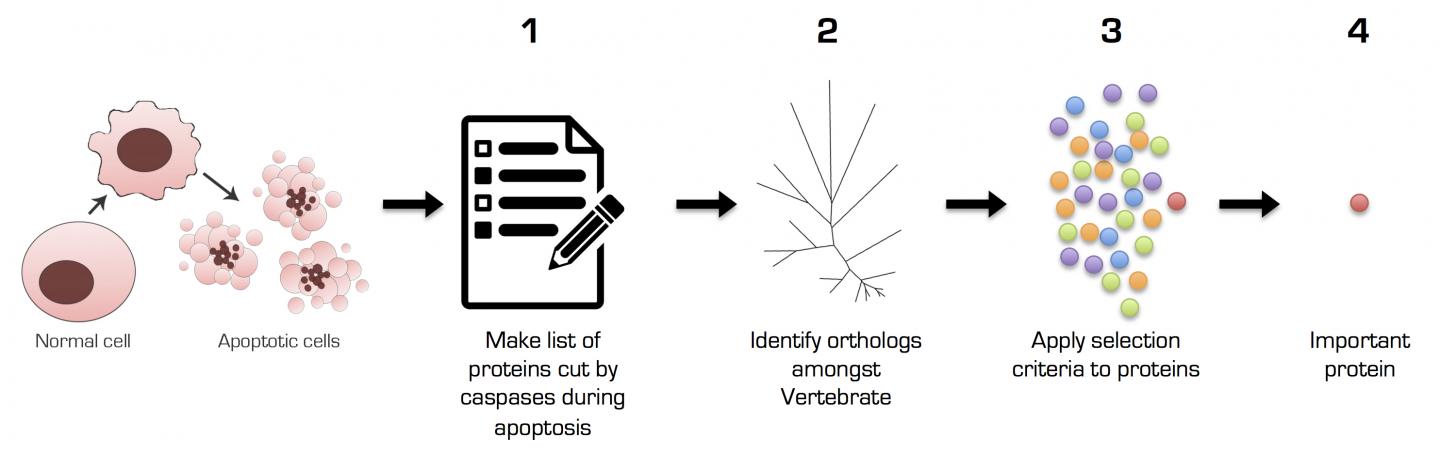
Apoptosis is an essential process for proper organ development, immune system functioning, and defense against viral infections and cancerous transformation. Once the apoptotic program is initiated in a cell, special enzymes, called caspases, are activated and cleave a very specific set of proteins.

“The goal of the study was to sort out this set and identify the proteins that are important in the apoptotic program. To do this, we looked at the evolutionary conservation of caspase substrates and additional characteristics of these proteins, based on sequence, structure and biochemical properties. We believed that the proteins that were the most preserved, and met our selection criteria, would be critical in the apoptotic process,” stated Skoltech Neurobiology and Brain Restoration Center professor Konstantin Piatkov.

###

This work is an important step in the understanding of the apoptotic program, and can be used to further investigate the therapeutic potential of the identified proteins.

On this study Skoltech collaborated with Nina Gubina from the RAS Institute of Theoretical and Experimental Biophysics and and Maxim Pyatkov from the RAS Institute of Mathematical Problems of Biology in Pushchino.

Media Contact
Alina Chernova
[email protected]

Original Source

https://www.skoltech.ru/en/2020/04/new-players-in-the-programmed-cell-death-mechanism/

Related Journal Article

http://dx.doi.org/10.3390/biom10040612

Tags: BioinformaticsBiologyCell Biology
Share12Tweet8Share2ShareShareShare2

Related Posts

Florida Cane Toad: Complex Spread and Selective Evolution

Florida Cane Toad: Complex Spread and Selective Evolution

February 7, 2026
New Study Uncovers Mechanism Behind Burn Pit Particulate Matter–Induced Lung Inflammation

New Study Uncovers Mechanism Behind Burn Pit Particulate Matter–Induced Lung Inflammation

February 6, 2026

DeepBlastoid: Advancing Automated and Efficient Evaluation of Human Blastoids with Deep Learning

February 6, 2026

Navigating the Gut: The Role of Formic Acid in the Microbiome

February 6, 2026
Please login to join discussion

POPULAR NEWS

  • Robotic Ureteral Reconstruction: A Novel Approach

    Robotic Ureteral Reconstruction: A Novel Approach

    82 shares
    Share 33 Tweet 21
  • Digital Privacy: Health Data Control in Incarceration

    63 shares
    Share 25 Tweet 16
  • Study Reveals Lipid Accumulation in ME/CFS Cells

    57 shares
    Share 23 Tweet 14
  • Breakthrough in RNA Research Accelerates Medical Innovations Timeline

    53 shares
    Share 21 Tweet 13

About

We bring you the latest biotechnology news from best research centers and universities around the world. Check our website.

Follow us

Recent News

Decoding Prostate Cancer Origins via snFLARE-seq, mxFRIZNGRND

Digital Health Perspectives from Baltic Sea Experts

Florida Cane Toad: Complex Spread and Selective Evolution

Subscribe to Blog via Email

Enter your email address to subscribe to this blog and receive notifications of new posts by email.

Join 73 other subscribers
  • Contact Us

Bioengineer.org © Copyright 2023 All Rights Reserved.

Welcome Back!

Login to your account below

Forgotten Password?

Retrieve your password

Please enter your username or email address to reset your password.

Log In
No Result
View All Result
  • Homepages
    • Home Page 1
    • Home Page 2
  • News
  • National
  • Business
  • Health
  • Lifestyle
  • Science

Bioengineer.org © Copyright 2023 All Rights Reserved.