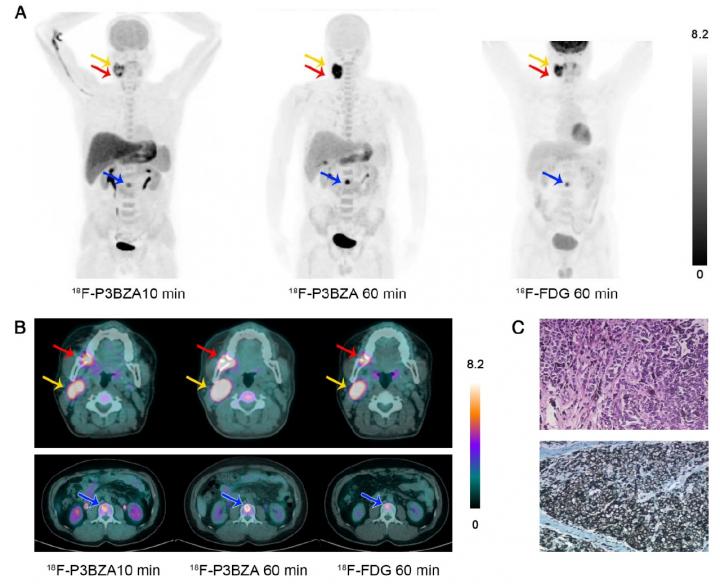
Credit: Xiaowei Ma, Shengjun Wang et al., Xijing Hospital, Fourth Medical University, Xi’an, China, and Stanford University, Stanford, CA.
A new nuclear medicine method for detecting malignant melanoma, one of the most aggressive skin cancers, has been successfully tested for the first time in humans and could improve detection of both primary and metastatic melanoma. The research is featured in the January 2019 print issue of the Journal of Nuclear Medicine.
The National Cancer Institute estimates there were more than 91,000 new U.S. cases of melanoma in 2018 and more than 9,000 deaths from the disease last year. Only 4 percent of patients with metastatic melanoma are alive five years after diagnosis. Therefore, development of specific molecular imaging probes to both detect melanoma at its earliest stages and to detect the metastasis of melanoma is critical for improving the survival of patients.
The new positron emission tomography (PET) tracer, N-(2-(diethylamino)-ethyl)-18F-5-fluoropicolinamide (18F-P3BZA) targets melanin pigment, which exists in most melanoma lesions and can also affect melanoma behavior and, thus, the outcome of radiotherapy. Melanin production shortens overall survival and disease-free survival in patients with metastatic melanoma.
“While melanin-targeted PET probes have been studied in small animal models for a long time, this is the first time such a probe has been successfully translated into clinical evaluation,” explains Zhen Cheng, PhD, at Stanford University. “Our research shows that 18F-P3BZA is safe and, moreover, it is highly promising for clinical diagnosis and staging of melanoma.”
For the study, six healthy individuals were injected with 18F-P3BZA and then received whole-body PET/CT scans and blood tests to assess biodistribution, pharmacokinetic, and radiation dosimetry at 10 minutes, one hour, two hours, and four hours post-injection. In this preliminary clinical application, five patients with suspected melanomas received 18F-P3BZA PET/CT imaging at 10 minutes and 1 hour after injection. For comparison of diagnostic ability, all patients also received 18F-fluoro-2-deoxyglucose (18F-FDG) PET/CT scans on the third day.
Results show that 18F-P3BZA is safe and clearly delineates melanoma tumors in patients. Cheng points out, “Given its specific melanoma-imaging capability, 18F-P3BZA is expected to be a new probe which may overcome some of the limitations of 18F-FDG, such as the false positive of inflammation and a substantially lower tumor-to-muscle contrast compared with 18F-P3BZA. Therefore, 18F-P3BZA may improve melanoma and metastasis detection and help guide therapeutic planning for melanoma patients.”
The quest for improved disease diagnosis and therapy is ongoing. Cheng notes, “Our findings highlight the promise and importance of developing novel molecular probes for cancer imaging and therapy guidance.”
###
Authors of “Biodistribution, Radiation Dosimetry, and Clinical Application of a Melanin-Targeted PET Probe, 18F-P3BZA, in Patients” include Xiaowei Ma, Xijing Hospital, Fourth Military Medical University, Xi’an, China, and Stanford University, Stanford, California; Shengjun Wang, Shuailiang Wang, Daliang Liu, Xiaohu Zhao, Fei Kang, Weidong Yang, and Jing Wang, Xijing Hospital, Fourth Military Medical University, Xi’an, China; and Hao Chen and Zhen Cheng, Stanford University, Stanford, California.
This study was supported by grants from the National Natural Science Foundation of China (81501501), the Key Program of National Natural Science Foundation of China (81230033), Shaanxi Science & Technology Co-ordination & Innovation Project (2016KTCQ03-09), the International Cooperation Program of Xijing Hospital (XJZT15G01), and the Office of Science (Biological and Environmental Research), U.S. Department of Energy (DE-SC0008397).
This study was made available online in May 2018 ahead of final publication in print in January 2019.
About the Society of Nuclear Medicine and Molecular Imaging
The Society of Nuclear Medicine and Molecular Imaging (SNMMI) is an international scientific and medical organization dedicated to advancing nuclear medicine and molecular imaging, vital elements of precision medicine that allow diagnosis and treatment to be tailored to individual patients in order to achieve the best possible outcomes.
SNMMI’s more than 17,000 members set the standard for molecular imaging and nuclear medicine practice by creating guidelines, sharing information through journals and meetings and leading advocacy on key issues that affect molecular imaging and therapy research and practice. For more information, visit http://www.
Media Contact
Rebecca Maxey
[email protected]
703-652-6772
Original Source
https:/
Related Journal Article
http://dx.