A USC-led research team developed a new tool to show how rising ocean temperatures help and hurt various marine microbes
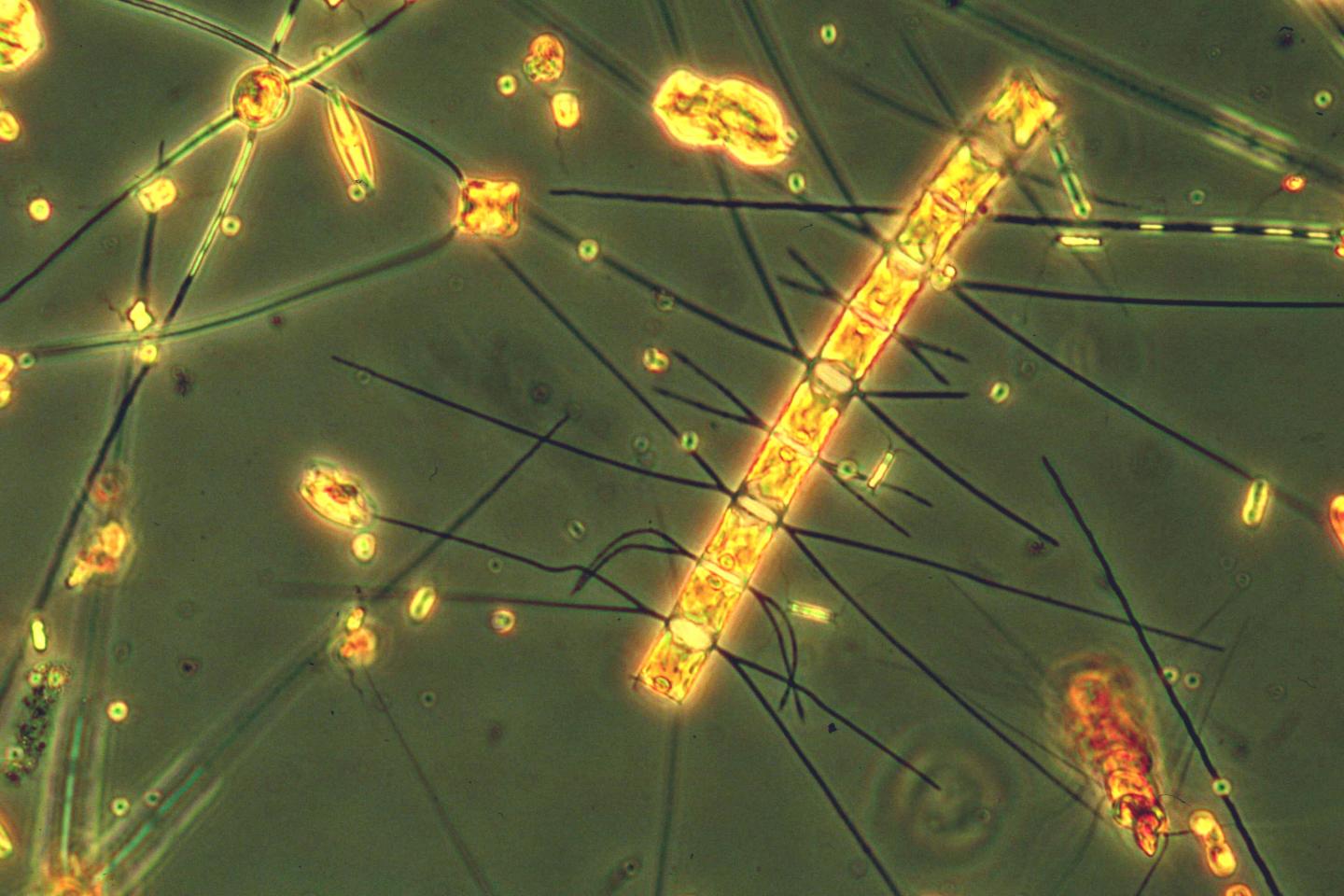
Credit: Photo credit: Ulrich Sommer, IFM-GEOMAR Kiel
Climate change is heating the oceans, which affects billions of marine microbes in ways scientists don’t fully understand. In response, USC researchers have developed a model to forecast how these important organisms will adapt to warming seas.
Oceans substantially shape life and climate on Earth. Marine microorganisms are responsible for producing half of the oxygen that we breathe. The oceans sequester vast amounts of carbon dioxide from the atmosphere — taking up about 30% of human-derived CO2. Fisheries, which are supported by marine microorganisms, contribute to food and income for about 820 million people worldwide, according to the Food and Agriculture Organization of the United Nations.
Those vital tasks and more are accomplished by plants and animals so tiny that thousands could swim in a teaspoon. In many ways, what Earth will look like in 50 to 100 years depends on how these tiny creatures respond to a changing climate.
“Microorganisms are critical to life on earth,” said Naomi Levine, assistant professor of biological and Earth sciences at the USC Dornsife College of Letters, Arts and Sciences and senior author of a new study about marine microbes. “The oceans are changing, but we don’t know what future ocean ecosystems will look like because we don’t know how these organisms will respond to changes.”
Researchers at USC — in collaboration with scientists at the University of Edinburgh and the National Oceanic and Atmospheric Administration (NOAA) — developed a predictive model to estimate how those microbes will adapt. Previously, the future of ocean systems has proven very complex to predict at the level of microscopic organisms living in the sea. However, this model provides a simple framework that can be used to understand the adaptation of different types of microorganisms to numerous variables, including human-derived changes in marine environments. It is also freely available to other scientists around the world.
Tweaking simulations of future ocean conditions, Levine and colleagues discovered marine microbes responded in two ways. Some microbes changed easily; suited for success in the short run, they thrived with little preparation for the future. Meanwhile, competitors — pushed to the margins for a spell — evolved to position for rapid proliferation over the long run once temperatures stabilized at a higher level.
“It’s like a tortoise and hare comparison, two different strategies to finishing the race,” Levine said.
Their findings appear today in Proceedings of the Natural Academy of Sciences.
This genetic turn of the tables shows how climate change works as a selective pressure on the evolution of marine microbes. While the study looks at two specific scenarios, the tool USC scientists developed has wider utility.
In addition, the study results show the importance of the interplay between physical and biological time intervals in determining evolutionary outcomes, which is valuable information to include in other models of global carbon cycles now being used to forecast climate change.
###
The USC marine science program, which is largely based at the USC Dornsife College and the USC Wrigley Institute for Environmental Studies, has 22 scientists — about one-quarter of the university’s biology department — focused on marine and environmental biology.
The study authors include Levine, Nathan Walworth and Emily Zakem of USC; John Dunne of NOAA’s Geophysical Fluid Dynamics Laboratory; and Sinead Collins of the University of Edinburgh.
This work was supported by grants from the Simons Foundation (#509727 and #542389), the Moore Foundation (#7397), the National Science Foundation (#1538525), NOAA’s Office of Oceanic and Atmospheric Research, and a Royal Society University Research Fellowship.
Media Contact
Gary Polakovic
[email protected]
213-740-1927
Related Journal Article
http://dx.