• HOME
  • NEWS
  • EXPLORE
    • CAREER
      • Companies
      • Jobs
    • EVENTS
    • iGEM
      • News
      • Team
    • PHOTOS
    • VIDEO
    • WIKI
  • BLOG
  • COMMUNITY
    • FACEBOOK
    • INSTAGRAM
    • TWITTER
Monday, July 6, 2026
BIOENGINEER.ORG
No Result
View All Result
  • Login
  • HOME
  • NEWS
  • EXPLORE
    • CAREER
      • Companies
      • Jobs
        • Lecturer
        • PhD Studentship
        • Postdoc
        • Research Assistant
    • EVENTS
    • iGEM
      • News
      • Team
    • PHOTOS
    • VIDEO
    • WIKI
  • BLOG
  • COMMUNITY
    • FACEBOOK
    • INSTAGRAM
    • TWITTER
  • HOME
  • NEWS
  • EXPLORE
    • CAREER
      • Companies
      • Jobs
        • Lecturer
        • PhD Studentship
        • Postdoc
        • Research Assistant
    • EVENTS
    • iGEM
      • News
      • Team
    • PHOTOS
    • VIDEO
    • WIKI
  • BLOG
  • COMMUNITY
    • FACEBOOK
    • INSTAGRAM
    • TWITTER
No Result
View All Result
Bioengineer.org
No Result
View All Result
Home NEWS Science News Chemistry

New model proposes jets go superluminal in gamma-ray bursts

Bioengineer by Bioengineer
September 24, 2019
in Chemistry
Reading Time: 2 mins read
0
IMAGE
Share on FacebookShare on TwitterShare on LinkedinShare on RedditShare on Telegram

IMAGE

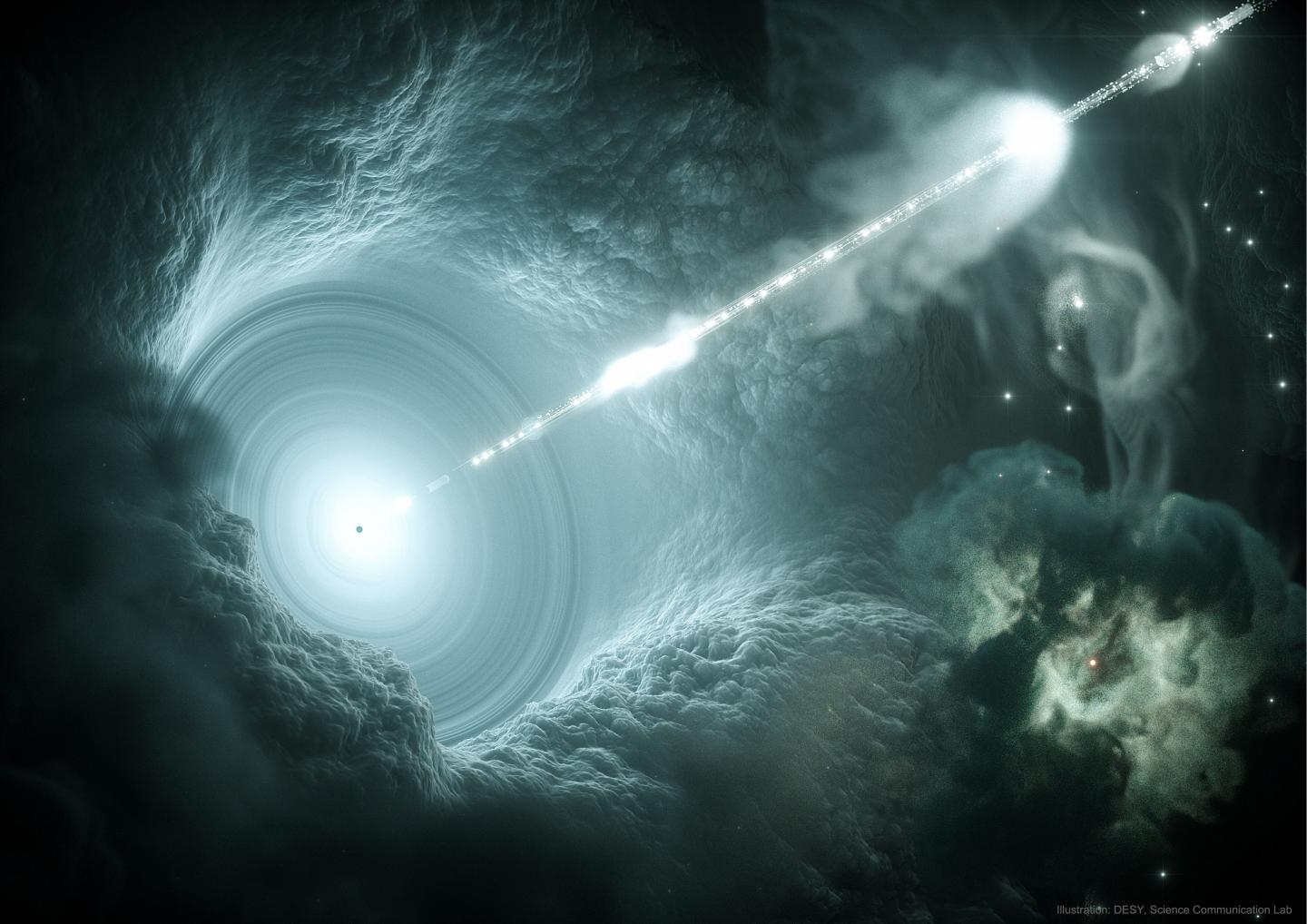
Credit: DESY, Science Communication Lab (used with permission by Astronomy Picture of the Day, which is co-managed by Robert Nemiroff at Michigan Tech).

Astrophysicists Jon Hakkila of the College of Charleston and Robert Nemiroff of the Michigan Technological University have published research indicating that blasts that create gamma-ray bursts may actually exceed the speed of light in surrounding gas clouds, but do so without violating Einstein’s theory of relativity. Hakkila and Nemiroff propose that such superluminal jets could create the time-reversibility seen in gamma-ray burst light curves. These proposed jets, however, do not violate the Einstein’s relativity because they only move faster than light does through the jet medium, not faster than light through vacuum.

Hakkila says that a good way to visualize this superluminal motion is to imagine someone on one side of a pond skipping a stone across the water in your direction. The frequently-hopping stone moves through the air between hops faster than the waves it generates move through water. Hakkila says you would see waves created by each skip of the approaching stone in reverse order, with waves from the most recent skip arriving first and those from the initial skip arriving last. This superluminal blast explanation retains many characteristics of accepted gamma-ray burst jet models, Hakkila says. Nemiroff adds, however, that their proposed scenario involves Cherenkov radiation, a type of light created by superluminal motion that was not previously thought to be important in generating the light curves of gamma-ray bursts.

“Standard gamma-ray burst models have neglected time-reversible light curve properties,” Hakkila says. “Superluminal jet motion accounts for these properties while retaining a great many standard model features.”

###

The article “Time-Reversed Gamma-Ray Burst Light Curve Characteristics as Transitions between Subluminal and Superluminal Motion” appears in the recent issue of The Astrophysical Journal.

Media Contact
Robert Nemiroff
[email protected]

Original Source

https://today.cofc.edu/2019/09/23/faster-than-the-speed-of-light-new-research-looks-at-gamma-ray-bursts/

Related Journal Article

http://dx.doi.org/10.3847/1538-4357/ab3bdf

Tags: AstronomyAstrophysicsSpace/Planetary Science
Share14Tweet9Share2ShareShareShare2

Related Posts

Intelligent Microgrid Management Promises Lower Household Energy Bills and Reduced Diesel Emissions — Chemistry

Intelligent Microgrid Management Promises Lower Household Energy Bills and Reduced Diesel Emissions

July 4, 2026
Graz University of Technology Deciphers the Structural Secrets of MOF Thin Films — Chemistry

Graz University of Technology Deciphers the Structural Secrets of MOF Thin Films

July 2, 2026

Breaking Thermodynamic Limits: Wavelength-Driven Catalysis Advances Ammonia Synthesis

July 2, 2026

From Quantum Mechanics to AI-Powered Materials Discovery: MARVEL Marks 12 Years of Transforming Computational Science

July 2, 2026
Please login to join discussion

POPULAR NEWS

  • Detection of EDCs in Breast Milk and Infant Urine Up to Six Months Highlights Early Exposure Risks

    77 shares
    Share 31 Tweet 19
  • New Drug Candidate Developed at McMaster Shows Potential for Treating Brain Cancer

    58 shares
    Share 23 Tweet 15
  • Saying Goodbye to PGY-6: Pediatric Fellowship Realities

    103 shares
    Share 41 Tweet 26
  • KTU Researchers Explore Ultrasound’s Role in Enhancing Blood Flow Beyond Diagnostics

    53 shares
    Share 21 Tweet 13

About

We bring you the latest biotechnology news from best research centers and universities around the world. Check our website.

Follow us

Recent News

Enzymes reveal homoharringtonine’s full plant pathway.

Tissue-resident Granzyme K+ CD8 T cells fuel Crohn’s

Macrophage UPP1-mtROS-cGAS-NLRP3 Axis Drives Lung Cancer Metastasis

Subscribe to Blog via Email

Success! An email was just sent to confirm your subscription. Please find the email now and click 'Confirm' to start subscribing.

Join 83 other subscribers
  • Contact Us

Bioengineer.org © Copyright 2023 All Rights Reserved.

Welcome Back!

Login to your account below

Forgotten Password?

Retrieve your password

Please enter your username or email address to reset your password.

Log In
No Result
View All Result
  • Homepages
    • Home Page 1
    • Home Page 2
  • News
  • National
  • Business
  • Health
  • Lifestyle
  • Science

Bioengineer.org © Copyright 2023 All Rights Reserved.