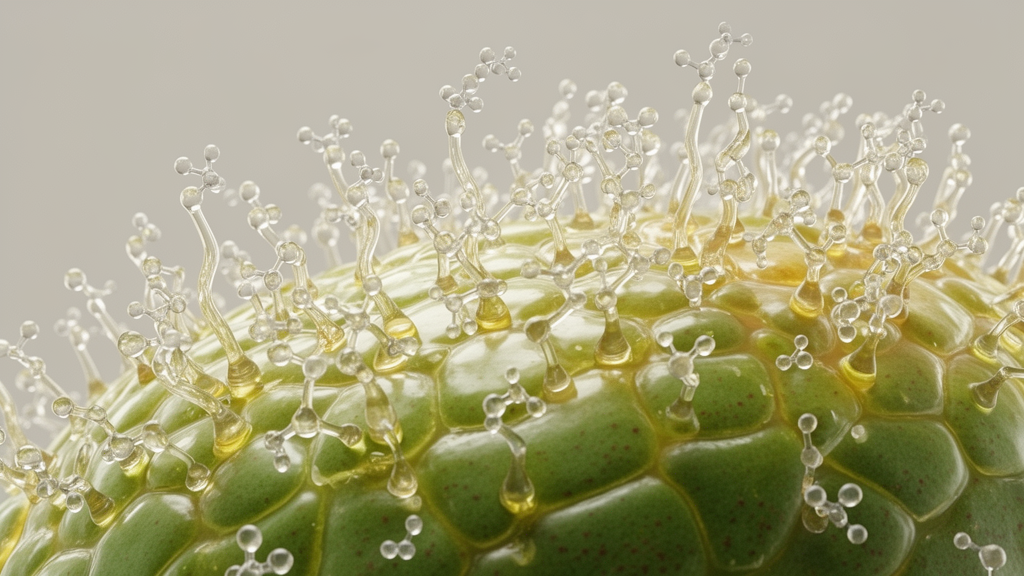
An integrated multi-omics investigation has uncovered the primary biochemical pathways and genetic networks governing cuticular wax biosynthesis in the foliage of mango trees, resolving long-standing questions regarding how tropical fruit foliage establishes protective surface barriers. Published in Horticulture Advances, the investigation systematically examined four distinct cultivars of Mangifera indica—’Yiwen’, ‘Kent’, ‘Chin Hwang’, and ‘Red Ivory’—to map how chemical composition and transcriptomic activity converge to build protective leaf wax coatings. Across the surveyed cultivars, total wax accumulation exhibited substantial phenotypic diversity, ranging from 25.99 to 119.28 micrograms per square centimeter of leaf surface. Profiling identified 93 discrete wax compounds across eight distinct chemical classes, demonstrating that terpenoids, esters, and alkanes represent the dominant structural constituents of the mango leaf cuticle. By correlating metabolite abundance with global expression patterns, the researchers pinpointed 34 core candidate genes and constructed an overarching biochemical framework defining cuticular wax production in mango foliage.
Plant cuticles represent vital three-dimensional hydrophobic interfaces composed predominantly of very-long-chain fatty acids alongside their specialized derivatives, functioning as primary physical defenses against environmental hazards. In perennial fruit trees, this exterior layer mitigates non-stomatal transpiration, limits ultraviolet radiation injury, prevents mechanical abrasions, and repels biotic pressures including fungal infections and insect infestations. Although mango leaves serve crucial physiological roles as the principal vegetative energy centers supporting tree vitality, fruit yield, and pharmacological compound accumulation, prior mechanistic evaluations of cuticle formation have centered almost exclusively on annual model species such as Arabidopsis thaliana and tomato, or focused on the epicuticular wax of harvested fruit. The biological and enzymatic processes driving the synthesis, intracellular transport, and deposition of cuticular compounds in developing mango leaves have remained largely uncharacterized until now.
To explore this regulatory network across diverse genetic backgrounds, the study evaluated four cultivars possessing distinct pedigrees and morphological characteristics grown under identical field conditions at the South Subtropical Crop Research Institute within the Chinese Academy of Tropical Agricultural Sciences in Zhanjiang, China. The selected germplasm included ‘Yiwen’, an artificial hybrid derived from crossing ‘Chin Hwang’ with ‘Aiwen’; ‘Kent’, a selection propagated from second-generation seedlings of the Indian cultivar ‘Brooks’; ‘Chin Hwang’, an established natural hybrid between ‘White’ and ‘Keitt’; and ‘Red Ivory’, which originated as a bud mutation of ‘Ivory 26’. Sampling protocols targeted ten-year-old trees displaying vigorous vegetative growth, harvesting healthy, undamaged leaves precisely ten days following the developmental transition from yellow to green. Three independent biological replicates were preserved for each cultivar, with individual replicates comprising multiple leaves designated for analytical extractions or immediately flash-frozen in liquid nitrogen and stored at minus eighty degrees Celsius for nucleic acid isolation.
Quantification of leaf cuticular wax involved careful organic solvent extraction followed by advanced chromatographic separation. Leaf surface areas were first recorded using a specialized digital leaf area meter, after which intact foliage samples underwent two consecutive thirty-second immersions in three hundred milliliters of chloroform under a laboratory fume hood. The extracted organic solvent was concentrated under reduced pressure at forty degrees Celsius, dried, and subsequently subjected to chemical derivatization using N,O-bis(trimethylsilyl)trifluoroacetamide containing one percent trimethylchlorosilane and anhydrous pyridine for one hour at seventy degrees Celsius. Analysis was performed utilizing a triple quadrupole gas chromatography-mass spectrometry platform configured with a TG-5MS capillary column and operating with helium carrier gas flowing at a constant rate of 1.2 milliliters per minute. The thermal gradient advanced from fifty to three hundred and twenty degrees Celsius, enabling high-resolution detection and quantification benchmarked against an internal n-tetracosane standard.
The metabolomic analysis detected 93 distinct chemical compounds across the leaves of the four cultivars, revealing pronounced variations in chemical diversity and total wax accumulation. The cultivar ‘Yiwen’ exhibited the greatest chemical complexity with 46 identified compounds, followed by ‘Kent’ and ‘Red Ivory’ with 36 compounds each, while ‘Chin Hwang’ contained 26 distinct metabolites. Only four wax components were universally shared across all four varieties, whereas 19, 14, 9, and 17 compounds were unique to ‘Yiwen’, ‘Kent’, ‘Chin Hwang’, and ‘Red Ivory’, respectively. Principal component analysis of the metabolomic profiles demonstrated that principal component one and principal component two explained 14.9 percent and 14.1 percent of the total variance, cleanly separating the cultivars along distinct compositional trajectories. Furthermore, total cuticular wax concentrations differed markedly among genotypes: ‘Yiwen’ and ‘Kent’ exhibited the highest wax densities at 119.28 and 116.94 micrograms per square centimeter, whereas ‘Chin Hwang’ accumulated 51.58 micrograms per square centimeter and ‘Red Ivory’ produced only 25.99 micrograms per square centimeter.
Categorization of the 93 identified compounds resolved the mango leaf wax into eight major chemical groups: terpenoids, esters, alkanes, alcohols, phenolics, ketones, aldehydes, and unclassified constituents. Terpenoids proved to be the overwhelmingly dominant component across all examined cultivars, comprising between 70.75 percent and 85.06 percent of the total wax composition and displaying a direct positive correlation with overall cuticular wax yield. Absolute terpenoid accumulations reached 99.338 micrograms per square centimeter in ‘Yiwen’, 93.318 in ‘Kent’, 43.888 in ‘Chin Hwang’, and 18.398 in ‘Red Ivory’. Esters and alkanes represented the next most abundant classes, accounting for 5.09 to 11.78 percent and 0.81 to 9.22 percent of the cuticle mass, respectively. In contrast, alcohols, phenols, ketones, and aldehydes occurred in minor proportions without statistically significant differences between varieties. Among seventeen distinct terpenoids identified, beta-amyrone, beta-amyrin, and a methylated ursenoic acid derivative were present in all four cultivars, while compounds such as ursolic aldehyde and friedelan-3-one appeared strictly within cultivar-specific metabolic profiles.
Transcriptomic sequencing performed on total RNA extracted from the corresponding leaf tissues yielded extensive sequencing depth to illuminate the transcriptional architecture behind these phenotypic discrepancies. High-throughput sequencing generated over 5.429 billion clean base pairs and more than 36 million high-quality filtered reads, achieving alignment rates ranging from 88.48 percent to 91.52 percent against the ‘Red Ivory’ reference genome with Q30 quality scores exceeding 95.64 percent. Principal component analysis of the global transcriptome data demonstrated tight clustering of biological replicates and distinct divergence among the varieties, with the first two principal components accounting for 63.20 percent and 25.90 percent of the total variance. Pairwise comparisons across the four germplasms revealed 15,690 differentially expressed genes. Gene Ontology enrichment mapped these transcripts predominantly to catalytic activities, binding, cellular components, and metabolic processes, while Kyoto Encyclopedia of Genes and Genomes enrichment highlighted substantial overrepresentation within general metabolic pathways, secondary metabolite biosynthesis, sphingolipid metabolism, ubiquinone-terpenoid biosynthesis, and fatty acid elongation.
To pinpoint the precise regulatory factors driving cuticular lipid accumulation, the team constructed coexpression correlation networks by evaluating Pearson correlation coefficients between 478 differentially expressed genes associated with lipid and terpene metabolism and the eight cuticular wax classes. Selecting the top fifty gene-metabolite interactions exhibiting the highest absolute correlation values per class generated an interaction matrix of four hundred pairs encompassing 289 unique candidate genes. Within this refined coexpression network, 34 functional genes showed direct, statistically significant correlations with the accumulation of specific cuticular wax components. Specifically, eight genes exhibited negative correlations with total terpenoid abundance, six genes were positively correlated with ester accumulation, two genes correlated negatively with ester content, while several distinct transcripts showed tight positive or negative linkages with alkane, aldehyde, ketone, and phenolic levels across the four cultivars.
Detailed annotation partitioned the 34 candidate genes into two primary functional categories governing distinct metabolic axes. The first group contained eighteen key genes regulating very-long-chain fatty acid elongation and subsequent modification into specialized wax derivatives. This cohort included two enoyl-CoA reductase genes, two fatty acyl-ACP thioesterase B genes, a fatty acid decarboxylase, a cuticular wax biosynthesis 1 homolog, seven 3-ketoacyl-CoA synthases spanning the KCS1, KCS11, KCS12, and KCS19 subfamilies, a 3-ketoacyl-CoA reductase, and four long-chain acyl-CoA synthetases designated LACS1 and LACS2. Notably, while functional genetics in model organisms such as Arabidopsis previously linked LACS1 loss-of-function with reduced cuticle mass, the mango leaf profiling documented an inverse relationship, with LACS1 and specific KCS homologs displaying negative correlations with total wax content, indicating that enzymatic divergence or specialized negative feedback loops operate within the tropical tree species.
The second primary group encompassed sixteen candidate genes directly dedicated to the biosynthesis of cuticular terpenoids via the cytoplasmic mevalonate and plastidial methylerythritol phosphate pathways. These enzymes included 1-deoxy-D-xylulose-5-phosphate reductoisomerase, 3-hydroxy-3-methylglutaryl coenzyme A synthase, multiple enzymes of the 2-C-methyl-D-erythritol pathway including ISPE, ISPF, and ISPG, geranyl pyrophosphate synthase, geranylgeranyl diphosphate synthase 1, and eight terpene synthases belonging to the TPS4, TPS7, TPS10, TPS12, and TPS13 families. The concerted activities of ISPG, GPPS, and GGPPS1 direct metabolic flux toward geranylgeranyl pyrophosphate and related prenyl diphosphate intermediates, which serve as foundational precursors for downstream terpene diversification. In particular, the elevated expression of TPS4 and TPS10 correlated positively with the synthesis of triterpene constituents such as lupeol, beta-amyrin, and friedelan-3-one, compounds that impart both mechanical resistance and documented bioactivities to mango leaves.
To rigorously evaluate the reliability of the high-throughput sequencing data, the researchers performed quantitative reverse transcription-polymerase chain reaction assays on seventeen representative candidate genes chosen across eleven major gene families. The selected validation targets included structural and regulatory transcripts from the LACS, FATB, KCS, ECR, DXR, ISPG, GPPS, GGPPS, and TPS families, with relative expression levels calculated via the two to the power of negative delta-delta cycle threshold method using ACTIN as an internal reference standard. Across all four mango cultivars, the relative transcriptional patterns measured by quantitative amplification aligned closely with the normalized fragments per kilobase of transcript per million mapped reads obtained from RNA sequencing. This experimental validation corroborated the identification of 22 candidate genes that negatively correlate with wax synthesis and 12 candidate genes that act as positive regulators of cuticle deposition.
Collectively, the integration of metabolomic quantification and transcriptomic networks allowed the authors to establish a comprehensive hypothetical model outlining epicuticular wax biosynthesis in mango foliage. Intriguingly, standard alkane-forming enzymes such as ECERIFERUM1, cytochrome b5, and wax ester synthases commonly found in herbaceous model plants were not directly identified in the coexpression network, suggesting that mango trees utilize specialized alternative pathways or homologous enzymes with divergent sequence characteristics. Furthermore, the network uncovered twelve previously unannotated candidate genes implicated in wax accumulation that warrant downstream functional characterization. By elucidating how cuticular wax content and terpenoid composition are genetically determined across diverse germplasms, this research delivers critical genetic resources and diagnostic molecular markers to accelerate future breeding programs aimed at optimizing stress resilience and canopy health in commercial mango cultivation.
Subject of Research: Molecular mechanisms and chemical profiling of cuticular wax biosynthesis in mango leaves
Article Title: Transcriptomic and metabolomic profiling reveal the mechanism of cuticular wax biosynthesis in mango leaves
Article References: Wu, J., Wu, X., Gu, C., Yin, H., Qi, K., Zhan, R., & Zhang, S. (2025). Transcriptomic and metabolomic profiling reveal the mechanism of cuticular wax biosynthesis in mango leaves. Horticulture Advances, 3(1), Article 35. https://doi.org/10.1007/s44281-025-00090-7
Image Credits: AI Generated
DOI: 10.1007/s44281-025-00090-7
Keywords: mango, Mangifera indica, cuticular wax, transcriptomics, metabolomics, terpenoids, very-long-chain fatty acids, gas chromatography mass spectrometry, RNA sequencing, differentially expressed genes, Yiwen, Kent, Chin Hwang, Red Ivory, fatty acid elongation, terpene synthase, qRT-PCR
News Source: Juliet Wilcox. (November 19, 2026). Mango Leaf Cuticular Wax Biosynthesis Mechanism Unveiled Through Multi-Omics Profiling. Scienmag.