• HOME
  • NEWS
  • EXPLORE
    • CAREER
      • Companies
      • Jobs
    • EVENTS
    • iGEM
      • News
      • Team
    • PHOTOS
    • VIDEO
    • WIKI
  • BLOG
  • COMMUNITY
    • FACEBOOK
    • INSTAGRAM
    • TWITTER
Saturday, June 27, 2026
BIOENGINEER.ORG
No Result
View All Result
  • Login
  • HOME
  • NEWS
  • EXPLORE
    • CAREER
      • Companies
      • Jobs
        • Lecturer
        • PhD Studentship
        • Postdoc
        • Research Assistant
    • EVENTS
    • iGEM
      • News
      • Team
    • PHOTOS
    • VIDEO
    • WIKI
  • BLOG
  • COMMUNITY
    • FACEBOOK
    • INSTAGRAM
    • TWITTER
  • HOME
  • NEWS
  • EXPLORE
    • CAREER
      • Companies
      • Jobs
        • Lecturer
        • PhD Studentship
        • Postdoc
        • Research Assistant
    • EVENTS
    • iGEM
      • News
      • Team
    • PHOTOS
    • VIDEO
    • WIKI
  • BLOG
  • COMMUNITY
    • FACEBOOK
    • INSTAGRAM
    • TWITTER
No Result
View All Result
Bioengineer.org
No Result
View All Result
Home NEWS Science News

New method converts carbon dioxide to methane at low temperatures

Bioengineer by Bioengineer
February 27, 2020
in Science News
Reading Time: 2 mins read
0
IMAGE
Share on FacebookShare on TwitterShare on LinkedinShare on RedditShare on Telegram

IMAGE

Credit: Sekine Laboratory, Waseda University


A new method developed by a team of Waseda University scientists led by Professor Yasushi Sekine may contribute to reducing the use of fossil fuels and help prevent global warming in the long-run.

The conversion of carbon dioxide to valuable chemicals such as methane has drawn great attention for use in supporting carbon capture and utilization. Especially, methane can be used not only as fuel but also as a hydrogen carrier, transporting town gas to existing infrastructure. For instance, some plants in Germany have already been launched based on the Power to Gas concept, which allows energy from electricity to be stored and transported in the form of compressed gas.

“To recycle carbon dioxide into methane, an established industrial method involves the reaction of hydrogen and carbon dioxide using a ruthenium-based catalyst at temperatures of 300 to 400 degrees Celsius, but this method limited how much and when methane could be produced since it requires such high temperature,” Sekine says. “Additionally, operation at low temperatures was demonstrated to be favorable to improve carbon dioxide conversion and increase the amount of methane produced.”

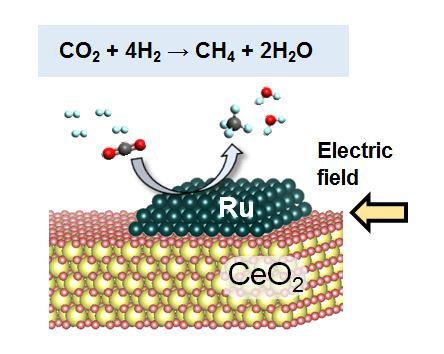
In this newly-developed method reported in Chemistry Letters, carbon dioxide can be converted into methane more efficiently and quickly in the 100 degrees Celsius range.

“This method involves a reaction of nanoparticles called cerium oxide with carbon dioxide in presence of ruthenium catalyst with an electric field,” explains Sekine. “The results show that the catalyst exhibited high and stable catalytic activity for converting carbon dioxide to methane through hydrogenation with the electric field.”

With this novel method, methane could be produced from carbon dioxide collected from the atmosphere, possibly enabling an unlimited amount of methane production by recycling carbon dioxide from the atmosphere released from factories into valuable energy resources.

###

Reference

Title of original article: Low-temperature conversion of carbon dioxide into methane in an electric field

Authors: Kensei Yamada, Shuhei Ogo, Ryota Yamano, Takuma Higo, and Yasushi Sekine

DOI: 10.1246/cl.190930

Journal: Chemistry Letters

Media Contact
Jasper Lam
[email protected]

Original Source

https://www.waseda.jp/top/en/news/73353

Related Journal Article

http://dx.doi.org/10.1246/cl.190930

Tags: Chemistry/Physics/Materials SciencesEnergy/Fuel (non-petroleum)Industrial Engineering/Chemistry
Share12Tweet8Share2ShareShareShare2

Related Posts

Tracking Lanthanide-Labeled Microplastics in Plants

June 25, 2026

POSTECH Researchers Slash Cost of Reconstituted Cell-Free Systems by 95%

June 25, 2026

AI and Physics Collaborate to Design Advanced Hydrogen Storage Materials

June 25, 2026

Natural Hallucinogens: Evolution’s Ecological Tools, Not Mere Chemical Byproducts

June 25, 2026
Please login to join discussion

POPULAR NEWS

  • Saying Goodbye to PGY-6: Pediatric Fellowship Realities

    103 shares
    Share 41 Tweet 26
  • Multi-Hospital Study Reveals Long Covid Burden Is Twice as High as Current Estimates

    92 shares
    Share 36 Tweet 23
  • Detection of EDCs in Breast Milk and Infant Urine Up to Six Months Highlights Early Exposure Risks

    77 shares
    Share 31 Tweet 19
  • New Drug Candidate Developed at McMaster Shows Potential for Treating Brain Cancer

    58 shares
    Share 23 Tweet 15

About

We bring you the latest biotechnology news from best research centers and universities around the world. Check our website.

Follow us

Recent News

Tracking Lanthanide-Labeled Microplastics in Plants

POSTECH Researchers Slash Cost of Reconstituted Cell-Free Systems by 95%

AI and Physics Collaborate to Design Advanced Hydrogen Storage Materials

Subscribe to Blog via Email

Success! An email was just sent to confirm your subscription. Please find the email now and click 'Confirm' to start subscribing.

Join 82 other subscribers
  • Contact Us

Bioengineer.org © Copyright 2023 All Rights Reserved.

Welcome Back!

Login to your account below

Forgotten Password?

Retrieve your password

Please enter your username or email address to reset your password.

Log In
No Result
View All Result
  • Homepages
    • Home Page 1
    • Home Page 2
  • News
  • National
  • Business
  • Health
  • Lifestyle
  • Science

Bioengineer.org © Copyright 2023 All Rights Reserved.