• HOME
  • NEWS
  • EXPLORE
    • CAREER
      • Companies
      • Jobs
    • EVENTS
    • iGEM
      • News
      • Team
    • PHOTOS
    • VIDEO
    • WIKI
  • BLOG
  • COMMUNITY
    • FACEBOOK
    • INSTAGRAM
    • TWITTER
Saturday, February 7, 2026
BIOENGINEER.ORG
No Result
View All Result
  • Login
  • HOME
  • NEWS
  • EXPLORE
    • CAREER
      • Companies
      • Jobs
        • Lecturer
        • PhD Studentship
        • Postdoc
        • Research Assistant
    • EVENTS
    • iGEM
      • News
      • Team
    • PHOTOS
    • VIDEO
    • WIKI
  • BLOG
  • COMMUNITY
    • FACEBOOK
    • INSTAGRAM
    • TWITTER
  • HOME
  • NEWS
  • EXPLORE
    • CAREER
      • Companies
      • Jobs
        • Lecturer
        • PhD Studentship
        • Postdoc
        • Research Assistant
    • EVENTS
    • iGEM
      • News
      • Team
    • PHOTOS
    • VIDEO
    • WIKI
  • BLOG
  • COMMUNITY
    • FACEBOOK
    • INSTAGRAM
    • TWITTER
No Result
View All Result
Bioengineer.org
No Result
View All Result
Home NEWS Science News Chemistry

New mathematical model for amyloid formation

Bioengineer by Bioengineer
January 28, 2020
in Chemistry
Reading Time: 3 mins read
0
IMAGE
Share on FacebookShare on TwitterShare on LinkedinShare on RedditShare on Telegram

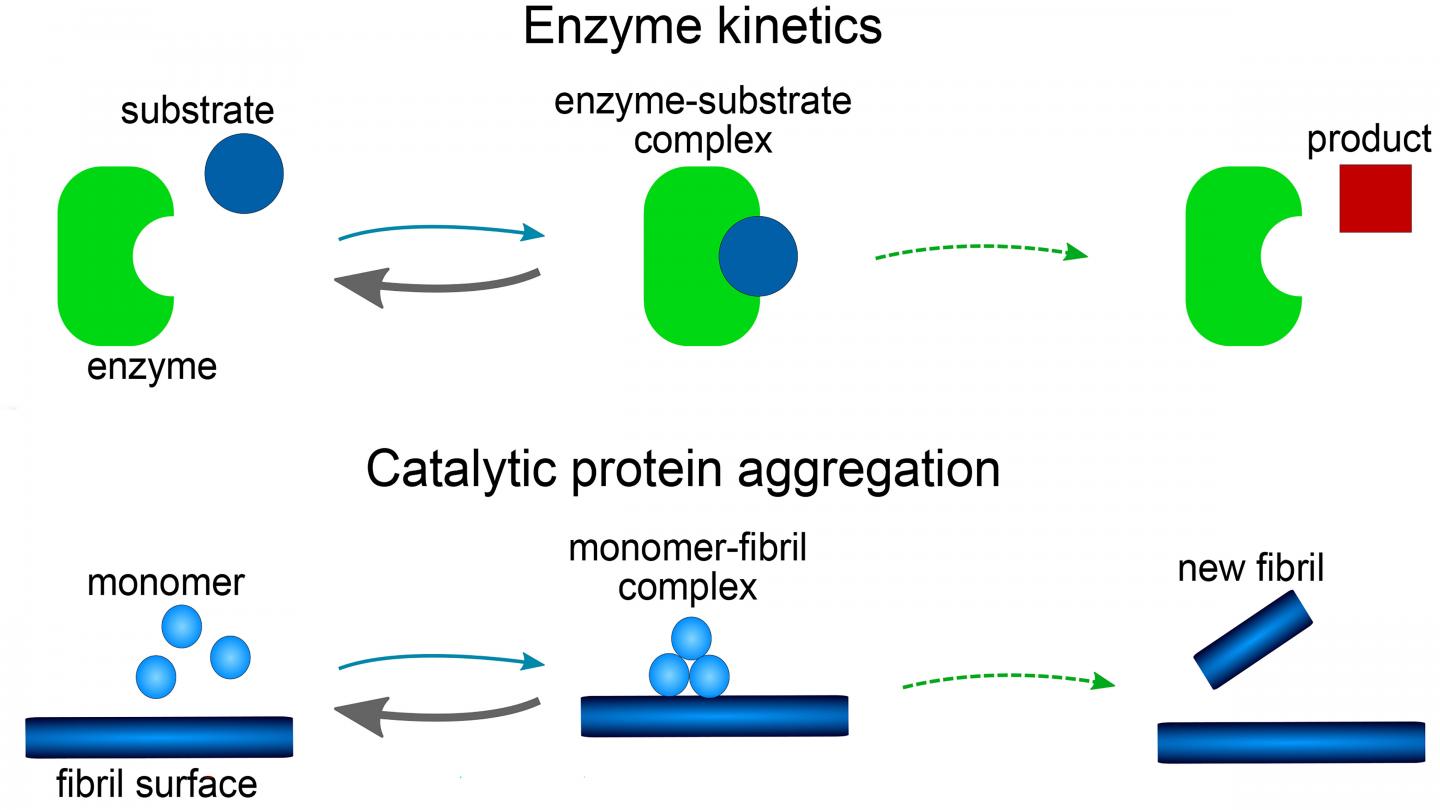
Equations describe chemical reactions responsible for the formation of protein aggregates associated with illnesses like Alzheimer’s disease
IMAGE

Credit: Alexander J. Dear

WASHINGTON, January 28, 2020 — Amyloids are aggregates consisting of stacks of thousands of proteins bound tightly together. Their formation is involved in several widespread disorders, including Alzheimer’s disease and Type II diabetes.

In this week’s Journal of Chemical Physics, by AIP Publishing, scientists report on a mathematical model for the formation of amyloid fibrils. The model sheds light on how the aggregation process can occur in a catalytic manner, something that has not been previously well understood.

The investigators applied their model to the aggregation of a specific protein associated with Alzheimer’s, Ab40. The results show the initiation of the aggregation process for Ab40?fibrils typically occurs at interfaces, such as near the surface of a liquid solution or the glass wall of a test tube. This has important implications for the interpretation of laboratory data used in the study of Alzheimer’s and other diseases.

The model consists of a set of mathematical equations, known as rate equations, that describe how protein aggregate concentrations change over time. Each reaction step in the model is shown to be analogous to those in reactions involving enzymes. The role of the enzyme is played by either the tip or side of a growing fiber or, possibly, a surface of the reaction vessel.

The investigators found the mathematical form of their model was related to the famous Michaelis-Menten equations, first published in 1913 to describe the rates of enzyme reactions. It has a far simpler mathematical form than all previous models used for amyloid formation and has the additional advantage that the equations can be solved by hand, without the need for computer simulations.

“We expect the methodology developed in this paper will underpin future efforts to model new amyloid formation phenomena,” co-author Alexander Dear said.

One of the key features of the mathematical solution found for Michaelis-Menten-type equations is a phenomenon known as saturation. When saturation occurs, the catalytic sites become fully occupied at high protein concentrations. In the case of the Ab40 studies, saturation also shows that the process initiating aggregation involves a surface, such as the wall of a test tube.

While the conclusions do not directly apply to the body itself, co-author Tuomas Knowles said, “This work will be central in facilitating the study of amyloid formation in the presence of other species found in body fluids.”

Co-author Sara Linse said, “This work takes the analysis of experimental data to a new level that will be essential for deriving potent inhibitors of amyloid formation.”

###

The article, “The catalytic nature of protein aggregation,” is authored by Alexander Dear, Georg Meisl, Thomas C. T. Michaels, Manuela R. Zimmermann, Sara Linse and Tuomas P. J. Knowles. The article will appear in The Journal of Chemical Physics on Jan. 28, 2020 (DOI: 10.1063/1.5133635). After that date, it can be accessed at https://aip.scitation.org/doi/10.1063/1.5133635.

Media Contact
Larry Frum
[email protected]
301-209-3090

Related Journal Article

http://dx.doi.org/10.1063/1.5133635

Tags: AlzheimerBiomechanics/BiophysicsChemistry/Physics/Materials SciencesDiabetesDiagnosticsMedicine/HealthMetabolism/Metabolic Diseasesneurobiology
Share12Tweet8Share2ShareShareShare2

Related Posts

blank

Breakthrough in Environmental Cleanup: Scientists Develop Solar-Activated Biochar for Faster Remediation

February 7, 2026
blank

Cutting Costs: Making Hydrogen Fuel Cells More Affordable

February 6, 2026

Scientists Develop Hand-Held “Levitating” Time Crystals

February 6, 2026

Observing a Key Green-Energy Catalyst Dissolve Atom by Atom

February 6, 2026
Please login to join discussion

POPULAR NEWS

  • Robotic Ureteral Reconstruction: A Novel Approach

    Robotic Ureteral Reconstruction: A Novel Approach

    82 shares
    Share 33 Tweet 21
  • Digital Privacy: Health Data Control in Incarceration

    63 shares
    Share 25 Tweet 16
  • Study Reveals Lipid Accumulation in ME/CFS Cells

    57 shares
    Share 23 Tweet 14
  • Breakthrough in RNA Research Accelerates Medical Innovations Timeline

    53 shares
    Share 21 Tweet 13

About

We bring you the latest biotechnology news from best research centers and universities around the world. Check our website.

Follow us

Recent News

Decoding Prostate Cancer Origins via snFLARE-seq, mxFRIZNGRND

Digital Health Perspectives from Baltic Sea Experts

Florida Cane Toad: Complex Spread and Selective Evolution

Subscribe to Blog via Email

Enter your email address to subscribe to this blog and receive notifications of new posts by email.

Join 73 other subscribers
  • Contact Us

Bioengineer.org © Copyright 2023 All Rights Reserved.

Welcome Back!

Login to your account below

Forgotten Password?

Retrieve your password

Please enter your username or email address to reset your password.

Log In
No Result
View All Result
  • Homepages
    • Home Page 1
    • Home Page 2
  • News
  • National
  • Business
  • Health
  • Lifestyle
  • Science

Bioengineer.org © Copyright 2023 All Rights Reserved.