• HOME
  • NEWS
  • EXPLORE
    • CAREER
      • Companies
      • Jobs
    • EVENTS
    • iGEM
      • News
      • Team
    • PHOTOS
    • VIDEO
    • WIKI
  • BLOG
  • COMMUNITY
    • FACEBOOK
    • INSTAGRAM
    • TWITTER
Wednesday, May 13, 2026
BIOENGINEER.ORG
No Result
View All Result
  • Login
  • HOME
  • NEWS
  • EXPLORE
    • CAREER
      • Companies
      • Jobs
        • Lecturer
        • PhD Studentship
        • Postdoc
        • Research Assistant
    • EVENTS
    • iGEM
      • News
      • Team
    • PHOTOS
    • VIDEO
    • WIKI
  • BLOG
  • COMMUNITY
    • FACEBOOK
    • INSTAGRAM
    • TWITTER
  • HOME
  • NEWS
  • EXPLORE
    • CAREER
      • Companies
      • Jobs
        • Lecturer
        • PhD Studentship
        • Postdoc
        • Research Assistant
    • EVENTS
    • iGEM
      • News
      • Team
    • PHOTOS
    • VIDEO
    • WIKI
  • BLOG
  • COMMUNITY
    • FACEBOOK
    • INSTAGRAM
    • TWITTER
No Result
View All Result
Bioengineer.org
No Result
View All Result
Home NEWS Science News

New imaging technology could ‘revolutionize’ cancer surgery

Bioengineer by Bioengineer
September 16, 2019
in Science News
Reading Time: 2 mins read
0
IMAGE
Share on FacebookShare on TwitterShare on LinkedinShare on RedditShare on Telegram

‘This is the future, a huge step towards our ultimate goal of revolutionizing surgical oncology’
IMAGE

Credit: University of Waterloo

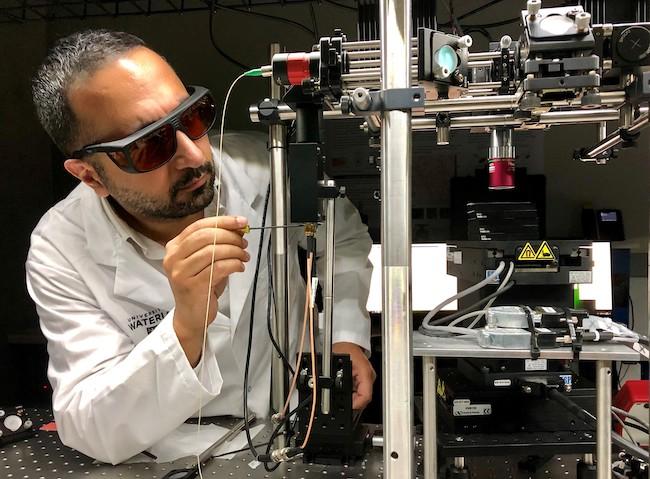
Cancer treatment could be dramatically improved by an invention at the University of Waterloo to precisely locate the edges of tumors during surgery to remove them.

The new imaging technology uses the way light from lasers interacts with cancerous and healthy tissues to distinguish between them in real-time and with no physical contact, an advancement with the potential to eliminate the need for secondary surgeries to get missed malignant tissue.

“This is the future, a huge step towards our ultimate goal of revolutionizing surgical oncology,” said Parsin Haji Reza, a systems design engineering professor who leads the project. “Intraoperatively, during surgery, the surgeon will be able to see exactly what to cut and how much to cut.”

A paper on the work, All-optical Reflection-mode Microscopic Histology of Unstained Human Tissues, was published Sep.t 16 in the journal Scientific Reports.

Doctors now rely primarily on pre-operation MRI images and CT scans, experience and visual inspection to determine the margins of tumors during operations.

Tissue samples are then sent to labs for testing, with waits of up to two weeks for results to show if the tumor was completely removed or not.

In about 10 per cent of cases – the rates for different kinds of cancer involving tumors vary widely – some cancerous tissue has been missed and a second operation is required to remove it.

The photoacoustic technology developed at Waterloo works by sending laser light pulses into targeted tissue, which absorbs them, heats up, expands and produces soundwaves. A second laser reads those soundwaves, which are then processed to determine if the tissue is cancerous or non-cancerous.

The system has already been used to make accurate images of even relatively thick, untreated human tissue samples for the first time ever, a key breakthrough in the development process.

Next steps include imaging fresh tissue samples taken during surgeries, integrating the technology into a surgical microscope and, finally, using the system directly on patients during operations.

“This will have a tremendous impact on the economics of health-care, be amazing for patients and give clinicians a great new tool,” said Haji Reza, director of the PhotoMedicine Labs at Waterloo. “It will save a great deal of time and money and anxiety.”

Researchers hope to develop a fully functioning system within about two years, a process including the need to clear ethical hurdles and securing regulatory approvals.

###

Collaborators on the project at Waterloo include master’s engineering student Saad Abbasi, post-doctoral fellow Kevan Bell, and physics co-op students Martin Le and Bazil Sonier. Also on the research team are oncologists Deepak Dinakaran and John Mackey, and pathologist Gilbert Bigras of the University of Alberta.

Media Contact
Chris Wilson-Smith
[email protected]

Original Source

https://uwaterloo.ca/news/news/new-imaging-technology-could-revolutionize-cancer-surgery

Tags: Biomedical/Environmental/Chemical EngineeringBiotechnologycancerMedicine/HealthResearch/DevelopmentSurgery
Share12Tweet8Share2ShareShareShare2

Related Posts

Mayo Clinic to Undergo Leadership Transition, Honoring Dr. Gianrico Farrugia’s Transformational Impact — Medicine

Mayo Clinic to Undergo Leadership Transition, Honoring Dr. Gianrico Farrugia’s Transformational Impact

May 13, 2026

Study Finds Sustained Weight Loss Possible by Transitioning from Injectable Obesity Drugs to Daily Oral Orforglipron (ATTAIN-MAINTAIN)

May 13, 2026

Weight Loss Maintained Seven Times More Effectively with Continued Maximum Dose of Tirzepatide, Study Finds

May 12, 2026

Immune Protein Identified as Potential Target to Slow Parkinson’s Disease Progression

May 12, 2026
Please login to join discussion

POPULAR NEWS

  • Research Indicates Potential Connection Between Prenatal Medication Exposure and Elevated Autism Risk

    842 shares
    Share 337 Tweet 211
  • New Study Reveals Plants Can Detect the Sound of Rain

    728 shares
    Share 290 Tweet 182
  • Salmonella Haem Blocks Macrophages, Boosts Infection

    62 shares
    Share 25 Tweet 16
  • Breastmilk Balances E. coli and Beneficial Bacteria in Infant Gut Microbiomes

    57 shares
    Share 23 Tweet 14

About

We bring you the latest biotechnology news from best research centers and universities around the world. Check our website.

Follow us

Recent News

Mayo Clinic to Undergo Leadership Transition, Honoring Dr. Gianrico Farrugia’s Transformational Impact

Study Finds Sustained Weight Loss Possible by Transitioning from Injectable Obesity Drugs to Daily Oral Orforglipron (ATTAIN-MAINTAIN)

Weight Loss Maintained Seven Times More Effectively with Continued Maximum Dose of Tirzepatide, Study Finds

Subscribe to Blog via Email

Enter your email address to subscribe to this blog and receive notifications of new posts by email.

Join 82 other subscribers
  • Contact Us

Bioengineer.org © Copyright 2023 All Rights Reserved.

Welcome Back!

Login to your account below

Forgotten Password?

Retrieve your password

Please enter your username or email address to reset your password.

Log In
No Result
View All Result
  • Homepages
    • Home Page 1
    • Home Page 2
  • News
  • National
  • Business
  • Health
  • Lifestyle
  • Science

Bioengineer.org © Copyright 2023 All Rights Reserved.