• HOME
  • NEWS
  • EXPLORE
    • CAREER
      • Companies
      • Jobs
    • EVENTS
    • iGEM
      • News
      • Team
    • PHOTOS
    • VIDEO
    • WIKI
  • BLOG
  • COMMUNITY
    • FACEBOOK
    • INSTAGRAM
    • TWITTER
Monday, October 5, 2026
BIOENGINEER.ORG
No Result
View All Result
  • Login
  • HOME
  • NEWS
  • EXPLORE
    • CAREER
      • Companies
      • Jobs
        • Lecturer
        • PhD Studentship
        • Postdoc
        • Research Assistant
    • EVENTS
    • iGEM
      • News
      • Team
    • PHOTOS
    • VIDEO
    • WIKI
  • BLOG
  • COMMUNITY
    • FACEBOOK
    • INSTAGRAM
    • TWITTER
  • HOME
  • NEWS
  • EXPLORE
    • CAREER
      • Companies
      • Jobs
        • Lecturer
        • PhD Studentship
        • Postdoc
        • Research Assistant
    • EVENTS
    • iGEM
      • News
      • Team
    • PHOTOS
    • VIDEO
    • WIKI
  • BLOG
  • COMMUNITY
    • FACEBOOK
    • INSTAGRAM
    • TWITTER
No Result
View All Result
Bioengineer.org
No Result
View All Result
Home NEWS Science News Health

New imaging modality targets cholesterol in arterial plaque

Bioengineer by Bioengineer
June 13, 2019
in Health
Reading Time: 3 mins read
0
IMAGE
Share on FacebookShare on TwitterShare on LinkedinShare on RedditShare on Telegram

Innovative research, reported in the SPIE Journal of Biophotonics, utilizes a dual-wavelength approach for the specific identification of plaque-causing cholesterol
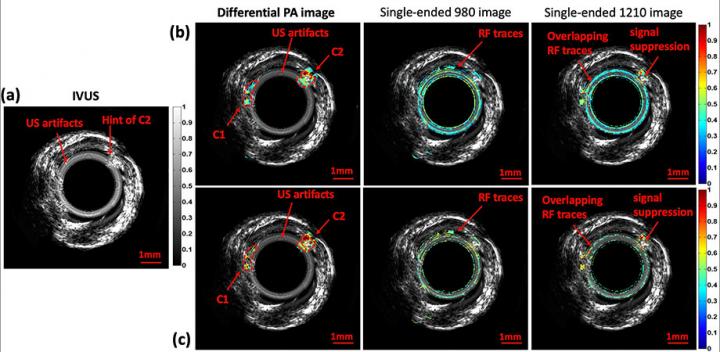
IMAGE

Credit: Sung Soo Sean Choi et al.

BELLINGHAM, Washington, USA and CARDIFF, UK – In an article published in the peer-reviewed SPIE publication Journal of Biomedical Optics (JBO), “Frequency-domain differential photoacoustic radar: theory and validation for ultra-sensitive atherosclerotic plaque imaging,” researchers demonstrate a new imaging modality that successfully identifies the presence of cholesterol in the arterial plaque.

Cholesterol in plaque, along with fat, calcium, and other blood-transported substances, can lead to atherosclerosis, a disease which can cause heart attacks or strokes. Early detection of cholesterol can lead to earlier treatments and improved health outcomes. Toronto-based researchers have demonstrated a unique detection technique that combines laser photoacoustics, a hybrid optical-acoustic imaging technology, with low-power continuous wave lasers and frequency-domain signal processing, in an approach known as photoacoustic radar. This advanced technology can accurately evaluate plaque-based cholesterol, and allow for more timely treatment of atherosclerosis.

According to JBO Editor-in-Chief, SPIE Fellow, and MacLean Professor of Engineering at the Thayer School of Engineering at Dartmouth College, New Hampshire, Brian Pogue, the findings mark an exciting new direction in imaging: “This is an original direction of imaging research that utilizes an innovative idea of detection based upon differences between wavelengths, and signal analysis based upon radar methods. Photoacoustic imaging has the best potential for imaging through thick tissues or blood: the high-sensitivity detection of cholesterol described in this paper is made possible with a specifically modified, dual wavelength approach.”

###

The article authors are Sung Soo Sean Choi, a PhD candidate at the University of Toronto; Bahman Lashkari, a research associate at the University of Toronto; and Andreas Mandelis, a professor of mechanical and industrial engineering and of electrical and computer engineering at the University of Toronto; Jungik Son, Natasha Alves-Kotzev, and Stuart F. Foster of the Sunnybrook Research Institute of Toronto; and Mark Harduar of Conavi Medical, Toronto; and Brian Courtney of both Sunnybrook Research Institute and Conavi Medical.

JBO, an open-access journal, is published in print and digitally by SPIE in the SPIE Digital Library, which contains more than 500,000 publications from SPIE journals, proceedings, and books, with approximately 18,000 new research papers added each year.

About SPIE

SPIE is the international society for optics and photonics, an educational not-for-profit organization founded in 1955 to advance light-based science, engineering, and technology. The Society serves 257,000 constituents from 173 countries, offering conferences and their published proceedings, continuing education, books, journals, and the SPIE Digital Library. In 2018, SPIE provided more than $4 million in community support including scholarships and awards, outreach and advocacy programs, travel grants, public policy, and educational resources. http://www.spie.org.

Contact:

Daneet Steffens

Public Relations Manager

[email protected]

+1 360 685 5478

@SPIEtweets

Media Contact
Daneet Steffens
[email protected]

Related Journal Article

http://dx.doi.org/10.1117/1.JBO.24.6.066003

Tags: Biomedical/Environmental/Chemical EngineeringBiotechnologyCardiologyCholesterolMedicine/HealthPulmonary/Respiratory MedicineResearch/DevelopmentStroke
Share12Tweet8Share2ShareShareShare2

Related Posts

Ancestry Shapes the Side Effects of Melanoma Immunotherapy, Study Finds

Ancestry Shapes the Side Effects of Melanoma Immunotherapy, Study Finds

October 5, 2026
How Walking Efficiency May Shape Urinary Symptoms in Older Adults

How Walking Efficiency May Shape Urinary Symptoms in Older Adults

October 5, 2026

Broken Machines and Missing Parts: Why Medical Equipment Fails in Ethiopia’s Teaching Hospitals

October 5, 2026

Poor Sleep, Not Shift Schedules, Drives Belly Fat in Hospital Workers, Study Finds

October 5, 2026
Please login to join discussion

POPULAR NEWS

  • Alloys That Shrink Their Own Grains: New PIX Mechanism Refines Metals With Heat Alone

    Alloys That Shrink Their Own Grains: New PIX Mechanism Refines Metals With Heat Alone

    29 shares
    Share 12 Tweet 7
  • Endurance Exercise Reshapes the Liver in Males and Females Through Distinct Molecular Routes

    29 shares
    Share 12 Tweet 7
  • Single Transcription Factor PU.1 Rapidly Converts Fibroblasts into Macrophage-Lineage Cells

    29 shares
    Share 12 Tweet 7
  • New Scale Measures How Ready Nurse Educators Really Are for the AI Era

    29 shares
    Share 12 Tweet 7

About

We bring you the latest biotechnology news from best research centers and universities around the world. Check our website.

Follow us

Recent News

Alloys That Shrink Their Own Grains: New PIX Mechanism Refines Metals With Heat Alone

Endurance Exercise Reshapes the Liver in Males and Females Through Distinct Molecular Routes

Single Transcription Factor PU.1 Rapidly Converts Fibroblasts into Macrophage-Lineage Cells

Subscribe to Blog via Email

Success! An email was just sent to confirm your subscription. Please find the email now and click 'Confirm' to start subscribing.

Join 85 other subscribers
  • Contact Us

Bioengineer.org © Copyright 2023 All Rights Reserved.

Welcome Back!

Login to your account below

Forgotten Password?

Retrieve your password

Please enter your username or email address to reset your password.

Log In
No Result
View All Result
  • Homepages
    • Home Page 1
    • Home Page 2
  • News
  • National
  • Business
  • Health
  • Lifestyle
  • Science

Bioengineer.org © Copyright 2023 All Rights Reserved.