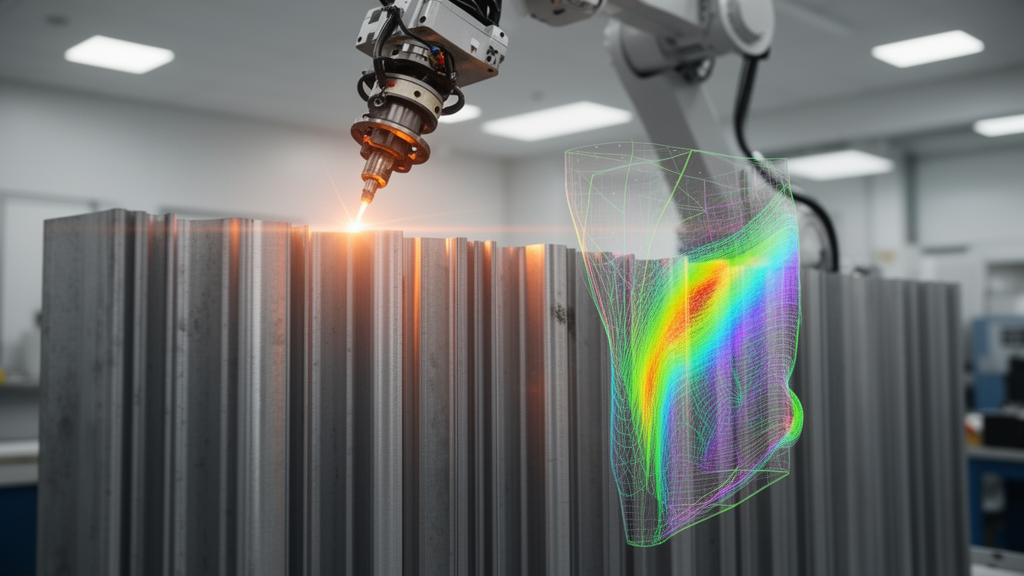
The work, published as an open-access research article in the journal Discover Surfaces on 11 August 2026, was carried out by Alexandra Morvayová, Mojtaba Karamimoghadam, Nicola Contuzzi, Mousa Javidani, Laura Fabbiano and Giuseppe Casalino, and targets a manufacturing technique known as wire arc additive manufacturing, or WAAM.
WAAM works by melting a metal wire feedstock with an electric welding arc and depositing it in controlled layers, much like welding, to build large metallic parts. The method offers high deposition rates, low running costs and considerable flexibility of equipment, making it an attractive alternative to traditional subtractive manufacturing. It also has well-known drawbacks: compared with other metal additive manufacturing methods, it delivers lower dimensional accuracy, poorer surface finish and higher residual stresses, all of which depend strongly on process parameters such as deposition rate, feeding rate and wire diameter.
Numerical modelling with the finite element method has become one of the most powerful tools for predicting the outcomes of WAAM, but it involves a trade-off. Macro-scale models can quickly estimate residual stresses and thermal history for full-sized components, yet they do not fully capture the geometry of the deposited layers. Meso-scale and micro-scale models offer far more detail and more physical phenomena, but they are generally not applicable to full-size parts. The new study addresses this gap by combining a macro-scale thermo-mechanical finite element simulation with an analytical formulation that predicts the shape of each deposited bead before the simulation begins.
To test the framework, the researchers deposited a simple cuboid specimen of AISI 308L stainless steel onto a low-alloy ST37 substrate plate measuring 200 by 100 by 10 millimetres. The wall consisted of five layers with three beads per layer, an imposed length of 190 millimetres, and a 1-millimetre-diameter wire. Deposition followed a zig-zag strategy in which the direction of travel alternated between beads, the deposition angle rotated by 180 degrees between successive layers, and a dwell time of 120 seconds was inserted after each completed layer. The process was performed in CMT mode using an Arcoweld machine with a Fronius iWave 300i power source and an Omron collaborative robotic arm, shielded by 99.99 percent pure argon, with three experimental replications.
A Flir T1020 bolometer thermal camera continuously recorded the temperature history during deposition, offering a 28-degree field of view, 1024 by 768 resolution, a 30 hertz frame rate and a lowest detectable temperature difference of 20 millikelvin. Measurements were taken at predefined points on the substrate and on the second layer, while the distortion of the base plate was examined at ten points along its upper right edge, spaced 20 millimetres apart. These experimental records then served as the benchmark against which the numerical model was judged.
On the computational side, the model first estimates bead width and height analytically from the wire feed rate, travel speed and wire diameter, assuming steady material transfer and an idealized bead shape with a constant contact angle of 45 degrees. For the chosen parameters — a 1-millimetre wire, a feed rate of 106.67 millimetres per second and a travel speed of 5 millimetres per second — this yields a bead width of 7.85 millimetres and a height of 2.77 millimetres. These dimensions then feed into a transient coupled thermo-mechanical finite element model in which material is added through an element birth-and-death technique, with newly activated elements assigned the melting temperature of the filler to represent the arrival of molten material from the arc. The welding arc itself is represented by a Goldak double-ellipsoidal heat source, which captures the asymmetric heat distribution ahead of and behind the moving arc, and heat losses from external surfaces are modelled through convection and thermal radiation.
The simulation reproduced the experimental thermal histories with strong agreement. At measuring point TC1, four main thermal cycles were recognizable, corresponding to the deposition of the second layer and three subsequent SS308L layers; the first layer appeared only as a gradual temperature decrease because the measurement point sat opposite the initial heat source position. The second peak exceeded the first, an effect the authors attribute to thermal accumulation and preheating of the substrate by the preceding deposition, and the second, third and fourth cycles showed a double-peak structure arising from the deposition sequence within each layer. At the more distant point TC2, all five layers were clearly distinguishable as individual peaks, and the simulated curves again closely mimicked the experimental records, with only minor deviations in peak magnitude that the authors link to simplifications such as constant convection coefficients and idealized bead geometry.
Distortion predictions also performed well. Comparing simulated and experimental substrate distortions at the ten measurement points after cooling, the average relative error was 4.88 percent, which the authors note outperforms a conventional macro-scale WAAM model that achieved an average error of 8.54 percent. The largest error occurred at point 10, close to the clamping, where the distortion value was small relative to the mesh size. The simulated distortion field showed the highest values, roughly 6 to 8 millimetres, in the central and free regions of the plate where material is least constrained, falling below 3 millimetres near the clamped edges, and the pattern followed the deposition path with a symmetric reduction toward both clamped ends. The simulated bead morphology also matched the manufactured specimen in overall geometry and macroscopic shape features, reproducing a shallow cavity in the frontal region, slight waviness of the upper beads and minor inward deformation of the lower beads.
The model also predicted the distribution of residual stresses, with the highest stresses located in the lower part of the specimen where it contacts the substrate, which partially blocks deformation, and the lowest stresses on the lateral sides of the deposited beads where heated material can flow more freely. However, the authors are explicit that no direct residual-stress measurements were performed in the study, so these predictions should be interpreted qualitatively rather than as fully validated quantitative values. The model likewise does not resolve defect formation mechanisms such as porosity, lack of fusion, cracking or internal cavities, and it does not predict metallurgical phase evolution, since latent heat is approximated implicitly through temperature-dependent specific heat capacity. The clamping conditions in the model represent an idealized approximation of the experimental fixture, because the fixture stiffness was not directly characterized, so the distortion validation is valid for the assumed clamping representation.
Overall, the framework offers an efficient tool for predicting the thermal response, macroscopic geometry and distortion of WAAM-built components while providing qualitative insight into residual-stress development, with a full simulation of the five-layer, three-bead structure taking approximately three hours on eight CPUs. The authors state that future work will focus on incorporating experimental residual-stress measurements for quantitative validation, refining the clamping representation, implementing adaptive layer-geometry updating, and coupling the model with microstructure-informed approaches to extend its predictive capability and industrial applicability.
Subject of Research: Hybrid numerical modelling of geometry, thermal history and residual stresses in SS308L walls built by wire arc additive manufacturing on a low-alloy steel substrate
Article Title: Numerical modelling of geometry, residual stresses and thermal history in SS308L walls manufactured by WAAM on low alloy substrate
Article References: Morvayová, A., Karamimoghadam, M., Contuzzi, N., Javidani, M., Fabbiano, L., & Casalino, G. (2026). Numerical modelling of geometry, residual stresses and thermal history in SS308L walls manufactured by WAAM on low alloy substrate. Discover Surfaces, 1(1), Article 8. https://doi.org/10.1007/s44507-026-00009-3
Image Credits: AI Generated
DOI: 10.1007/s44507-026-00009-3
Keywords: wire arc additive manufacturing, WAAM, finite element modelling, SS308L stainless steel, residual stresses, thermal history, substrate distortion, Goldak heat source, bead geometry, CMT deposition, additive manufacturing, thermo-mechanical simulation
News Source: Denise Maddox. (October 28, 2026). New Hybrid Model Predicts Heat, Distortion and Stresses in 3D-Printed Steel Walls. Scienmag.