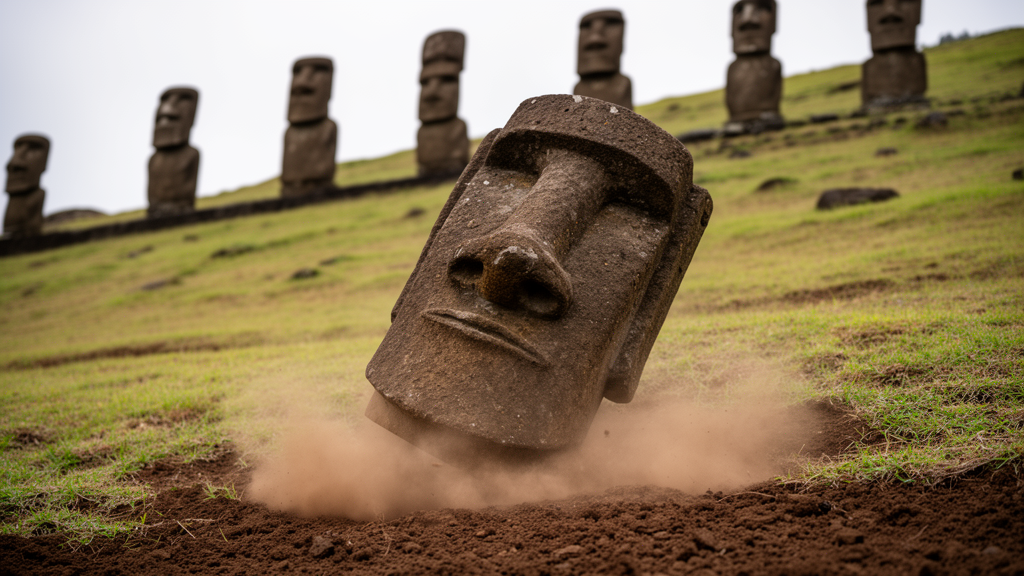
The monumental statues of Rapa Nui, better known as Easter Island, have toppled in a strikingly consistent way: face-down, inland, away from the sea. A new open-access study in the journal Built Heritage offers the first closed-form structural explanation for that pattern, and it comes with practical consequences for the roughly 50 moai that conservation programmes have re-erected on their stone platforms since 1960. According to the analysis, adding the famous cylindrical red scoria topknots, the pukao, makes the assemblies measurably easier to tip forward than sideways, and forward tipping is the weakest link in the entire system.
The study, authored by Lucas Ribeiro and Marcos André Simonssini, treats the installed statue-plus-topknot assembly as a rigid body resting on the prepared platform surface of an ahu, the monumental stone structure on which the moai stand. Using canonical proportions documented by the Easter Island Statue Project and material densities reported in the geomechanical literature for the Rano Raraku tuff and Puna Pau red scoria, the authors derive critical tipping angles, pseudostatic seismic thresholds and minimum tipping energies from elementary statics. All numerical values in the paper are reproducible from a Python script supplied as a supplementary file.
The reference case is a canonical moai 4.5 metres tall and 16 tonnes in mass, consistent with the seven statues of Ahu Akivi, carrying a typical 5-tonne pukao. For the bare statue, the vertical centre of mass sits at approximately 0.522 times the statue height, about 2.35 metres above the platform. Adding the pukao raises the combined centre of mass to approximately 0.671 times the statue height, roughly 3.02 metres, an elevation of about 29 percent. That lift alone would not matter if the base were square, but the base of an installed moai is rectangular, and that asymmetry drives the paper’s central result.
Because the front-to-back depth of the base is only about 0.6 times its lateral width, the effective half-base dimension is much smaller in the frontal direction. The critical tipping angle, computed as the arctangent of the half-base divided by the centre-of-mass height, is therefore directionally anisotropic. Laterally, the critical angle falls from approximately 17.7 degrees for the bare moai to 13.9 degrees with the pukao. Frontally, it falls from approximately 10.8 degrees to 8.5 degrees. The pukao reduces the margin by about 21 percent in both directions, but the frontal margin was already the smaller one, and the topknot widens that gap in absolute terms.
The seismic implications follow from a pseudostatic criterion, in which the minimum horizontal acceleration for tipping equals gravitational acceleration times the tangent of the critical angle. Frontal tipping of the bare moai requires approximately 0.19 g; with the pukao installed, the threshold drops to approximately 0.15 g, about 22 percent lower. The authors note that this directional anisotropy is more consequential than the pukao effect itself: an event producing roughly 0.18 g would marginally topple the bare moai frontally while leaving it stable laterally. Rapa Nui lies near the Easter Microplate at the Pacific–Nazca plate boundary, with documented historical seismicity including an Ms 6.3 event in 1987 and an M 6.6 event in 2022, so thresholds in this range are physically attainable regionally, although the paper identifies no specific pre-instrumental event in the toppling window.
Energy tells the same story even more sharply. The minimum energy needed to tip the assembly from vertical to its critical angle is the gravitational potential energy gained by the rising centre of mass. For frontal toppling of the assembly, that barrier is approximately 6.7 to 6.9 kilojoules, only about 37 percent of the lateral value of roughly 18.3 to 18.9 kilojoules. Within each direction, the pukao barely changes the energy requirement, because the smaller critical angle is offset by the larger total mass and longer lever arm. The dominant feature of the energy landscape is direction, not configuration: frontal tipping is both the lowest-threshold and the lowest-energy mode of failure.
This structural envelope is consistent with the archaeological record without adjudicating among the proposed causes of toppling. A 1996 survey of 24 image-ahu containing 111 moai found that approximately 80 percent of fallen statues lay inland in a uniform west-northwest direction, with every fall attributed to loss of basal leverage and failure of the ahu front slab wall. For coastal moai facing inland, frontal tipping is inland fall, so any perturbation past the low frontal threshold produces exactly the observed face-down pattern. The authors are explicit that this constrains the preferred axis of failure but does not by itself distinguish seismic triggers, nonviolent ritual toppling, postcontact neglect or human force; the chronological evidence, with most moai standing in 1722 and 1770 and essentially none by 1868, independently challenges the precontact warfare hypothesis.
Wind, by contrast, can be largely excluded. Under conservative assumptions, the wind speed required to initiate frontal overturning is approximately 51 metres per second for the assembly, while mean trade winds at Mataveri run about 7 to 8 metres per second and even an extreme 30-metre-per-second gust develops only about 35 percent of the overturning moment needed. Applied human force is also less affected by the pukao than one might assume: when the force is applied at the top of the structure, the added mass is roughly compensated by the longer lever arm, so the topknot’s stability cost bears specifically on physical perturbation mechanisms such as seismic shaking, foundation tilt and wind rather than on deliberate pushing.
The model carries clear caveats. The pukao is in reality balanced as a separate piece in a shallow, rearward-offset concavity rather than rigidly attached, so a full dynamic treatment would require a two-block rocking model; the single-rigid-body analysis provides the static-tipping limit of that more general behaviour. The adopted depth-to-width ratio of 0.6 is grounded in measurements of 137 installed moai, whose median ratio is 0.56, meaning the reported frontal margins are mildly nonconservative upper bounds. Most importantly, the ahu platform is idealised as a level, rigid foundation, whereas historical evidence indicates that outward failure of the front slab wall frequently triggers toppling by tilting the platform surface; a coupled platform-and-assembly model would likely yield lower effective thresholds, reinforcing the conservation conclusions.
For conservation practice, the framework functions as a first-order screening tool. Because the critical angle of an assembly is governed by the ratio of pukao mass to moai mass rather than absolute size, restored assemblies can be ranked by frontal stability margin using dimensions alone, identifying candidates for priority structural health monitoring, particularly periodic measurement of baseline tilt in the frontal direction. The model also quantifies the structural cost of any proposal to reinstall a pukao on a currently bare restored moai, among them the fifteen statues re-erected at Ahu Tongariki during the 1992 to 1996 restoration. The authors identify a structural analysis of the ahu platform as a foundation system as the necessary complement to their work, the missing lower component of an integrated assessment of the complete moai, pukao and ahu monument.
Subject of Research: A closed-form structural stability model of moai and pukao assemblies on Rapa Nui platform structures for heritage conservation
Article Title: Static stability of monumental moai–pukao assemblies on the ahu of Rapa Nui: a closed-form structural model for built heritage conservation
Article References: Ribeiro, L., & Simonssini, M. A. (2026). Static stability of monumental moai–pukao assemblies on the ahu of Rapa Nui: a closed-form structural model for built heritage conservation. Built Heritage, 10(1), Article 67. https://doi.org/10.1186/s43238-026-00298-0
Image Credits: AI Generated
DOI: 10.1186/s43238-026-00298-0
Keywords: Rapa Nui, Easter Island, moai, pukao, ahu, structural stability, built heritage, conservation, seismic threshold, tipping angle, rocking dynamics, monumental statuary
News Source: Denise Maddox. (October 28, 2026). Engineers Model Why Easter Island Moai Fall Face-Down First. Scienmag.