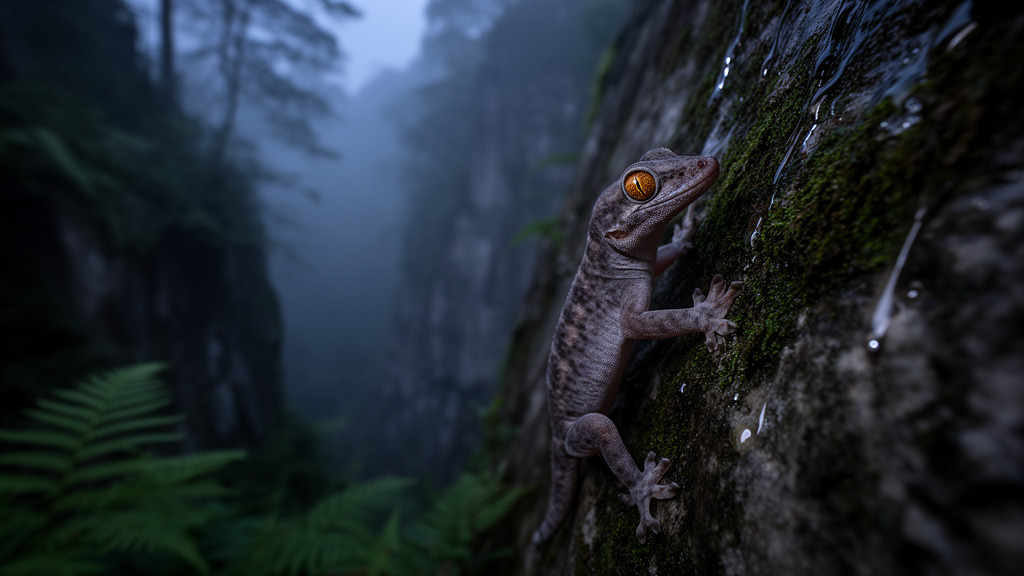
Scientists surveying the walls and crevices of artificial structures on the southern slope of the Qinling Mountains have described a new species of gecko, Gekko luanchuanensis, from Luanchuan County in Henan Province, China. The discovery, published in the journal ZooKeys, is based on three specimens collected between August and September 2025 at elevations of 754 to 782 meters above sea level. The animals had been living, largely unnoticed, on human-built walls in a region better known for its role as a natural boundary between China’s Palaearctic and Oriental biogeographic realms than for its hidden reptile diversity.
The new species belongs to the genus Gekko, a large radiation of geckos in the family Gekkonidae that currently comprises seven subgenera. One of these, Japonigekko, was erected in 2020 and has quickly become one of the most taxonomically active groups in Chinese herpetology. Before this study, the subgenus contained 39 recognized species, 27 of which occur in China. Members of Japonigekko share a characteristic suite of traits: moderate body size, nostrils typically in contact with the rostral scale, two to four nasal scales, variable rows of dorsal tubercles, zero to 32 precloacal pores, one to four postcloacal tubercles, and lateral folds that lack tubercles.
The species diversity of this subgenus has long been underestimated, and the pace of discovery reflects that. In the past five years alone, ten new Japonigekko species have been described from China, each supported by mitochondrial DNA sequences and morphological comparisons. These include Gekko jinjiangensis from Yunnan, G. liui and G. fengshanensis from Hainan and Guangxi, G. alpinus from Sichuan, G. paucituberculatus from Guangxi, G. tesselatus from Sichuan, G. kaiyai from Henan, G. cib from Sichuan, and G. mosaicus from Yunnan. The new species from Luanchuan continues this pattern, and with its formal description the number of recognized Gekko species worldwide rises to 102, the number of species in the subgenus Japonigekko to 40, and the number of Japonigekko species in China to 28.
The three specimens from Luanchuan were collected at night at coordinates 33°78’N, 111°61’E, when the average nighttime temperature ranged from 23 to 25 degrees Celsius. Liver samples were preserved in 95 percent ethanol for genetic analysis, while the animals themselves were fixed in 10 percent formalin and stored in 75 percent ethanol at the museum of Anhui Normal University. The type series consists of an adult male holotype, catalogued as HSR25011, and two paratypes: a subadult female and a juvenile female, all collected on 22 to 23 August 2025. The holotype, an adult male, measures 46.52 millimeters from snout to vent, a moderate size for the group.
Morphologically, Gekko luanchuanensis is set apart from its congeners by a combination of characters. Its nostrils are fused with the snout scale; it has 23 to 25 interorbital scales; its dorsal tubercles are small and sparse and do not form rows at midbody; it has 141 to 157 midbody scale rows and 35 to 37 ventral scale rows; its limbs lack tubercles; webbing between the digits is absent; and it bears 6 to 8 precloacal pores and two postcloacal tubercles on each side. In life, the animal is light brown with dense dark-brown markings on the head, a W-shaped dark marking at the junction of head and neck, and 6 to 8 dark-gray stripes running along the back from the neck to the tail base. The tail carries roughly ten brownish-yellow rings whose margins darken toward gray.
To test whether these differences held up statistically, the researchers compared the new species with its closest relative, Gekko swinhonis, using analysis of covariance with snout-vent length as a covariate. After accounting for body size, the two species differed significantly in head length, right forelimb length, and hindlimb length, with P values below 0.05. Juveniles were excluded from the morphometric analysis to minimize the influence of age on the measurements. Beyond the statistics, several qualitative characters separate the two: the new species has a smoother body surface with fewer tubercles and no rows of dorsal tubercles at midbody, whereas G. swinhonis carries more tubercles arranged in 6 to 9 dorsal rows; the new species has 23 to 25 interorbitals against 20 to 23 in G. swinhonis; and the relative length of the toes differs, with the new species showing the sequence fourth, third, fifth, second, first, where G. swinhonis places the fifth toe ahead of the third.
The molecular evidence rests on two mitochondrial markers, the 16S ribosomal RNA gene and cytochrome b, totaling 1,636 base pairs of concatenated sequence, of which 556 base pairs come from 16S and 1,080 from cytochrome b. The researchers compared their new material against sequences from 14 Chinese Japonigekko species as the ingroup, with Gekko gecko and G. vittatus serving as outgroups. Both Bayesian inference and maximum-likelihood analyses produced similar topologies, and the Luanchuan gecko formed a strongly supported independent clade, with a Bayesian posterior probability of 1.00 and a maximum-likelihood bootstrap value of 92. Within that larger clade, G. swinhonis was recovered as the new species’ closest relative. The uncorrected group mean p-distance between the two, based on the concatenated dataset, is 13.99 percent.
Genetic distances between the new species and its congeners underscore how distinct it is. For the 16S fragment, distances range from 4.86 percent against G. swinhonis to 16.47 percent against G. palmatus. For cytochrome b, they range from 12.22 percent against G. swinhonis to 21.67 percent against G. kaiyai. Although phylogenetic analyses placed the new species in close association with G. auriverrucosus, G. cib, G. melli, and G. subpalmatus, it can be distinguished from each of these by morphological characters. Against G. auriverrucosus it differs in interorbital counts, dorsal tubercle number, and subdigital lamellae, and it lacks tubercles on the limbs and tail. Against G. cib and G. subpalmatus it differs in interorbital counts, midbody scale counts, and the absence of webbing. Against G. melli it is smaller, with fewer interorbitals, fewer midbody and ventral scales, no webbing, and fewer precloacal pores.
The relationship with G. swinhonis carries biogeographic weight. Gekko swinhonis, described in 1864 from a type specimen collected in Beijing, is endemic to China and widely distributed across the Loess Plateau, the Huabei Plain, the Huanghuai Plain, and areas north of the Yangtze River, reaching as far south as Zhejiang Province. Earlier work had already hinted that this widespread species was not a single uniform entity. Specimens from Shaanxi were noted to have indistinct or absent tubercles, and populations from Xi’an showed differences in microdermatoglyphics relative to those from Xunyang. A phylogeographic study identified two reciprocally monophyletic lineages within G. swinhonis, a lowland lineage and a Qinling lineage, whose high genetic divergence and morphological differences suggested the presence of a cryptic species. More recently, a detailed study of the diversity, phylogeny, and biogeography of Japonigekko reported that the G. swinhonis complex includes at least one lineage that may represent a distinct species.
The new species is currently known only from the Qinling Mountains in Henan and Shaanxi Provinces and the Taihang Mountains in Shanxi Province, while G. swinhonis occupies most of the plains of northern China. The authors hypothesize that the divergence between the two species was associated with the Qinling orogeny, the mountain-building event that formed the range through the collision of the North and South China Blocks during the Paleozoic and Triassic periods. The Qinling Mountains, forming a natural north-south boundary between two biogeographic realms, are considered a globally significant area for biodiversity, and the discovery of G. luanchuanensis adds to that record. The researchers suggest that areas surrounding the Qinling and Taihang Mountains may also provide suitable habitat for the new species. For now, the Luanchuan gecko joins a growing list of Chinese Japonigekko species that have emerged from a once-underestimated diversity, and its description brings the global count of Gekko species to a round and newly meaningful 102.
Subject of Research: Description of a new gecko species, Gekko luanchuanensis, from the Qinling Mountains, China, using morphological and mitochondrial DNA evidence
Article Title: A new species of the subgenus Japonigekko ( Squamata , Gekkonidae , Gekko ) from Luanchuan County, Henan Province, China
Article References: Zhang, Y., Jiang, Z., Huang, R., Huang, S., Yang, J., Wu, H., Ding, Z., Liu, W., Zhang, Y., & Wu, H. (2026). A new species of the subgenus Japonigekko (Squamata, Gekkonidae, Gekko) from Luanchuan County, Henan Province, China. ZooKeys, 1296, 45-62. https://doi.org/10.3897/zookeys.1296.206148
Image Credits: AI Generated
DOI: 10.3897/zookeys.1296.206148
Keywords: Gekko luanchuanensis, new species, gecko, Japonigekko, Qinling Mountains, Henan Province, China, mitochondrial DNA, phylogenetics, taxonomy, Gekko swinhonis, herpetology
News Source: Margaret Porter. (October 28, 2026). New gecko species hiding on China’s Qinling Mountains raises Gekko count to 102. Scienmag.