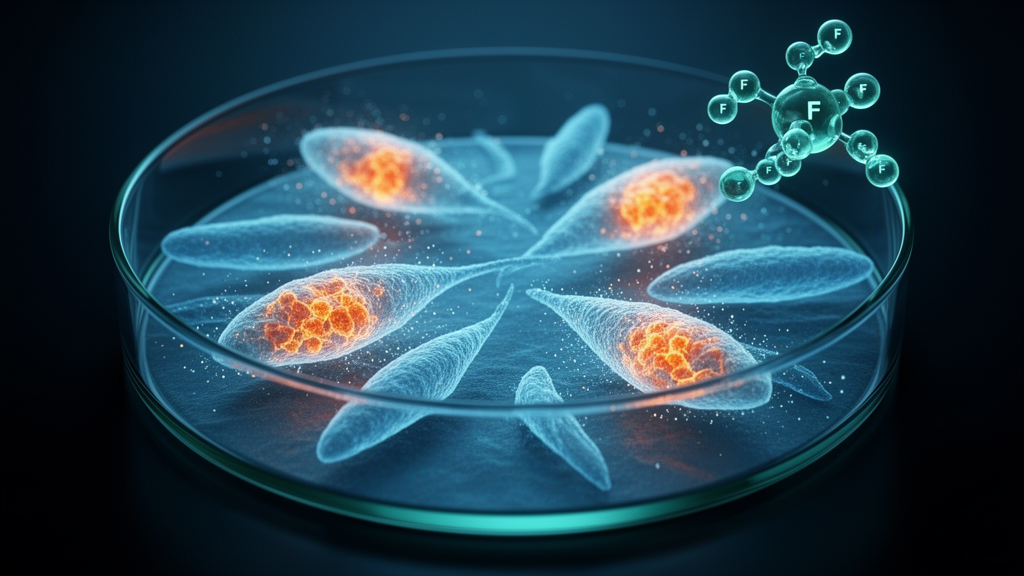
GenX, the short-chain PFAS replacement introduced to take over from PFOA in fluoropolymer manufacturing, has been shown to disrupt human prostate stromal cells at nanomolar concentrations, according to a new open-access study published on 30 September 2026 in Applied Biological Chemistry. The research, led by Ji Won Park and Seon Min Lee with colleagues under senior author Tae Woo Oh, exposed WPMY-1 human prostate stromal cells to GenX for 24 hours and documented a dose-dependent loss of viability, activation of caspase-3- and PARP-associated apoptotic signaling, elevated intracellular reactive oxygen species, and a broad transcriptomic remodeling affecting 218 genes.
The concentrations tested were not arbitrary. The authors note that HFPO-DA, the acid related to GenX, has been measured in finished drinking water at up to 631 ng/L, roughly 2 nanomolar, and in surface water near fluorochemical facilities at levels exceeding 14,000 ng/L, approximately 50 nanomolar. Human biomonitoring studies have reported serum HFPO-DA concentrations up to 5.85 ng/mL, about 21 nanomolar, in populations living near point sources. The dose range of 0 to 50 nanomolar used in the study therefore spans environmentally relevant exposure levels, which is precisely why the findings at the upper end of the range carry weight.
In the MTT viability assay, significant reductions in cell survival emerged only at 25 and 50 nanomolar, while 6.25 and 12.5 nanomolar produced no significant change. Morphological observations mirrored this pattern: cells progressively shrank, rounded, and detached as the concentration increased, with the most pronounced changes at the two highest doses. The study’s design, with three independent biological replicates and one-way ANOVA followed by Dunnett’s post hoc testing, gives the dose-response curve a conventional statistical footing.
Beneath the viability loss, the protein-level evidence pointed to apoptosis. The cleaved PARP/PARP ratio and the cleaved caspase-3/caspase-3 ratio rose dose-dependently, and at 50 nanomolar the pro-apoptotic Bax increased while the anti-apoptotic Bcl-2 decreased, elevating the Bax/Bcl-2 ratio. Notably, the cleaved caspase-9/caspase-9 ratio was not significantly altered across the concentration range, so the authors are careful not to claim a strongly caspase-9-driven upstream mechanism. When cells were pretreated for two hours with 20 micromolar Z-VAD-FMK, a pan-caspase inhibitor, the GenX-induced cleavage of PARP and caspase-3 was attenuated in a concentration-dependent manner, indicating that the apoptotic response depends on caspase activity.
The oxidative arm of the response was equally clear. DCFDA fluorescence imaging showed that intracellular ROS increased upon GenX exposure, and this increase was blunted by pretreatment with 5 millimolar N-acetylcysteine. SOD2 and catalase protein levels rose concentration-dependently, reaching statistical significance at 25 and 50 nanomolar, and NAC pretreatment also attenuated this antioxidant induction. The reversibility of both the ROS signal and the antioxidant enzyme response by NAC supports a redox-dependent component of GenX cytotoxicity. The authors caution, however, that DCFDA measures total intracellular ROS without distinguishing among specific reactive species or subcellular compartments, so mitochondrial versus cytosolic origins cannot be assigned from these data.
To move beyond single markers, the team performed 3′ mRNA sequencing on cells treated with 50 nanomolar GenX for 24 hours alongside untreated controls. Using a fold-change threshold of at least 1.5, they identified 218 differentially expressed genes, 113 upregulated and 105 downregulated, while 3,044 genes remained unchanged. Gene Ontology enrichment across biological process, cellular component, and molecular function domains highlighted stress-responsive transcription, cytokine production, cell adhesion, and kinase activities. Top biological process terms included smooth muscle cell differentiation, positive regulation of cytokine production, peptidyl-tyrosine phosphorylation, and wound healing, while molecular function terms converged on receptor ligand activity, growth factor activity, and cytokine activity.
Pathway-level analysis reinforced the picture. KEGG enrichment identified the MAPK signaling pathway, calcium signaling, PI3K-Akt signaling, cAMP signaling, cytokine-cytokine receptor interaction, JAK-STAT, TGF-β, focal adhesion, Rap1, and Wnt signaling, all at FDR below 0.05. Reactome analysis independently flagged signaling by interleukins, cytokine signaling in the immune system, receptor tyrosine kinase signaling, MAPK family cascades, PDGF signaling, and extracellular matrix organization. Mapping the differentially expressed genes onto the PI3K-Akt pathway revealed that ligand- and receptor-level inputs were predominantly upregulated while core transducing elements were downregulated, and in the cytokine-cytokine receptor interaction pathway, IL-6 family ligands and IL15 were upregulated while IL-12/IL-35 family components and IL-1 family ligands were downregulated.
Protein-protein interaction network analysis using STRING with Markov cluster clustering resolved the 218 genes into ten functional modules. These included a growth factor, calcium, and vascular signaling module containing KIT, NOS3, PDGFB, and PDGFD; a stress-responsive transcriptional module built around the AP-1 axis with FOS, JUN, and EP300; an interleukin-mediated inflammatory module with IL1A, IL15, IL11, and IL33; an extracellular matrix and adhesion module with THBS1, ITGA2B, and LAMA2; a Wnt-related developmental module with WNT4, WNT5B, and WNT10B; and an ER stress-associated IRE1-ASK1 module comprising ERN1, DERL3, and MAP3K5. The authors interpret the AP-1 and IRE1-ASK1 modules as a plausible transcriptomic correspondence to the observed ROS-associated apoptotic response, while stressing that this co-representation is a coordinated stress-response signature rather than direct evidence of pathway activation.
The limitations are laid out candidly. All work was done in a single immortalized cell line, WPMY-1, an SV40 large-T antigen-immortalized myofibroblastic model, and primary human prostate stromal cells may respond differently. Analyses were restricted to a single 24-hour time point and a single transcriptomic concentration of 50 nanomolar. MAPK phosphorylation, ER stress markers such as BiP and CHOP, ECM protein deposition, cytokine secretion, and beta-catenin stabilization were not measured, so the pathway-level findings remain hypothesis-generating and require targeted mechanistic validation. No flow-cytometric apoptosis quantification, mitochondrial membrane potential measurement, or cytochrome c release assay was performed, and the apoptotic response rests on Western blot evidence with pharmacological rescue rather than a fully resolved mechanism.
Context matters for why this matters beyond the cell culture dish. GenX was developed on the premise of reduced bioaccumulation and lower persistence relative to legacy PFAS, but its detection in surface water, drinking water, and air near production facilities has raised questions about whether a shorter fluorinated chain truly means diminished hazard. Prior toxicological work has reported hepatic, renal, immune, and developmental effects in rodent models, including liver tumors in chronically exposed mice and neonatal mortality and reduced birth weight at higher gestational doses in rats. The U.S. EPA established a drinking water health advisory of 10 ng/L for GenX chemicals in 2022 and subsequently set this as a legally enforceable maximum contaminant level. The present study does not provide direct evidence for in vivo dose-response relationships, and the authors explicitly warn against extrapolating from in vitro nanomolar effects to human health risk. What the study does deliver is a hypothesis-generating network map: priority hub genes including FOS, JUN, EP300, MAP3K5, ERN1, IL1R1, IL11, THBS1, ITGA2B, KIT, PDGFB, WNT4, and FZD3 now offer concrete targets for the phospho-antibody assays, cytokine secretion profiling, and primary-cell validation that will determine whether these nanomolar signals translate into meaningful biology.
Subject of Research: Toxic effects of the PFAS replacement GenX on human prostate stromal cells
Article Title: Toxicological assessment of GenX in WPMY-1 normal prostate stromal cells: apoptotic responses, oxidative stress, and multi-pathway transcriptomic remodeling
Article References: Park, J. W., Lee, S. M., Kim, H. J., Kwon, J. M., Kim, H. M., Jeong, S. H., Moon, Y. G., Kim, H. H., & Oh, T. W. (2026). Toxicological assessment of GenX in WPMY-1 normal prostate stromal cells: apoptotic responses, oxidative stress, and multi-pathway transcriptomic remodeling. Applied Biological Chemistry, 69(1), Article 71. https://doi.org/10.1186/s13765-026-01139-5
Image Credits: AI Generated
DOI: 10.1186/s13765-026-01139-5
Keywords: GenX, PFAS, HFPO-DA, prostate stromal cells, WPMY-1, apoptosis, oxidative stress, ROS, transcriptomics, PARP, caspase-3, environmental toxicology
News Source: Drew Townsend. (October 29, 2026). PFAS replacement GenX triggers apoptosis and oxidative stress in prostate stromal cells at nanomolar doses. Scienmag.