• HOME
  • NEWS
  • EXPLORE
    • CAREER
      • Companies
      • Jobs
    • EVENTS
    • iGEM
      • News
      • Team
    • PHOTOS
    • VIDEO
    • WIKI
  • BLOG
  • COMMUNITY
    • FACEBOOK
    • INSTAGRAM
    • TWITTER
Monday, October 5, 2026
BIOENGINEER.ORG
No Result
View All Result
  • Login
  • HOME
  • NEWS
  • EXPLORE
    • CAREER
      • Companies
      • Jobs
        • Lecturer
        • PhD Studentship
        • Postdoc
        • Research Assistant
    • EVENTS
    • iGEM
      • News
      • Team
    • PHOTOS
    • VIDEO
    • WIKI
  • BLOG
  • COMMUNITY
    • FACEBOOK
    • INSTAGRAM
    • TWITTER
  • HOME
  • NEWS
  • EXPLORE
    • CAREER
      • Companies
      • Jobs
        • Lecturer
        • PhD Studentship
        • Postdoc
        • Research Assistant
    • EVENTS
    • iGEM
      • News
      • Team
    • PHOTOS
    • VIDEO
    • WIKI
  • BLOG
  • COMMUNITY
    • FACEBOOK
    • INSTAGRAM
    • TWITTER
No Result
View All Result
Bioengineer.org
No Result
View All Result
Home NEWS Science News

New function in a protein of plants essential to developing drought-tolerant crops

Bioengineer by Bioengineer
September 26, 2019
in Science News
Reading Time: 2 mins read
0
IMAGE
Share on FacebookShare on TwitterShare on LinkedinShare on RedditShare on Telegram

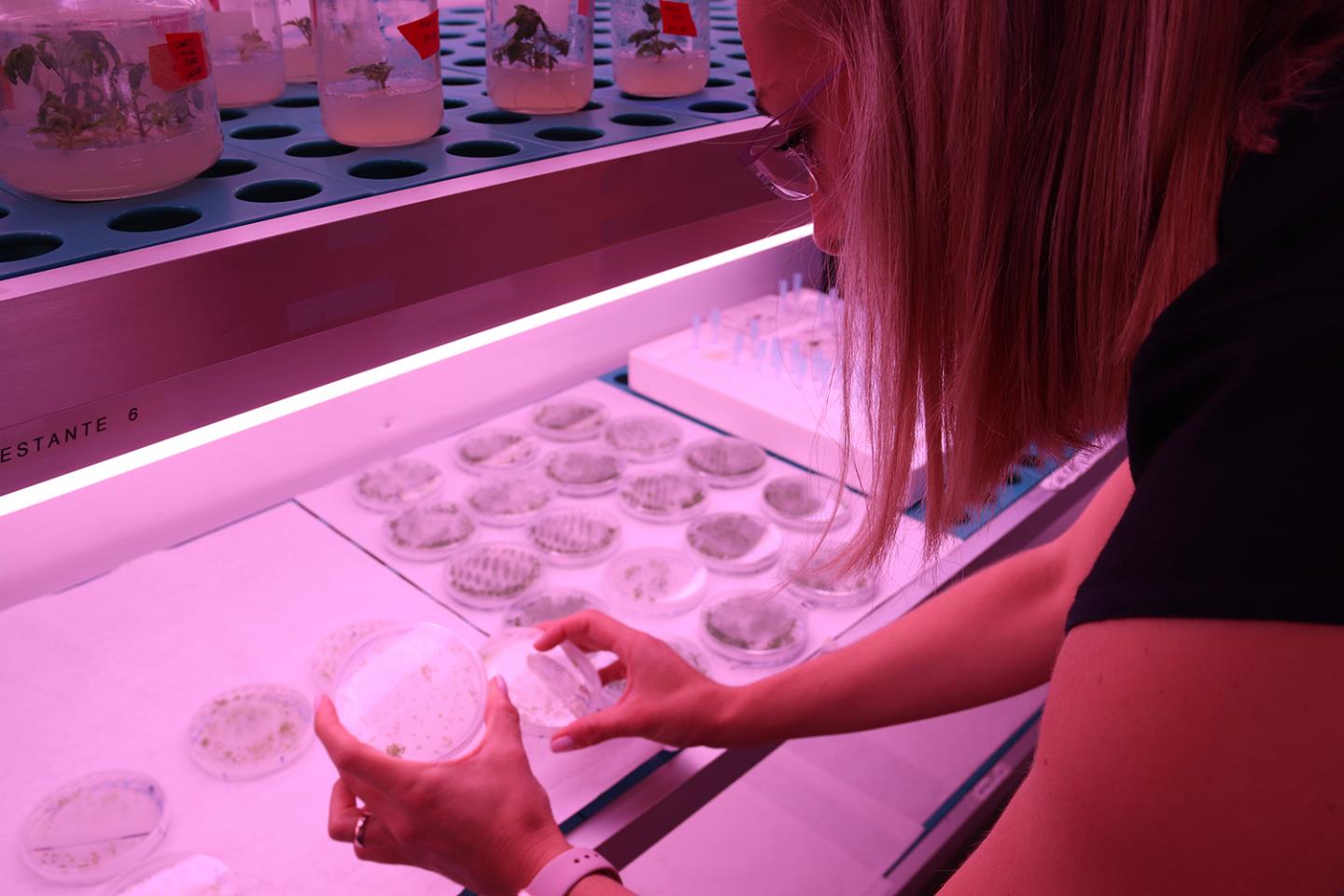
The BAG4 protein regulates the flow of potassium in occlusive cells, which optimizes the use of water by the plant
IMAGE

Credit: Universitat Politècnica de València (UPV)

Researchers of the Universitat Politècnica de València (UPV) and the University of Málaga (UMA) have discovered a new function in the BAG4 plant protein. In the study, they prove that this protein takes part in the regulation of the plant transpiration, the transport of potassium in occlusive cells and thus, the opening of the stomas, the pores located on leaves, from where the plant transpires. This finding is particularly significant for developing crops that are more resistant to drought conditions. Their work has been published in the Plant Physiology journal.

In the study, in which the French center BPMP (Biochimie et Physiologie Moléculaire des Plantes) has also participated, the researchers did an analysis of proteins that are able to physically interact with the channel that regulates how potassium enters the occlusive cells of the plant-known as KAT1-and later they studied how this protein regulated the KAT1 function.

“KAT1 is responsible for the potassium entering the occlusive cells, which directly affects the opening of the stomas and, finally, the plant transpiration. Our aim was focused on knowing how the transport of potassium is regulated in order to improve it in the future,” explains Antonella Locascio, researcher at the Institute for Plant Molecular and Cellular Biology (IBMCP), a joint center between UPV and CSIC.

In order to do that, the team of UPV, the University of Málaga and BPMP looked for proteins that directly interact with the KAT1 channel, using Arabidopsis thaliana as a model plant. “We did a biochemical and genetic study of the BAG4 protein to assess its interaction with and effect on the channel. From this study, we discovered that the presence of this protein significantly improves the transport of potassium, contributing to it arriving at the plasma membrane of plants,” explains Lynne Yenush, researcher at IBMCP (UPV-CSIC).

According to the researchers, the identification of physiologically significant regulators, in this case, the BAG4 protein, opens up the door to new strategies to obtain plants more resistant to stressful water situations and less vulnerable to the action of several pathogens.

“Stomas are a main structure that regulate the efficiency of the use of water, as well as the entry door of many pathogens that affect agriculture. Knowing the molecular level and how the complex process of stomas opening and closing is regulated can help us to design new crops resistant to pests and drought,” concludes José Miguel Mulet, researcher at IBMCP.

###

Reference

Locascio A, Marques MC, García-Martínez G, Corratgé-Faillie C, Andrés-Colás N, Rubio L, Fernandez JA, Véry AA5, Mulet JM, Yenush LP. BCL2-ASSOCIATED ATHANOGENE4 Regulates the KAT1 Potassium Channel and Controls Stomatal Movement. Plant Physiology. DOI 10.1104/pp.19.00224

Media Contact
[email protected]
[email protected]

Related Journal Article

http://dx.doi.org/10.1104/pp.19.00224

Tags: Agricultural Production/EconomicsBiologyBiotechnologyClimate ChangePlant SciencesPollution/RemediationTemperature-Dependent Phenomena
Share12Tweet8Share2ShareShareShare2

Related Posts

AI Reads Students' Faces to Measure Attention in Online Classes

AI Reads Students’ Faces to Measure Attention in Online Classes

October 5, 2026
Blood Clones That Masquerade as Cancer: New Framework Draws Hard Lines in Precision Oncology

Blood Clones That Masquerade as Cancer: New Framework Draws Hard Lines in Precision Oncology

October 5, 2026

A Hidden DNA Insertion Paints Quinoa Leaves in Red and Green

October 5, 2026

Biochar Research Booms as Scientists Map the Race to Rescue the World’s Dying Soils

October 5, 2026
Please login to join discussion

POPULAR NEWS

  • Alloys That Shrink Their Own Grains: New PIX Mechanism Refines Metals With Heat Alone

    Alloys That Shrink Their Own Grains: New PIX Mechanism Refines Metals With Heat Alone

    29 shares
    Share 12 Tweet 7
  • Endurance Exercise Reshapes the Liver in Males and Females Through Distinct Molecular Routes

    29 shares
    Share 12 Tweet 7
  • Single Transcription Factor PU.1 Rapidly Converts Fibroblasts into Macrophage-Lineage Cells

    29 shares
    Share 12 Tweet 7
  • New Scale Measures How Ready Nurse Educators Really Are for the AI Era

    29 shares
    Share 12 Tweet 7

About

We bring you the latest biotechnology news from best research centers and universities around the world. Check our website.

Follow us

Recent News

Alloys That Shrink Their Own Grains: New PIX Mechanism Refines Metals With Heat Alone

Endurance Exercise Reshapes the Liver in Males and Females Through Distinct Molecular Routes

Single Transcription Factor PU.1 Rapidly Converts Fibroblasts into Macrophage-Lineage Cells

Subscribe to Blog via Email

Success! An email was just sent to confirm your subscription. Please find the email now and click 'Confirm' to start subscribing.

Join 85 other subscribers
  • Contact Us

Bioengineer.org © Copyright 2023 All Rights Reserved.

Welcome Back!

Login to your account below

Forgotten Password?

Retrieve your password

Please enter your username or email address to reset your password.

Log In
No Result
View All Result
  • Homepages
    • Home Page 1
    • Home Page 2
  • News
  • National
  • Business
  • Health
  • Lifestyle
  • Science

Bioengineer.org © Copyright 2023 All Rights Reserved.