• HOME
  • NEWS
  • EXPLORE
    • CAREER
      • Companies
      • Jobs
    • EVENTS
    • iGEM
      • News
      • Team
    • PHOTOS
    • VIDEO
    • WIKI
  • BLOG
  • COMMUNITY
    • FACEBOOK
    • INSTAGRAM
    • TWITTER
Sunday, May 10, 2026
BIOENGINEER.ORG
No Result
View All Result
  • Login
  • HOME
  • NEWS
  • EXPLORE
    • CAREER
      • Companies
      • Jobs
        • Lecturer
        • PhD Studentship
        • Postdoc
        • Research Assistant
    • EVENTS
    • iGEM
      • News
      • Team
    • PHOTOS
    • VIDEO
    • WIKI
  • BLOG
  • COMMUNITY
    • FACEBOOK
    • INSTAGRAM
    • TWITTER
  • HOME
  • NEWS
  • EXPLORE
    • CAREER
      • Companies
      • Jobs
        • Lecturer
        • PhD Studentship
        • Postdoc
        • Research Assistant
    • EVENTS
    • iGEM
      • News
      • Team
    • PHOTOS
    • VIDEO
    • WIKI
  • BLOG
  • COMMUNITY
    • FACEBOOK
    • INSTAGRAM
    • TWITTER
No Result
View All Result
Bioengineer.org
No Result
View All Result
Home NEWS Science News Chemistry

New dopamine sensors could help unlock the mysteries of brain chemistry

Bioengineer by Bioengineer
September 15, 2020
in Chemistry
Reading Time: 2 mins read
0
IMAGE
Share on FacebookShare on TwitterShare on LinkedinShare on RedditShare on Telegram

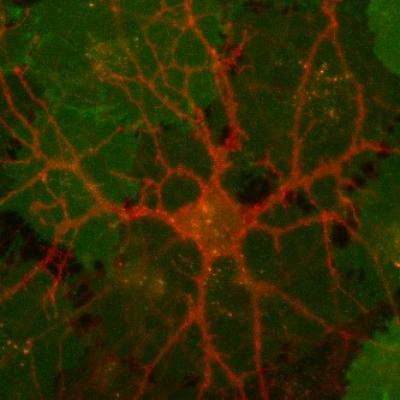
Researchers develop a wider spectrum for dLight1 sensor, allowing multiplex imaging of neurotransmitters
IMAGE

Credit: UC Regents

Sacramento, CA– In 2018, Lin Tian and her team at UC Davis Health developed dLight1, a single fluorescent protein-based biosensor. This family of highly specific sensors detects dopamine, a hormone released by neurons to send signals to other nerve cells. When combined with advanced microscopy, dLight1 provides high resolution, real-time imaging of the spatial and temporal release of dopamine in live animals.

Recently, Tian and her team succeeded in expanding the color spectrum of the dLight1 sensor. In an article published Sept. 7 in Nature Methods, they introduced two new spectral variants of dLight1: the yellow YdLight1 and the red RdLight1.

“The new sensors will help researchers to detect and monitor different information processing activities in the brain,” said Lin Tian, associate professor of biochemistry and molecular medicine and the lead author on the study. “With the different colors, we will be able to see multiple neurochemical release and neural activities at the same time.”

The RdLight1 permits the simultaneous assessment of dopamine, pre- or post-synaptic neuronal activity and the glutamate release in specific types of cells and neuronal projections in animals. Its increased light penetration and imaging depth provide enhanced dopamine signal quality. This allows researchers to optically dissect dopamine’s release and model its effects on neural circuits.

As a neurotransmitter, dopamine plays an important role in movement, attention, learning and the brain’s pleasure and reward system.

“These exciting new tools opened a new door to developing color-shifted neurochemical indicators. Together with other tools, they have great potential to unlock the mysteries of brain chemistry in health and disease,” Tian said. “The knowledge we gain from these sensors will facilitate the development of safer next-generation therapies to neuropsychiatric disorders such as depression, anxiety, schizophrenia and addiction.”

###

The coauthors on this study at University of California, Davis are Tommaso Patriarchi, Junqing Sun, Ruqiang Liang, Chunyang Dong, Kyle Pugher, Grace Or Mizuno, Carolyn M. Davis and Brian Wiltgen, and at the University of California, San Francisco are Ali Mohebi, Aaron Marley Mark von Zastrow and Joshua D. Berke.

This work was supported by National Institutes of Health grant (DP2MH107056); BRAIN Initiative awards (U01NS090604, U01NS013522, U01NS103571, U01NS094375); Rita Allen Young Investigator Award and R01DA045783; Olga Mayenfisch Foundation; and Novartis Foundation for medical-biological Research.

Article: Patriarchi et al. An expanded palette of dopamine sensors for multiplex imaging in vivo, Nature Methods. https://doi.org/10.1038/s41592-020-0936-3

Media Contact
Nadine Yehya
[email protected]

Original Source

https://health.ucdavis.edu/health-news/contenthub/new-dopamine-sensors-could-help-unlock-the-mysteries-of-brain-chemistry-/2020/09

Related Journal Article

http://dx.doi.org/10.1038/s41592-020-0936-3

Tags: BehaviorBiotechnologyDisabled PersonsMedicine/HealthMemory/Cognitive ProcessesMental HealthMicrobiologyneurobiologyNeurochemistryPharmaceutical Sciences
Share12Tweet8Share2ShareShareShare2

Related Posts

Miniature Sensor Uses Light to Detect Touch — Chemistry

Miniature Sensor Uses Light to Detect Touch

May 8, 2026
Iron Minerals Determine Whether Dissolved Organic Matter Fuels Microbes or Becomes Long-Term Carbon Storage — Chemistry

Iron Minerals Determine Whether Dissolved Organic Matter Fuels Microbes or Becomes Long-Term Carbon Storage

May 8, 2026

Kate Evans Appointed Associate Lab Director for Biological and Environmental Systems Science at ORNL

May 8, 2026

Advancing Multiscale Modeling and Overcoming Operational Challenges in Autothermal COâ‚‚-to-Methanol Reactors

May 8, 2026
Please login to join discussion

POPULAR NEWS

  • Research Indicates Potential Connection Between Prenatal Medication Exposure and Elevated Autism Risk

    840 shares
    Share 336 Tweet 210
  • New Study Reveals Plants Can Detect the Sound of Rain

    727 shares
    Share 290 Tweet 181
  • Scientists Investigate Possible Connection Between COVID-19 and Increased Lung Cancer Risk

    68 shares
    Share 27 Tweet 17
  • Salmonella Haem Blocks Macrophages, Boosts Infection

    61 shares
    Share 24 Tweet 15

About

We bring you the latest biotechnology news from best research centers and universities around the world. Check our website.

Follow us

Recent News

Evaluating Digoxin Use in Patients with Symptomatic Rheumatic Heart Disease

Evaluating the Effectiveness and Safety of Digitalis Glycosides in Treating Heart Failure

Urdu Fall Risk Questionnaire Adapted for Elderly

Subscribe to Blog via Email

Enter your email address to subscribe to this blog and receive notifications of new posts by email.

Join 82 other subscribers
  • Contact Us

Bioengineer.org © Copyright 2023 All Rights Reserved.

Welcome Back!

Login to your account below

Forgotten Password?

Retrieve your password

Please enter your username or email address to reset your password.

Log In
No Result
View All Result
  • Homepages
    • Home Page 1
    • Home Page 2
  • News
  • National
  • Business
  • Health
  • Lifestyle
  • Science

Bioengineer.org © Copyright 2023 All Rights Reserved.