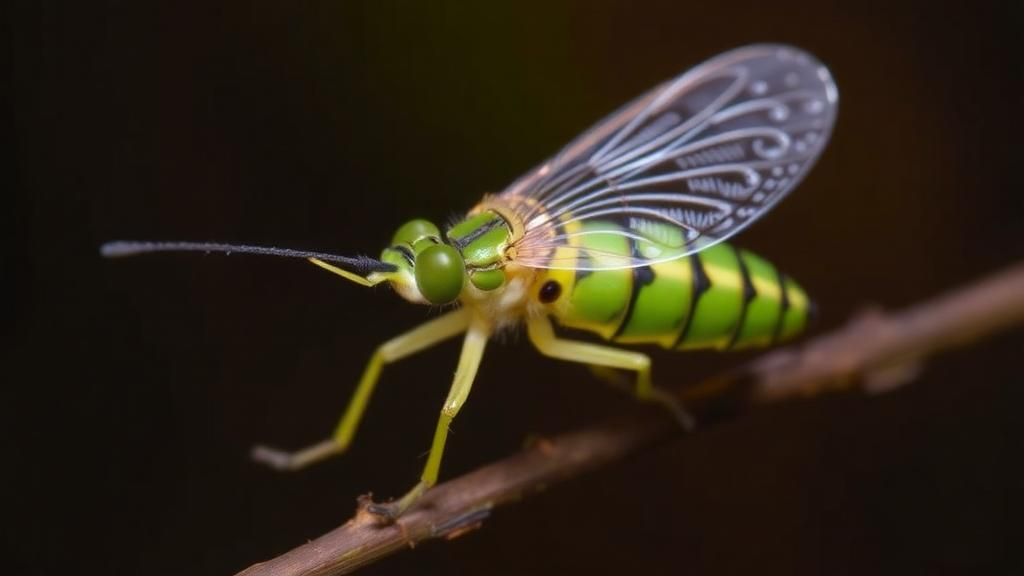
Deep in the protected rainforests of western Panama, entomologists have quietly been cataloguing one of the most overlooked branches of freshwater biodiversity: the caddisflies. These small, moth-like insects, whose aquatic larvae build intricate cases from sand grains and silk, are now at the center of a discovery that reshapes how scientists understand the insect geography of Central America. In a new study published in the journal Neotropical Biology and Conservation, researchers describe a species new to science, Protoptila harrisi, and report the first record of another species, Protoptila bribri, within Panama’s borders. With these two additions, the Republic of Panama now hosts 17 known species of the genus Protoptila and a remarkable national total of 535 caddisfly species spread across 15 families and 56 genera.
The work is the product of years of sustained field effort by the Aquatic Invertebrate Research Group at the Universidad Autónoma de Chiriquí, known as AIRG, working alongside the university’s Museo de Peces de Agua Dulce e Invertebrados, or MUPADI. The team’s research program, aimed squarely at closing the enormous knowledge gaps surrounding Panama’s aquatic invertebrates, has focused on the Trichoptera, the order that contains caddisflies, and the Plecoptera, the stoneflies, in the country’s western highlands. Several of the personnel involved also participated in a major conservation initiative, the Sustainable Production System and Biodiversity Conservation Project, managed by Panama’s Ministry of the Environment and funded by the World Bank. That project, along with the university’s own registered research efforts, supplied both the funding and the fieldwork that made the new discoveries possible.
The new species, Protoptila harrisi, was found in the Bosque Protector Palo Seco, a vast protected forest of roughly 254,446 hectares in Bocas del Toro Province and the Comarca Ngäbe-Buglé. The reserve serves as a critical conservation corridor, linking La Amistad International Park, which straddles the border with Costa Rica, to the Fortuna Forest Reserve further east in Chiriquí Province. Its landscape is stitched together by three major drainages: the Río Aguas Blancas and Río Yorkin in the north, tributaries of the Río Sixaola; the Río Teribe and its tributaries in the center; and the Río Changuinola to the southeast, fed by rivers such as the Río Riscó and streams flowing into the Chiriquí Lagoon. The climate is oceanic tropical, with average annual temperatures between 25 and 27 degrees Celsius, relentless humidity averaging 84.5 percent, and rainfall that climbs as high as 2,513 millimeters along the southern strip between the Río Teribe and Río Changuinola.
The holotype male, the single specimen upon which the species description is formally based, was collected at Quebrada Martínez in the Comarca Ngäbe-Buglé at 520 meters above sea level, caught in a Malaise trap between October 8 and 12, 2019. A paratype male was taken nearby at 480 meters earlier that same year. Both specimens were preserved in alcohol and now reside in institutional collections: the holotype in the Museo de Invertebrados at the Universidad de Panamá, and the paratype in MUPADI. The species is named in honor of Dr. Steven C. Harris of Pennsylvania Western University in Clarion, Pennsylvania, in recognition of his lifelong contributions to aquatic sciences and caddisfly taxonomy, with particular emphasis on the microcaddisflies of the Nearctic and Neotropical regions.
Morphologically, Protoptila harrisi presents a subtle puzzle. The authors describe its male genitalia as relatively simple and unremarkable in general structure, yet those same structures carry the diagnostic signatures that separate it from every known relative. Its lateral lobes of tergum X, a key feature in caddisfly identification, are undivided and unjointed, a condition it shares with some North American species such as P. maculata and P. palina. Unlike those northern relatives, however, the new species shows no trace of basal preanal appendages. Among Central American species it most closely resembles P. jolandae from Costa Rica, sharing elongate, tapering lateral lobes and a narrow, projecting process on sternum IX with a somewhat forked apex. The differences lie in finer details: P. harrisi possesses longer, more tightly spiral paramere appendages, a distinctively shaped phallus, and a shorter, more clearly bifid ventral lobe of sternum VIII. Two other recently described Panamanian species, P. inflata and P. totumas, also share broad similarities, but their distinctive morphology rules out confusion with the newcomer.
The technical description itself follows the rigorous standards of modern taxonomy. The male forewing measures just 2.0 millimeters from base to apex, with wing veins arranged in a pattern of forks I, II, and III on the forewing and fork II only on the narrow, acutely pointed hind wing. The spur formula, a standard caddisfly character, reads 0:4:4. Specimens were cleared using a 5 percent potassium hydroxide solution with gentle heat, then rinsed in distilled water and acidified alcohol before examination under a dissecting microscope, allowing researchers to resolve the fine sclerotized structures of the genitalia that distinguish one species from another. Forewing lengths were measured against a 5-millimeter microscale, and morphological terminology follows the established framework for Protoptila laid out by Holzenthal and Blahnik in 2006.
The second addition to Panama’s fauna, Protoptila bribri, was previously known only from Costa Rica. Researchers collected males at two Panamanian sites: the Río Caisán in Chiriquí Province’s Renacimiento District at 484 meters elevation, using a UV-LED bucket trap in May 2023, and at Quebrada Martínez in the Bosque Protector Palo Seco, where specimens were taken with ultraviolet light traps in August and November of 2019. This kind of cross-border record matters far beyond a simple checklist entry. It extends the known range of the species and reinforces the ecological continuity between the Talamanca mountain systems of Costa Rica and western Panama, a region recognized as one of Central America’s richest biological corridors.
The Río Chiriquí Viejo drainage, where P. bribri was collected, is one of Panama’s 52 major watersheds, encompassing 1,352 square kilometers of Chiriquí Province near the Costa Rican border. The river rises near Cerro Punta northeast of the town of Volcán, runs southwest to Plaza de Caisán, and then tracks the border closely, at one point passing within 100 meters of it at Paso Canoas, before turning southeast to join the Río Jacú, the Río Gariché, and finally emptying into Charco Azul Bay on the Pacific coast. The watershed is dominated in its northeastern corner by Volcán Barú and the northern talus of the Talamanca range, descending to sea level along the Pacific. It remains largely forested, with scattered farms and wooded stream corridors that provide the shaded, clean waterways Protoptila larvae require. In 2023 the AIRG team surveyed 27 stream locations across this drainage on a monthly basis, a sampling intensity that continues to pay dividends.
The genus Protoptila itself is the second most diverse genus in the caddisfly subfamily Protoptilinae, with 90 described species distributed across North and South America. The adults are delicate insects typically collected with ultraviolet light traps and Malaise tents, while their larvae scrape diatoms and organic film from the surfaces of stones in flowing water, making them valuable indicators of stream health. Before this study, Panama’s Protoptila fauna stood at 15 species, four of them endemic. The updated list now compiled by the researchers shows a striking biogeographic pattern: of the 17 Panamanian species, 11 are shared with Costa Rica, while shared occurrences with South America, Mexico, and the rest of Central America are minimal. Species such as P. tojana, whose type specimen came from Mexico, range as far as Peru, while endemics like P. harrisi, P. inflata, P. perdida, P. rambala, and P. totumas are so far known only from Panama itself.
The authors argue that this lopsided distribution says less about true biogeography than about where entomologists have bothered to look. The apparent lack of affinity between Panama and Costa Rica and the rest of Central America most likely reflects sparse inventory activity in neighboring countries rather than genuine faunal boundaries. Costa Rica currently hosts 19 species of Protoptila, and since it now shares 12 of those with Panama, the researchers predict that at least a few more will eventually surface in Panama’s western highlands. With five new species described from Panama to date, four of them in recent years, the possibility of further undocumented species within the country remains very real. Evidence also suggests that some Protoptila species favor defined altitudinal ranges, a hypothesis that only continued collecting can confirm. For now, every new record and every newly described species sharpens the picture of a freshwater insect fauna that remains astonishingly underexplored, and confirms Panama’s rainforest streams as one of the hemisphere’s great remaining frontiers for biodiversity discovery.
Subject of Research: Taxonomy and distribution of the caddisfly genus Protoptila in Panama, including a new species description and a new country record
Article Title: The Trichoptera of Panama. XXVI. Status of the genus Protoptila ( Trichoptera , Glossosomatidae )
Article References: Blahnik, R. J., Aguirre, Y. P., & Armitage, B. J. (2023). The Trichoptera of Panama. XXVI. Status of the genus Protoptila (Trichoptera, Glossosomatidae). Neotropical Biology and Conservation, 18(4), 251-258. https://doi.org/10.3897/neotropical.18.e111801
Image Credits: AI Generated
DOI: 10.3897/neotropical.18.e111801
Keywords: Trichoptera, Glossosomatidae, Protoptila, caddisflies, Panama, new species, Protoptila harrisi, biodiversity, Neotropics, taxonomy, freshwater insects, Bosque Protector Palo Seco
News Source: Gavin Prescott. (October 19, 2026). New Caddisfly Species from Panama’s Rainforests Push Country’s Insect Tally to 535. Scienmag.