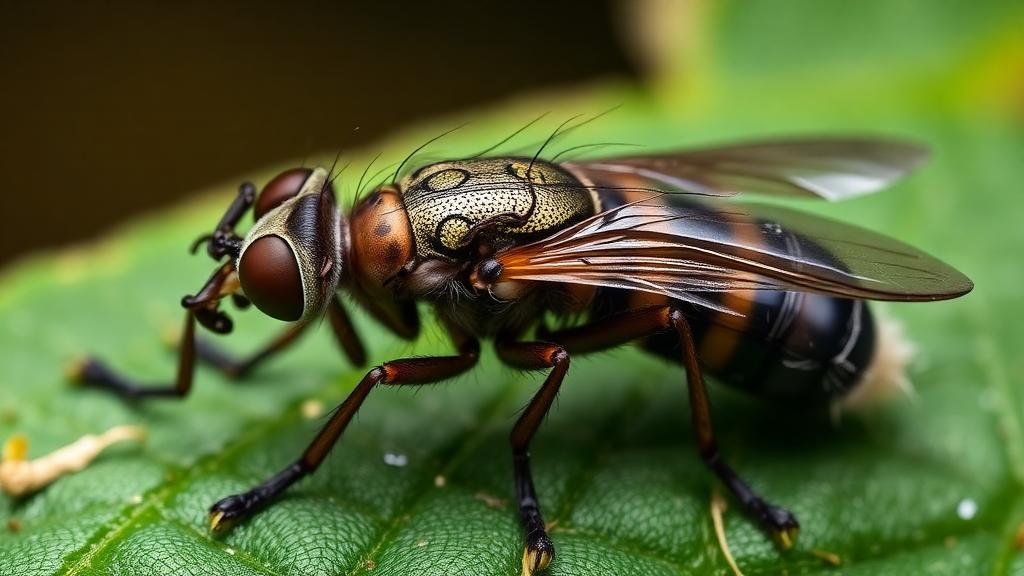
Deep in the forests of northeastern, central, and southern China, entomologists have quietly uncovered a hidden diversity of parasitic flies that had been sitting in museum drawers for decades. A sweeping new revision published in the Biodiversity Data Journal describes four species of the tachinid fly subgenus Drino that are entirely new to science, and in doing so rewrites the roster of Chinese members of this enigmatic group. The work, led by Chuntian Zhang and colleagues at Shenyang Normal University, recognizes fifteen valid known species in China and brings the total number of species recorded from the country to nineteen, each now distinguishable with the help of a newly constructed identification key.
The newly named species are Drino liaoningensis from Liaoning Province in the northeast, Drino uniseta and Drino oharai from Hubei Province in central China, and Drino meridionalis from the Guangxi Autonomous Region in the south. Each was confirmed through painstaking comparison of more than two hundred specimens drawn from four major collections: the Institute of Zoology of the Chinese Academy of Sciences in Beijing, the National Museum of Natural History in Paris, the Smithsonian’s National Museum of Natural History in Washington, and the Insect Collection of Shenyang Normal University, where the type specimens of the new species are now deposited. The researchers also examined type material digitally through the Global Biodiversity Information Facility, including the syntype of Drino lota and the holotypes of Drino argenticeps and Drino facialis.
What makes this discovery remarkable is how uniform these flies appear on the outside. Members of the genus Drino are medium-sized insects, ranging from roughly seven to twelve millimeters in body length, with highly consistent thoracic and abdominal bristle patterns. For more than a century, taxonomists trying to separate closely related species were forced to rely on subtle and notoriously variable features, such as the faint patterns of dusting, or pruinosity, on the abdominal segments. The new study sidesteps that problem by leaning heavily on the anatomy of the male terminalia, the genital structures that have long been recognized as the most reliable diagnostic characters in the tachinid family.
That methodological shift represents a direct response to a historical weakness in the group’s taxonomy. The French dipterist Jean-Baptiste Robineau-Desvoidy established the genus Drino in 1863, but its modern concept traces to Paul Mesnil, who redefined the group in the late 1940s and early 1950s and proposed seven subgenera, only three of which survive today. Mesnil’s foundational work, however, omitted descriptions of the male genitalia for critical type material, leaving later researchers with identification keys built on plastic external traits that often overlap between species. The new revision closes that gap by providing thirty-three detailed figures of the heads, bodies, and male terminalia of the new species, plus ninety illustrations of type specimens of the known species.
The technical effort behind those images is itself a story. Specimens were photographed with a Canon EOS 60D fitted with a 65-millimeter macro lens, and the intricate genital structures were captured using an infinity-corrected optical system built around an Olympus 10x microscope objective paired with a Raynox tube lens. Hundreds of individual frames were shot on a motorized focus-stacking rail under a light source with a color rendering index above 97.6 percent, with roughly fifty to sixty percent overlap between successive images, and then merged into razor-sharp composite photographs using Helicon Focus software. Hand-drawn illustrations were then prepared on an iPad directly from those stacked photographs to guarantee morphological accuracy.
Each of the four new species carries a suite of diagnostic characters that separates it from its closest relatives. Drino liaoningensis, collected by sweep netting in Qingyuan County at elevations of 600 to 800 meters, is distinguished by a nearly bare eye, a parafacial about one and a half times the width of its antenna, and cerci narrowly separated along the apical three-fifths of their length. Drino meridionalis, found in Guangxi and Fujian, shows a distinctive notch near the middle of the cerci in lateral view, a feature absent in its lookalike Drino parafacialis. Drino uniseta takes its name from a single long, strong bristle at the tip of the fifth sternite’s lateral lobe, an unusually clean-cut character. Drino oharai, the most widely distributed of the four, ranges across five provinces and is named in honor of Dr. James E. O’Hara, whose contributions to tachinid systematics shaped the modern classification the authors relied upon.
The broader significance of the work extends beyond naming new species. Tachinid flies are parasitoids: their larvae develop inside the bodies of other insects, primarily moths and butterflies as well as some hymenopterans, eventually killing their hosts. This lifestyle makes them major players in natural pest control and objects of intense interest for biological control programs. An accurate taxonomy is the foundation for any such application, because misidentified parasitoids have historically derailed biological control introductions. With nineteen Chinese species now keyed and illustrated, ecologists and applied entomologists working in the region finally have a dependable reference for identifying which Drino species they are dealing with.
The revision also clarifies the group’s global picture. The world checklist by O’Hara and colleagues in 2020 recognized twenty-six species in the nominate subgenus Drino, distributed across every major zoogeographic region except Australasia. The genus as a whole, including the subgenera Palexorista and Zygobothria, now numbers 127 known species worldwide, with China emerging as a particular hotspot of diversity at 39 species. The new study’s examination of type specimens from Paris, Washington, and Beijing, combined with fresh field collections spanning more than a decade of sweep-netting expeditions, suggests that this diversity may still be underestimated, particularly in the mountainous regions of southern and southwestern China where several of the new species were found.
For the researchers, the four new species are as much a product of modern imaging technology as of fieldwork. The ability to photograph type specimens held in European and American museums, compare them pixel by pixel with Chinese material, and illustrate genital structures at microscopic resolution has effectively collapsed the geographic barriers that once made tachinid taxonomy a slow and error-prone endeavor. The result is a taxonomy grounded in verifiable, reproducible imagery rather than subjective descriptions of dusting patterns, and a foundation that future phylogenetic work on the tribe Eryciini can build upon.
The four new species descriptions, the identification key to all nineteen Chinese species, and the complete set of illustrations are published as open access in the Biodiversity Data Journal, ensuring that the next person to sweep a parasitic fly from a Chinese mountainside will know exactly what they are holding.
Subject of Research: Taxonomic revision describing four new species of the tachinid fly subgenus Drino from China
Article Title: Four new species of subgenus Drino ( sensu stricto ) Robineau-Desvoidy, 1863 from China, with a review of the Chinese species ( Diptera , Tachinidae )
Article References: Liu, X., & Zhang, C. (2026). Four new species of subgenus Drino (sensu stricto) Robineau-Desvoidy, 1863 from China, with a review of the Chinese species (Diptera, Tachinidae). Biodiversity Data Journal, 14, Article e175030. https://doi.org/10.3897/bdj.14.e175030
Image Credits: AI Generated
Keywords: Drino, Tachinidae, taxonomy, new species, China, parasitoid flies, Diptera, biodiversity, entomology, male terminalia, species description, Four
News Source: Drew Townsend. (October 19, 2026). Four New Parasitic Fly Species Unveiled from China in Major Taxonomic Overhaul. Scienmag.