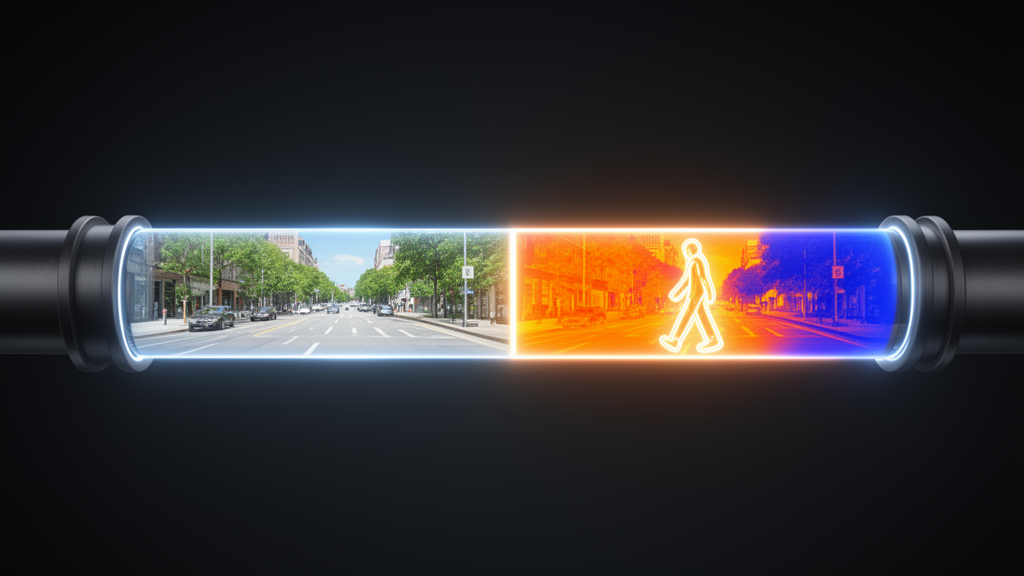
Researchers have unveiled a cross-modal object detection algorithm called DARF, designed to help computers see reliably in conditions where ordinary cameras struggle, such as darkness, glare and cluttered backgrounds. The work, published in Scientific Reports, builds on the popular YOLOv8 detection architecture and combines two new modules that strengthen early image features and blend visible-light and infrared information more intelligently than previous approaches. The problem DARF addresses is well known in computer vision.
In low illumination or visually busy scenes, visible-light images often lose target textures and overall quality, making pedestrians or objects hard to detect. Infrared images can fill in target contours and edges because they capture heat signatures rather than reflected light, but they lack color and surface texture. Existing visible-infrared detection methods have struggled to exploit both streams without letting one interfere with the other.
The authors identify two specific shortcomings in prior systems. First, the shallow features at the front end of a detection network are typically weak at extracting multi-directional and multi-scale details, undermining the fundamental representations on which later stages depend. Second, most fusion strategies rely on simple feature concatenation or fixed-weight aggregation, which cannot separate shared information from modality-specific complementary information, nor adjust the relative contribution of the visible and infrared channels as scene conditions change.
The result is significant inter-modal interference that degrades detection accuracy. DARF responds with a two-part strategy the team describes as front-end basic feature enhancement followed by back-end dual-modal adaptive fusion. The first improvement, a Multi-branch Direction-Aware Feature module known as MDAF, is embedded at the front of the backbone network.
By processing features along multiple directions and scales, it enriches the shallow representations before any fusion takes place, giving the network a stronger foundation for the cross-modal work that follows. The second improvement, a Dual-Modal Adaptive Routing fusion module called DMAR, sits between the backbone and the detection neck, the part of the architecture that feeds final predictions. Rather than concatenating the two image streams or weighting them with fixed coefficients, DMAR performs fine-grained adaptive fusion, dynamically routing information so that the network can emphasize whichever modality is more informative for a given scene and location within the image.
The reported results show that DARF achieves higher detection accuracy than representative existing methods on both datasets. According to the authors, this supports the effectiveness of both the MDAF enhancement module and the DMAR adaptive routing fusion module, as well as the overall framework that combines them within a YOLOv8-based detector. The study is an algorithmic contribution evaluated on benchmark datasets rather than a deployment trial, so real-world performance in specific applications such as nighttime surveillance or autonomous driving remains to be demonstrated.
The paper was published as an open-access article on 26 October 2026 by Senyi Zhang, Jianguang Zhao and Jingjing Fan, and is being shared early as a citable, peer-reviewed accepted version subject to further editorial processing before the final Version of Record appears.
Subject of Research: Direction-aware adaptive routing fusion for visible-infrared cross-modal object detection
Article Title: DARF: direction-aware adaptive routing fusion for cross-modal detection
Article References: Zhang, S., Zhao, J., & Fan, J. (2026). DARF: direction-aware adaptive routing fusion for cross-modal detection. Scientific Reports. https://doi.org/10.1038/s41598-026-75364-9
Image Credits: AI Generated
DOI: 10.1038/s41598-026-75364-9
Keywords: object detection, computer vision, infrared imaging, cross-modal fusion, YOLOv8, deep learning, LLVIP dataset, KAIST dataset, feature fusion, low-light detection, adaptive routing, Scientific Reports
News Source: Blake Davidson. (October 27, 2026). New AI framework fuses visible and infrared images for sharper object detection. Scienmag.