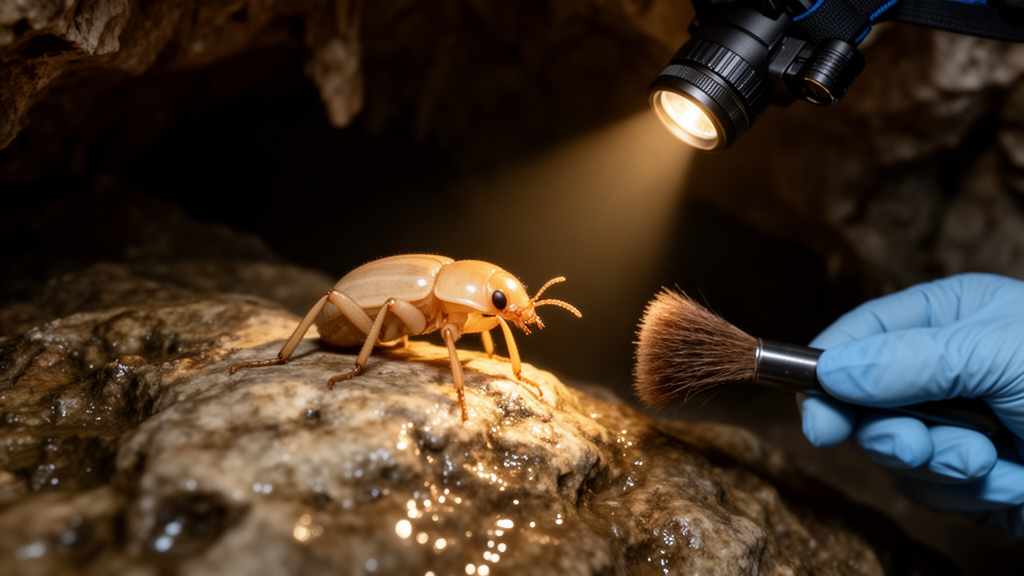
For more than nine decades, a tiny blind beetle called Horologion speokoites existed as a single specimen in a museum drawer, collected once in 1931 from a small West Virginia cave and never seen again. Its hourglass-shaped body and bizarre mix of anatomical traits defied classification, earning the genus a “near mythical” status among entomologists. Now, a team led by Curt Harden has reported the discovery of a second species, Horologion hubbardi, living in Williams Cave in Bath County, Virginia, roughly 70 kilometers away on the opposite side of the Appalachian Mountains. The finding, published in the journal Subterranean Biology, finally allows scientists to place this enigmatic lineage within the carabid beetle family tree and to formally describe its anatomy in detail.
The original specimen was found by J. Manson Valentine on July 12, 1931, on a piece of rotten wood beneath a flowstone formation in Arbuckle Cave, a small, shallow cave in a cow pasture in the Greenbrier Valley of West Virginia. Valentine published a detailed description just eight months later, in 1932, carefully cataloging the traits that prevented him from assigning the beetle to any known tribe or subfamily of ground beetles. The species was small, eyeless, densely pubescent, and slow-moving, and when disturbed it burrowed into wood. Valentine remained fascinated by the beetle for the rest of his long life, still developing ideas about how to rediscover it up to his death at age 92.
Over the following decades, taxonomists proposed wildly different placements for the genus based solely on Valentine’s description and drawings, never on the type specimen itself. Van Emden in 1936 placed it in the tribe Psydrini; Jeannel in 1949 disagreed and erected a monotypic family, Horologionidae, arguing for a relationship with patrobines. Later authors shifted it among Bembidiinae, Anillina, and eventually treated it as incertae sedis within the supertribe Trechitae. A persistent error crept into standard identification keys when a 1960 review incorrectly described the beetle’s mesocoxae as disjunct rather than conjunct, contradicting Valentine’s original account and compounding decades of confusion.
The breakthrough came in 2018, when Harden discovered a second specimen in the Carnegie Museum of Natural History in Pittsburgh. It had been collected in Williams Cave in September 1991 by David A. Hubbard, Jr., and sent to the late beetle specialist Thomas C. Barr, who apparently never noticed it among several other cave beetles in the same vial. The specimen bore striking humeral carinae ending in curved spines, unlike any other North American carabid. Because it was a female, the team could not immediately rule out that these features represented sexual dimorphism rather than a distinct species.
Fieldwork followed. In 2018 and 2019, the researchers deployed 85 buried pitfall traps in deep-soil and shallow subterranean habitats near both caves, hoping to intercept populations of Horologion living outside caves; none were captured. In 2022 and 2023, however, repeated trips into Williams Cave yielded additional specimens, including males and fresh material suitable for DNA extraction. Visual scanning of surfaces and drip pools proved to be the only effective method; bait stations with cheeses, tuna, and peanut butter produced nothing. Two trips into Arbuckle Cave were unsuccessful, and H. speokoites remains known only from its holotype.
The molecular analysis drew on DNA extracted from both fresh specimens of H. hubbardi and a matrix of 259 taxa representing all tribes of Trechitae, using fragments of eight genes: the ribosomal genes 18S and 28S, the mitochondrial COI gene, and five nuclear protein-coding genes. Maximum likelihood analysis of the concatenated matrix, run in IQ-TREE with 200 searches and 500 standard bootstrap replicates, strongly supported the placement of Horologion within Trechitae, with bootstrap support of 100 percent. The beetle was recovered as sister to the tribe Bembidarenini, a group found only in the Southern Hemisphere, with moderate support of 72 percent, within a larger clade that also includes the tribe Trechini, supported at 90 percent.
These results overturn the older hypotheses. The molecular data provide strong evidence against placements of Horologion within Psydrini, Anillini, Trechini, or Patrobini. The morphological evidence tells the same story. A key discovery was that the basal male protarsomeres of Horologion are actually dentate, as in most trechites; Valentine had erroneously described them as undentate, and the small denticle on the holotype’s first protarsomere is invisible from certain angles, including the orientation in which the leg was permanently mounted. The team also confirmed four fixed clypeal setae and a suborbital seta on each side of the head, character states shared with Bembidarenini and Trechini, and four or more setae on the ligula. On this basis, the authors formally recognize Horologion as its own tribe, Horologionini, within Trechitae.
The new species itself is distinctive. Horologion hubbardi is about 3.2 millimeters long, eyeless, densely pubescent, and flattened, with elytral humeri bearing raised carinate shelves that terminate in sharp, curved spines. Males have the first and second protarsomeres asymmetrically expanded and spinose on their inner margins, whereas in H. speokoites only the first protarsomere is weakly dentate. The male genitalia also differ, with smaller parameres bearing three apical setae rather than six, and a straighter median lobe. Re-examination of the H. speokoites holotype revealed further discrepancies with Valentine’s account, including the presence of a discal seta on each elytron, a feature Valentine believed absent. The two species are separated by roughly 70 air kilometers and several ridges of noncarbonate rock with peaks above 1,200 meters, supporting their recognition as reproductively isolated lineages.
All known specimens of H. hubbardi were found in or near small pools of water fed by ceiling drips, supporting the hypothesis that the terrestrial epikarst, the honeycombed zone of voids in the rock above the cave, is the beetle’s primary habitat rather than the cave passages themselves. Most specimens were found dead, suggesting caves are not a hospitable home. The researchers propose that morphological features such as the large elytral plica, the interlocking pro-mesothoracic junction, dense pubescence, and widely separated metacoxae may be adaptations for surviving flooding in epikarstic voids, which fill from the top and drain from the bottom. The short appendages and setae suggest the beetles live in small interstices rather than open caverns.
The combined evidence makes Horologion a true relict: its closest relatives, the Bembidarenini, live in the Southern Hemisphere, leaving this lineage as the sole northern representative of an ancient clade in the Appalachians. The common ancestor of the two species likely inhabited the region before the two lineages were driven into deeper, cooler epikarstic refugia as the Pleistocene ended. Because the two caves lie in entirely different watersheds on opposite sides of the Eastern Continental Divide, even water-mediated dispersal between them is impossible today. The authors suggest that additional populations or species of Horologion may still await discovery in shallow subterranean habitats of the middle Appalachians, and that such elusive taxa surviving in well-studied regions highlight how much of global biodiversity remains undocumented.
Subject of Research: Phylogenetic systematics and new species description of the enigmatic cave beetle genus Horologion
Article Title: Phylogenetic systematics of the enigmatic genus Horologion Valentine, 1932 ( Coleoptera , Carabidae , Trechinae , Horologionini ), with description of a new species from Bath County, Virginia
Article References: Harden, C. W., Davidson, R. L., Malabad, T. E., Caterino, M. S., & Maddison, D. R. (2024). Phylogenetic systematics of the enigmatic genus Horologion Valentine, 1932 (Coleoptera, Carabidae, Trechinae, Horologionini), with description of a new species from Bath County, Virginia. Subterranean Biology, 48, 1-49. https://doi.org/10.3897/subtbiol.48.114404
Image Credits: AI Generated
DOI: 10.3897/subtbiol.48.114404
Keywords: Horologion, carabidae, cave beetle, trechitae, phylogenetics, new species, Appalachian karst, epikarst, taxonomy, molecular systematics, biodiversity, endangered relict
News Source: Gavin Prescott. (October 27, 2026). Ninety Years Later, a Second Species of a Near-Mythical Blind Cave Beetle Finally Emerges. Scienmag.