In real slopes, mines, geothermal reservoirs and underground storage sites, the joints that slice through rock masses are pushed and pulled under combinations of normal and shear stress, sometimes repeatedly as loads rise and fall.
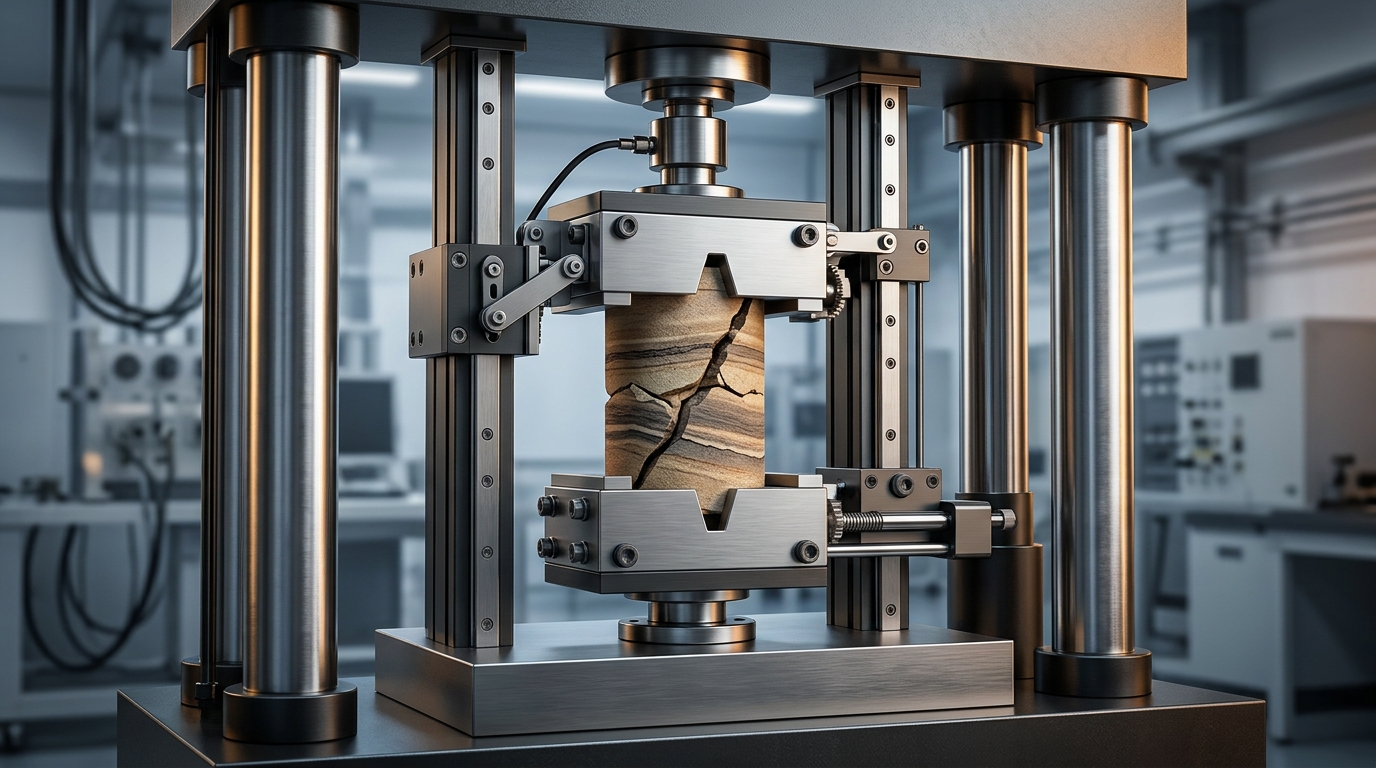
The core idea is deceptively simple. The new add-on sits inside the press and redirects part of that vertical force into shear along an inclined fracture plane. The vertical load comes from the press itself, while a counterforce is generated by two pneumatic actuators working in parallel, which the authors say provides a force level with sufficient precision to hold a constant pressure at the joint.
The device’s geometry is adjustable as well. The central part of the sample holder can be rotated so that the shear angle, the angle between the fracture plane and the loading direction, can be set anywhere between 15 and 75 degrees. According to the paper, the complete apparatus measures 1.0 by 2.0 by 2.5 metres and can be installed in any uniaxial testing device with sufficient space, with installation and removal taking about an hour for experienced laboratory staff. Its main technical parameters include a vertical loading capacity of 0 to 500 kilonewtons, a horizontal loading capacity of minus 59 to plus 59 kilonewtons, a vertical displacement rate capacity of 0.01 to 200 millimetres per minute, a maximum horizontal displacement of 30 millimetres and a data acquisition rate of 5 kilohertz, with the first, third and fifth of those figures depending on the uniaxial machine used.
Inside the frame, the components divide the labour in a way that mirrors a classical shear box but with more freedom. A loading plate takes the vertical load from the press, supports hold the central part of the device and transmit the applied forces, and upper and lower sample holders play the roles of the upper and lower shear boxes in a conventional apparatus. A load bearing plate and connector transmit horizontal force, the pneumatic actuators generate the counterforce, and low-friction slide bars allow the lower holder to move horizontally. Those slide bars, made of high-strength, corrosion-resistant steel and fitted with linear bearings, are described as critical elements: they let the lower part of the device move freely under the applied forces without significant energy loss to friction, which the authors say enhances the accuracy and repeatability of the tests. A double slide rail and central shaft are included to mitigate the risk of vibration and force deflection under high vertical load.
The cyclic loading sequence works through a two-stage process that coordinates axial loading with the horizontal counterforce. In the first stage, the uniaxial machine applies a downward vertical load while the pneumatic actuators generate a relatively low counterforce. Once the shear resistance at the joint interface is overcome, the lower sample holder begins to slide horizontally in one direction. In the second stage, the vertical loading velocity is reversed into unloading and the counterforce is increased, pushing the lower part of the specimen back toward its initial position. Repeating these two stages produces a cyclic shear motion. The authors describe the same mechanism from the force-balance side: increasing vertical load, once frictional resistance is overcome, causes sliding on the fracture plane and moves the lower part of the device to the right; when the vertical load falls below the force equilibrium, the movement reverses and the lower part moves back to the left.
One feature the authors emphasise is observational access. Because the sample’s front and back sides remain fully visible during a test, the setup allows digital image correlation, high-speed camera observations, strain gauges, acoustic emission monitoring, fibre optics, seismic wave velocity measurements and infrared camera observations to be applied easily, along with an LVDT system for monitoring sample displacements. Vertical displacement is monitored by the uniaxial testing rig itself, while horizontal displacement is recorded by a separate LVDT sensor, and sensors integrated into the device collect and store digital data on force, stress, displacement, strain and time.
To demonstrate that the apparatus actually works, the team fabricated several concrete specimens containing artificial joints, with simulated rock joint surfaces designed to show similar morphology and roughness using specially crafted moulds. Laser scanning of the joint surfaces was carried out both before and after testing to capture detailed surface information, and the rectangular cut surfaces measured 0.1 by 0.1 metres. Three types of exemplary tests followed. The first examined shear tests on fractures at two shear angles, 45 and 55 degrees, with the counterforce maintained at 10 kilonewtons and a vertical loading rate of 0.02 millimetres per second.
The second test type applied defined biaxial loading conditions, with the shear angle fixed at 45 degrees, counterforces of 10 and 30 kilonewtons, and the same constant vertical loading rate of 0.02 millimetres per second. Here the displacement-stress relationship showed higher shear resistance under the higher counterforce, which the authors note is theoretically expected from the Barton-Bandis model: an increase in effective normal stress enhances shear strength by amplifying the contribution of surface roughness and the basic friction angle. The tests also captured shear dilation data at the 10 kilonewton counterforce. Because the device allows a chosen shear angle to be combined with an adjusted counterforce, it can generate different Mohr circles, enabling determination of the sample’s strength envelope, assuming in this case that joint cohesion is zero.
The third test type was the one the device is named for: cyclic shear testing at a fixed shear angle of 45 degrees, a counterforce of 10 kilonewtons and a vertical loading and unloading rate of 0.02 millimetres per second. Before testing, the joints of the concrete blocks were pre-polished to ensure consistent initial conditions. As the cycles accumulated, the recorded shear stress gradually decreased, a reduction the authors attribute primarily to progressive degradation of the joint surface roughness, as documented by the laser scans of the tested specimens.
The authors are candid about the limits of the current configuration. The system accommodates specimens with maximum cross-sectional dimensions of 0.1 by 0.1 metres, so testing larger samples would require an enlarged shear fixture and possibly a higher-capacity loading frame and counterforce. The present setup also supports only quasi-static cyclic shearing and cannot perform high-frequency cyclic loading, a constraint the authors attribute to the response limits of pneumatic actuators, though they suggest that upgrading to faster actuation systems could address it. Even with those restrictions, the device is capable of shear tests on intact samples, shear tests on fractures at various angles, shear tests under defined biaxial loads and cyclic shear tests, a versatility the authors say allows determination of rock mechanical parameters under complex stress conditions. In subsequent experiments they plan to add an infrared radiation camera and acoustic emission sensors.
Subject of Research: A cyclic shear test add-on device for rock joints that attaches to uniaxial compression testing rigs
Article Title: Cyclic shear test device for rock: an add-on for a uniaxial compression test rig
Article References: Huang, T., Friedel, M., Konietzky, H., & Frühwirt, T. (2025). Cyclic shear test device for rock: an add-on for a uniaxial compression test rig. GeoEnergy Communications, 1(1), Article 4. https://doi.org/10.1007/s44421-025-00003-4
Image Credits: AI Generated
DOI: 10.1007/s44421-025-00003-4
Keywords: rock mechanics, cyclic shear testing, uniaxial compression rig, rock joints, shear strength, pneumatic actuators, biaxial loading, Barton-Bandis criterion, shear dilation, geothermal reservoirs, laboratory apparatus, surface roughness
News Source: Denise Maddox. (November 3, 2026). New add-on device turns uniaxial presses into cyclic rock shear testers. Scienmag.