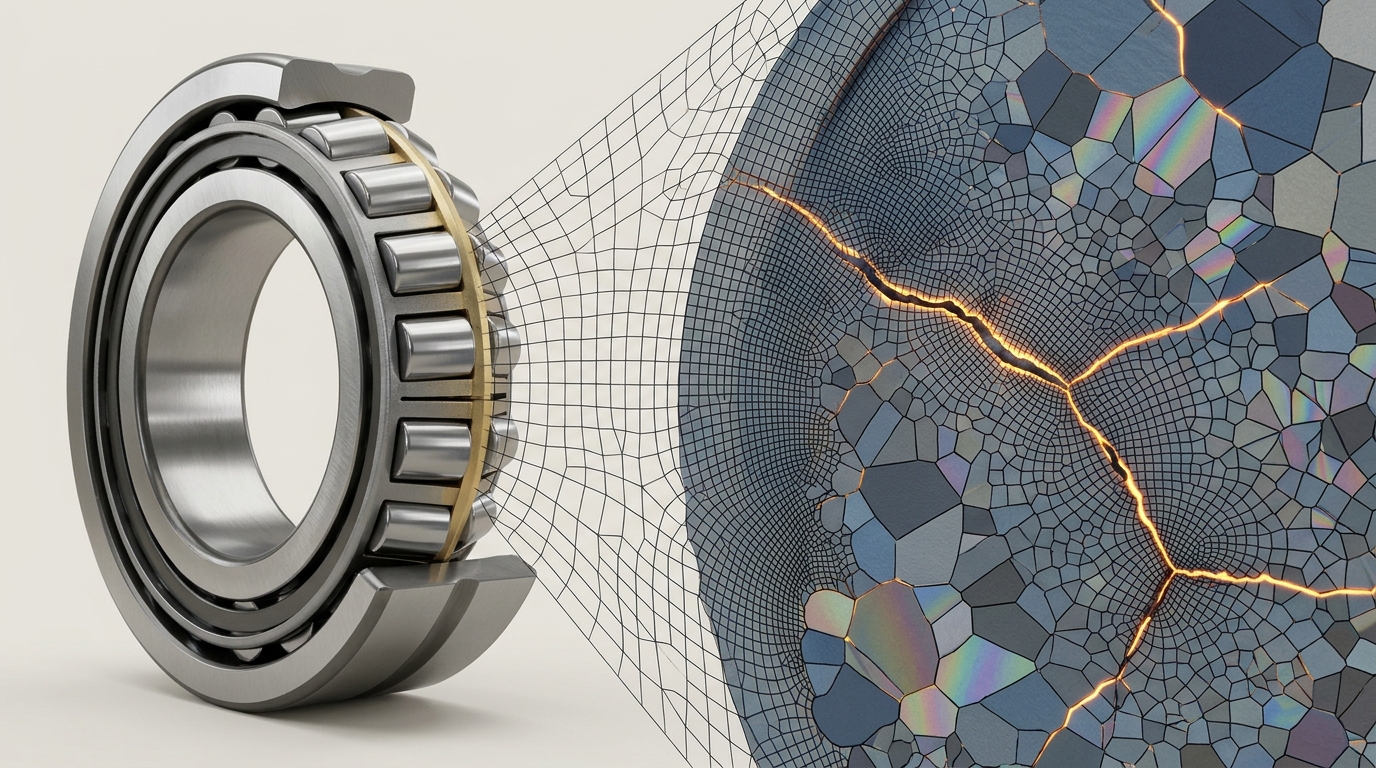
Researchers from Ningbo University and Ningbo Delikebei Technology Co., Ltd have proposed an integrated multiscale method for predicting rolling contact fatigue life in rolling bearings, linking the bearing's overall structure to grain-scale material damage. The approach, described in a preprint under review for the journal Mechanical Sciences, couples a crystal plasticity model of individual metal grains with a phase-field description of crack formation, and drives both from the bearing’s own design parameters. The study proposes the method for rolling contact fatigue (RCF) life prediction of rolling bearings.
The framework begins with what the authors call a dimension-chain mapping. This step takes the bearing’s structural dimensions and automatically reconstructs a parametric model, then runs a macroscale contact analysis to determine how loads are distributed across the raceway. Those contact parameters are then handed down to a grain-scale simulation as a moving Hertzian load, meaning the pressure patch that rolls across the bearing surface in service is reproduced inside the microscopic model.
At the grain scale, the crystal plasticity component captures how individual crystals deform under that moving pressure, while the phase-field method represents crack initiation and growth as a continuous damage field rather than a discrete crack surface. A three-layer solution framework with a cycle-jump scheme calculates how that damage evolves over many load cycles. A three-layer solution framework with a cycle-jump scheme calculates the damage evolution.
The work is presented as an integrated multiscale method for rolling contact fatigue life prediction, a problem the authors note is difficult despite the ubiquity of rolling bearings in machinery. The study presents the method as an integrated CAD/CAE-based fatigue design approach, in which a dimension-chain mapping drives parametric reconstruction and macroscale contact analysis.
The simulation results point to a clear microstructural culprit. An elliptical aluminium oxide, or Al2O3, inclusion promotes crack initiation and significantly reduces the predicted life of the bearing. According to the model results, this elliptical Al2O3 inclusion promotes crack initiation and significantly reduces the predicted life.
Geometric design choices also matter, according to the model. A larger rolling-element diameter extends the predicted fatigue life, while a larger raceway curvature coefficient shortens it. Positive radial clearance, meaning a gap between the rolling elements and the raceways, likewise shortens the predicted life. According to the model results, a larger rolling-element diameter extends the predicted life, while a larger raceway curvature coefficient or positive radial clearance shortens it.
The study presents the approach as an integrated multiscale method for rolling contact fatigue life prediction of rolling bearings. In the coupled crystal plasticity-phase-field model, the contact parameters computed at the macroscale are transferred to the grain-scale model as a moving Hertzian load, and the three-layer solution framework with a cycle-jump scheme calculates the damage evolution.
The moving Hertzian load transfer is a key technical link in the chain. In the framework, the contact parameters are transferred to the grain-scale crystal plasticity-phase-field model as a moving Hertzian load. The results show that an elliptical Al2O3 inclusion promotes crack initiation and significantly reduces the predicted life, while a larger rolling-element diameter extends the life and a larger raceway curvature coefficient or positive radial clearance shortens it.
The authors present the method as an integrated CAD/CAE-based fatigue design tool, meaning computer-aided design and computer-aided engineering are joined in a single automated workflow. The dimension-chain mapping drives parametric reconstruction, so changing a bearing dimension automatically updates the model, and the results feed back to the designer as predicted life. The preprint, with discussion started on 3 November 2026 and currently under review for Mechanical Sciences, reports these model results on the effects of an elliptical Al2O3 inclusion, rolling-element diameter, raceway curvature coefficient and radial clearance on predicted fatigue life.
As with any simulation-based design method, the predicted lives depend on the accuracy of the underlying material models and the assumptions built into the contact analysis, and the work remains at preprint stage pending peer review. The study presents a coupled crystal plasticity-phase-field approach in which macroscale contact parameters drive grain-scale damage evolution, and reports predicted effects of an elliptical Al2O3 inclusion, rolling-element diameter, raceway curvature coefficient and radial clearance on rolling contact fatigue life.
Subject of Research: A multiscale crystal plasticity and phase-field damage model for predicting rolling contact fatigue life of rolling bearings from design parameters.
Article Title: A Coupled Crystal Plasticity-Phase-Field Damage Model for Integrated CAD/CAE-Based Fatigue Design of Rolling Bearings
Article References: Ji, C., Du, W., Zhao, Y., & Wu, Y. (2026). A Coupled Crystal Plasticity-Phase-Field Damage Model for Integrated CAD/CAE-Based Fatigue Design of Rolling Bearings. https://doi.org/10.5194/ms-2026-192
Image Credits: AI Generated
DOI: 10.5194/ms-2026-192
Keywords: rolling bearings, rolling contact fatigue, crystal plasticity, phase-field damage, fatigue life prediction, Al2O3 inclusions, CAD/CAE integration, multiscale modelling, Hertzian contact, cycle-jump scheme, bearing design, Coupled
News Source: Denise Maddox. (November 3, 2026). New Multiscale Model Links Bearing Structure to Grain-Scale Fatigue Damage. Scienmag.