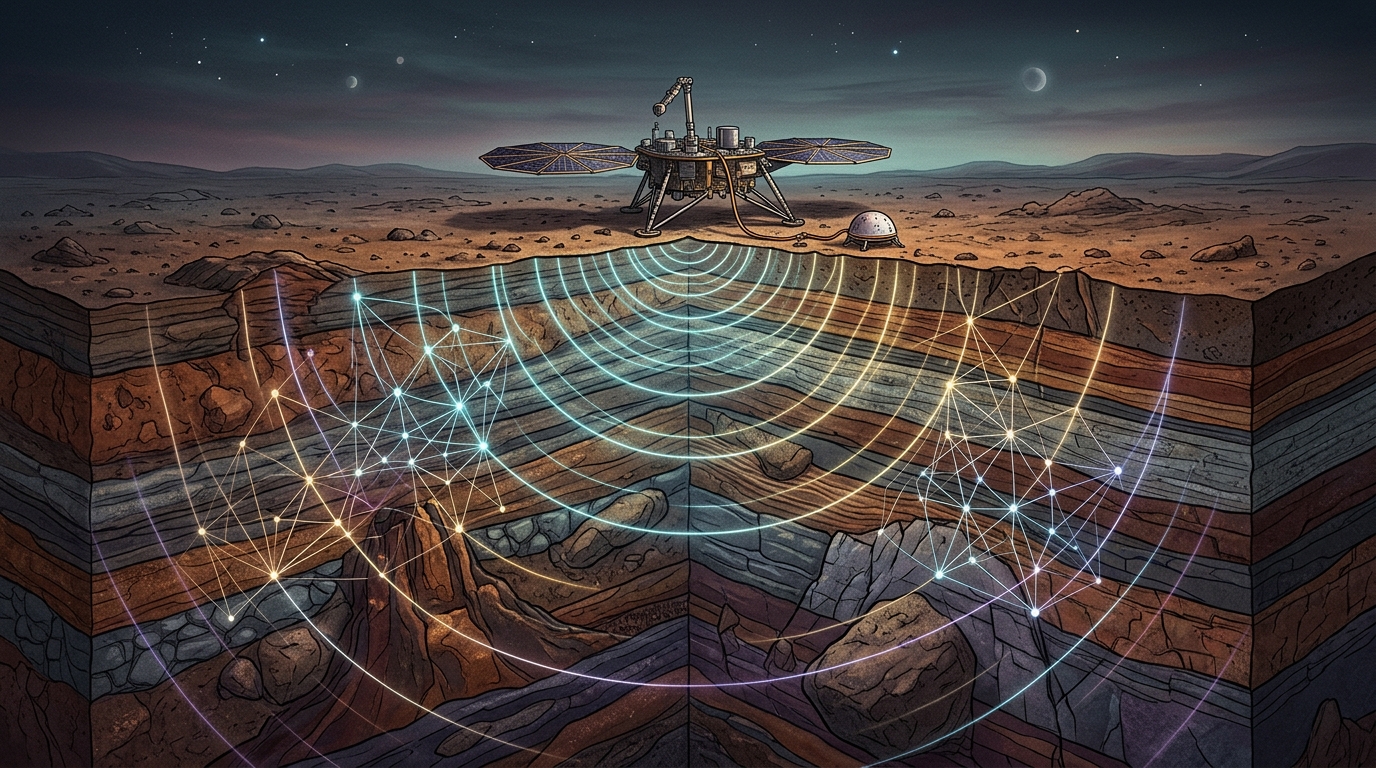
Astronauts and robots exploring an uncharted planet would need to know what lies on and beneath the surface before anyone could safely put down a lander or start digging. A Virginia Tech mechanical engineering team has now developed a method that combines vibrations and artificial intelligence to determine how deeply a rock is buried, helping robotic excavators clear terrain more efficiently. The research, led by assistant professor Erik Komendera and Ph.D. candidate Yiyan Ruan, was published in IEEE Sensors Journal and may help rovers land safely on Mars, the Moon, or other largely unexplored planets.
The problem the team set out to solve is deceptively simple to describe. On current missions to Mars, factors such as the elevation and roughness of terrain and the height of rocks affect the options for where to put down a spacecraft. If a rock is in the way of a potential landing surface, a robotic excavator could chip away at it. But if the rock is actually a buried boulder, that robot should not waste energy and wear out its tools trying to remove something that is immovable. As Komendera put it, humans have always had to deal with large and heavy obstacles that cannot simply be ignored or scooped out of the way without careful planning, and it is easy for people to look at rocks and make quick, testable judgments about whether a rock is resting or partially buried. The question was how robots could make those same judgments, and the team now has an answer.
Komendera, who once worked as an engineer at the NASA Langley Research Center, assembled a set of tools that could save future excavators a great deal of work. To test the approach, his team buried 18 concrete blocks of different sizes and shapes at different depths in sand. They struck the exposed rock with an instrumented hammer, then measured the resulting vibrations remotely using a scanning laser Doppler vibrometer. A laser measured the vibrations created as the hammer tapped the stone, capturing data without any sensor needing to touch the rock itself.
The measurements were taken at multiple heights on the rock’s surface. Researchers then fed the results to a neural network that learned the relationship between vibration characteristics, visible rock geometry, and burial depth. In other words, the system was trained to connect what a robot could see of a rock with how the rock responded to being struck, and to use that pairing to infer how much of the rock was hidden below ground.
Estimating how deep a rock is buried using vibrations can be tricky, Ruan explained, because the feedback is affected by the rock’s geometry and the way the soil holds it. The relationship between soil stiffness, the angle at which the rocks made contact with the sand, and other factors made taking the readings complex. By teaching the AI to account for these factors, the team was able to build models that could reliably determine depth. By carefully selecting features from the vibration measurements and the exposed geometry, the researchers produced reliable data using a compact neural network with just two hidden layers, a deliberately lightweight design that could eventually run on the limited computing hardware aboard a rover.
The technique turns an ordinary hammer strike into a measuring instrument. Every impact sends vibrations through the rock and into the surrounding sand, and the way those vibrations behave depends on how much of the rock is embedded and how firmly the soil grips it. A scanning laser Doppler vibrometer can read those vibrations from a distance, so a rover would not need to attach anything to the rock or dig around it to learn what it is dealing with. That remote, non-contact measurement is what makes the approach practical for robotic exploration, where every unnecessary motion costs power, time, and mechanical wear.
Those models could one day guide a robotic excavator on Mars to handle obstacles correctly in the terrain. A rover confronted with a rock could strike it, scan the vibrations, and decide whether the obstacle is a loose stone it can push aside or a massive boulder anchored deep in the ground that should be avoided altogether. Such a judgment would protect the robot’s tools, conserve its energy budget, and keep excavation missions on schedule.
For now, the work remains grounded on Earth, where the team tested its approach in sand with concrete blocks standing in for rocks. The researchers plan to continue building datasets and testing their approach on Earth, where the tool could prove useful in its own right. Komendera sees Earth-bound applications such as analyzing construction or disaster scenarios when potential hazards are buried. The same vibration-and-AI method could help determine the components of unstable rock formations, measure underground caverns, and even assist with disaster cleanup, where crews need to know what is buried beneath rubble before they start moving it.
The study, titled Burial Depth Estimation for Partially Embedded Rocks Using Scanning Laser Doppler Vibrometry and Neural Networks, was published in IEEE Sensors Journal on September 18, 2026, with the DOI 10.1109/JSEN.2026.3733381. The work was a peer-reviewed publication from Virginia Tech, and it points toward a future in which robots exploring other worlds can assess hidden hazards as quickly and intuitively as a human engineer sizing up a rock on a construction site, simply by listening to what the ground tells them.
Subject of Research: Using vibrations, laser vibrometry and neural networks to estimate the burial depth of partially embedded rocks for robotic excavation on other planets
Article Title: Using vibrations to reveal what lies beneath other planets’ surfaces
Article References: Using vibrations to reveal what lies beneath other planets’ surfaces. Original publication (Bibliographic details unavailable.)
Image Credits: AI Generated
DOI: Not provided
Keywords: vibrations, artificial intelligence, neural networks, laser Doppler vibrometry, buried rocks, robotic excavation, Mars, Moon, space exploration, Virginia Tech, IEEE Sensors Journal, planetary terrain
News Source: Denise Maddox. (November 3, 2026). Vibrations and AI reveal how deeply rocks are buried on other planets. Scienmag.